DID you think Jews would overwhelmingly resist the Islamification of America? Think again. To the liberal Jew, the Muslim is “the Other,” the noble outsider, the heroic victim. See this amazing video.
Gov. Chris Christie of New Jersey announced on Monday that his administration would drop its legal challenge to allowing gay marriage in the state, hours after same-sex couples started exchanging vows.
Mr. Christie’s decision to withdraw his appeal before the state’s Supreme Court, a reversal from his long-held position that the question of gay marriage should be decided by voters, effectively removes the last hurdle from making same-sex marriage legal in New Jersey. (more…)
Comments Off on Same-Sex “Marriage” Comes to New Jersey
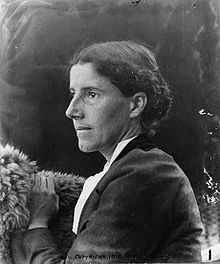
The poem by the suffragist Charlotte Perkins Gilman reminded me of Benjamin Franklin’sThe Way to Wealth. Gilman complains of belonging to subject class, of being forced to stay behind, of being “kept so small.” This reminds me of the people who complain of being taxed in The Way to Wealth. “Won’t these heavy Taxes quite ruin the Country?” they ask. “How shall we be ever able to pay them?”
A “plain clean old Man” replies, “We are taxed twice as much by our Idleness, three times as much by our Pride and four times as much by our Folly; and from these Taxes the Commissioners cannot ease or deliver us by allowing an Abatement. However let us hearken to good Advice, and something may be done for us; God helps them that help themselves, as Poor Richard says, in his Almanack of 1733.” (more…)
Comments Off on The Way to Wealth vs. the Road to Serfdom
I recently came across this from a leftist posting. This is indeed how the left views us — not as people with whom they disagree, but as evil and backward as the Taliban.
JORGE Bergoglio, the man proclaimed as pope, spoke of the dangers last Thursday of Catholics who become “disciple[s] of ideology.” What did he mean by “ideology?” If we read his words closely and interpret them in context, it is obvious what he meant. The ideology is nothing other than Catholicism. In fact, if we read him correctly, he calls Catholicism a “serious illness.”
Imagine that. A “pope” tells Catholics they are seriously ill for being Catholic.
“When we are on the street and find ourselves in front of a closed Church,” [the pope] said, “we feel that something is strange.” Sometimes, he said, “they give us reasons” as to why they are closed: They give “excuses, justifications, but the fact remains that the Church is closed and the people who pass by cannot enter.” (more…)
There was no television, no rock music, and no culture of youth worship in America when my friend Barbara was born in a small town in southwestern Indiana in 1935. The town was surrounded by farms. Barbara used to visit her grandparents in a white frame house with a large porch on one of those farms. There was a well for water and a drinking cup. She would help her grandmother gather eggs in the chicken house. Her grandmother wore a long-sleeved dress, a bonnet with a big brim, and shoes with two-inch heels. Barbara remembers playing dominoes. The grown-ups would play card games like Euchre. Around the player piano, the family would sing along to songs like “My Darling Clementine” and “She’ll be Coming ‘Round the Mountain.” (more…)
And do you know why there aren’t millions of female computer programmers today? It’s because girls lack “role models.” But then, boys must have lacked role models once too because at some point in scientific history there had to have been no role models at all. It’s a conundrum. But it’s a conundrum that doesn’t much disturb those who refuse to acknowledge that the vast majority of women do not want to be computer programmers no matter how many gorgeous and dubious role models are thrust in their faces.
It has been the one of the bizarre goals of the French Fifth Republic to devalue the heroism of the French Army in various wars, and to sing the praises of the victorious enemy, whether German, North Vietnamese, Algerian, or Mohammedan. This misplaced emotional attachment for the enemy and disdain for one’s own soldiers is a mysterious quirk of the Western mind, programmed, it would seem, to feel guilt for having attempted to save itself. We suffer guilt for winning a war, repentance for even fighting a war, and shame for having caused harm to the victorious enemy.
But usually it is a quirk of the left-wing Western mind, patriots being temperamentally more inclined to feel gratitude towards those who are willing to die defending them. If you recall the return of American soldiers from Vietnam you know that the great divide in the country in the mid-seventies would continue to split us into a so-called “cultural war”, and that this cultural war, like the fall of Saigon, has also been lost.
Before Saigon there was Dien Bien Phu in 1954, when a weakened French army suffered a monumental defeat at the hands of the fierce North Vietnamese general Vo Nguyen Giap, a name we heard every day on the news in the ’70’s. From Wikipedia (accents retained): (more…)
The problem with the assertion that women working grows the economy is that all labor done at home doesn’t count toward traditional GDP analysis. If you pay a teacher to educate your kids, that generates measurable economic growth; homeschooling doesn’t.
In fact, any time a commercial transaction is substituted for a non-commercial one, the economy grows. But that doesn’t mean we’re better off. Today I mended a sweater, cooked our lunch at home, cooked dinner at home and cleaned the bathroom. If instead I’d paid my tailor to repair the sweater ($5), bought lunch out ($15), bought dinner out ($25) and had a cleaning lady do the bathroom ($10), I could have grown the economy by $55. The tailor, waitress and cleaning lady would undeniably be better off then, but would I be? (more…)
Comments Off on Domesticity vs. Gross Domestic Product
I am writing regarding your recent comments on divorce. Doubtlessly, modern divorce law has wreaked havoc on the culture, on the institution of marriage, and on the family. But you propose (and correct me if I misunderstood) entirely forbidding legal divorce. This, I think, is a step too far.
I recently made a comment on an Internet discussion about “traditional” marriage. The use of the term “traditional marriage” by defenders of what actually exists now rubs me the wrong way. I wonder what you think of my comment:
Traditional marriage (aka real marriage, actual marriage, marriage by definition, etc.) has three elements: (more…)
Comments Off on “Traditional Marriage” Disappeared Long Ago
MARK STEYN suggests, in light of the National Park Service's actions during the government shutdown, that national park lands be returned to the states.
I have an Asian exchange student in my home for the year. Due to visa constraints, he’s going to the local Catholic school.
My, has this been a learning experience! The Mass in school is so … disappointing, full of icky Christian pop songs. No reverence; no gravitas. There’s one butch-looking nun– excuse the expression, I can think of no other way to describe her. I had to look twice to see if she was male or female. I’m talking man pants, T-shirt, overweight, with keys hanging on belt loops. The other nun dresses like a monk and tries to be “loving” from what I can see. Most of the rest of the faculty seems to be laity, which I expected. Fortunately, the theology teacher seems to be on fire for the faith.
I went to the open house last month and was shocked to learn that the school is adopting the Common Core. (more…)
Comments Off on Catholic School Adopts Common Core
The depressing effect of mass female employment and mass immigration on wages that Jeff W. writes about in this entry is absolutely tremendous. Since 1970, while worker productivity has more than doubled, real wages have remained virtually unchanged.
At The Public Discourse, Morgan Bennett’s article The New Narcoticdiscusses the effects on a person’s brain of internet pornography (the internet being the modern method of “drug” delivery) and the consequent effects of having so many “brain-damaged” people in society. Bennett writes:
In sum, brain research confirms the critical fact that pornography is a drug delivery system that has a distinct and powerful effect upon the human brain and nervous system. (more…)