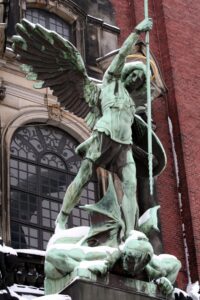
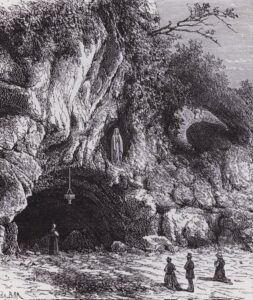
St. Anthony in the Tomb

“THE most remarkable incident told of him by his great biographer is, that having shut himself up in a tomb, he remained long alone in it. The friend who brought him at intervals bread for his support, found him once lying as it were dead on the ground, and severely beaten by an attack of demons in the night. The friend rescued him, and having taken him back, Antony suffered another attack from all sorts of beasts and reptiles, who appeared to surround him.

(more…)

Comments Off on St. Anthony in the Tomb

St. Anthony in the Wilderness

FROM The lives of the Fathers of the Eastern Deserts, or, The wonders of God in the wilderness by Richard Challoner:

Accordingly, as often as be could hear of any one that labored with more diligence than ordinary in the pursuit of virtue and perfection, he was sure to visit him, and to seek in his conversation and method of life, some lesson for his own instruction and edification. In the meantime he labored with his own hands for his daily food; and all that he gained over and above what was necessary to purchase his pittance of bread, he gave to the poor. He prayed very much, and endeavoring quite to forget the world and all his worldly kindred, he turned all his affections and desires towards purchasing the hidden treasure of true wisdom, and the precious pearl of divine love. In order to [do] this he gave diligent attention to the word of God, contained in the holy Scriptures, which he heard, and by meditating thereon, laid up all these precepts of our Lord in such a manner in his soul, as never to forget any of them; but to have them always written in his memory, as in a book. He envied no one, (more…)

Comments Off on St. Anthony in the Wilderness

The Medieval Concept of the ‘Just Price’

From The Framework of a Christian State by Fr. Edward Cahill, S.J. (McGill and Son, 1932); pp. 42-44:

The mediaeval law of Just Price is another example of the altruistic spirit which permeated the social and economic life of the middle ages. Individuals were not permitted to use freely the property they controlled in ways that might be detrimental to the common good. They were compelled, when the needs of others required it, to place the goods they had to dispose of at the service of the public under equitable conditions. The poor and weak were protected against unfair competition, so that all might be secured a fair access to the material goods of the community.

The laws of Just Price had to be observed in wages, buying and selling and every contract of exchange; otherwise the contracted was accounted unjust and invalid in conscience, and the aggrieved party had a claim to restitution. ‘Whoever,’ writes Trithemius, a well-known fifteenth century author, ‘buys up corn, meat and wine in order to drive up their prices, and amass money at the cost of others, is, according to the laws of the Church, no better than a common criminal. In a well-government community all arbitrary raising of prices in the case of articles of food and clothing is peremptorily stopped. In times of scarcity merchants who have supplies of such commodities can be compelled to sell them at fair prices; for in every community care should be taken that all the members should be provided for, lest a small number be allowed to grow rich, and revel in luxury to the hurt and prejudice of the many.’

(more…)

Comments Off on The Medieval Concept of the ‘Just Price’

A False Pope and His Words of Comfort

I NOTICED in the news that “Pope” Leo XIV took time from his busy schedule to meet with families of the devastating fire at a ski resort bar on New Year’s Eve in Crans-Montana, Switzerland.

Forty young people were killed and more than 100 experienced severe injuries in the most horrible way after the bar exploded into flames. A sparkler held high by a young waitress sitting on someone’s shoulders touched the ceiling and all of the bar’s flammable materials ignited at once. Here is a news story that is all too tragically true. The faces of the families cannot hide their real grief. The photos of the victims are not professionally staged. There is no government political agenda or call to disarm citizens.

Presumably Leo was offering genuine sympathy, not conspicuous compassion for the cameras. Though a true pope, in the case of a tragedy such as this, would presumably offer private and not public sympathies, given the nature of the bar celebration, I do not doubt the sincerity of Leo’s sympathy. He is generally a restrained and dignified figure, especially in comparison to the scattershot vulgarity and coarseness of his predecessor, Francis.

There was nothing objectionable in Leo’s consoling remarks to the families of victims. Well, wait a minute, yes, there was:

Dear brothers and sisters, nothing will ever be able to separate you from the love of Christ (cf. Rom 8:35), nor your loved ones who suffer or whom you have lost.

On this score, “Pope” Leo is not one to offer consolation. He and his brothers in theological revolution have caused incalculable harm to souls and separation from the love of Christ. Apostasy, heresy and other sins against divine commandments can separate us from the love of Christ. While it is not true that there was no hope for these young victims, the conciliar revolutionaries who have taken over the Catholic Church have made that hope much less realistic for people the world over, as the graces that flowed from the Catholic Church’s teachings and Holy Sacraments have been lost to them.

So far, Leo’s brief tenure has been a series of unconvincing assurances that the revolution has been good. In this regard, as Thomas Droleskey points out, he is similar to the late Soviet leader Leonid Brezhnev in his address to the 26th Congress of the Communist Party of the Soviet Union (CPSU) on February 23, 1981. (more…)

Comments Off on A False Pope and His Words of Comfort

Down with Equality

“WOMEN, I contend, are not men’s equals in anything but responsibility. We are not their inferiors, either, or even their superiors. We are quite simply different races. We live by an impulse separate from that of men. A separate tide beats in our blood. Our bodies are shaped to bear children, and our lives are a working-out of the processes of creation. All our ambitions and intelligence are beside that great elemental point. Yet, for the first time in history, society takes no cognizance of it.”

— Phyllis McGinley, “The Honor of Being a Woman”

(more…)

Comments Off on Down with Equality

When Childhood Isn’t Childhood

“YOUTH is a perfectly wonderful commodity and far too valuable, as Shaw has pointed out, to be wasted on the young. Yet like all human benefactions, it has its penalties, which in today’s urgent society have frighteningly increased. I don’t think I am merely nostalgic when I contend that being a child nowadays is a tougher proposition than it was when my generation and I compared arithmetic answers between classes or devoured bread-and-pickle sandwiches on the front porch after school. For one thing, it isn’t as much fun.

“On the surface this assertion may sound like gibbering nonsense. Never before in history has childhood had so much attention paid to its welfare and its amusement. It is cosseted, pampered, immunized against unhappiness as against polio or whooping cough. (more…)

Comments Off on When Childhood Isn’t Childhood

He Purified Water

THE Lord is baptised, not because He had need to be cleansed, but in order that, by the contact of His pure flesh, He might purify the waters and impart to them the power of cleansing.”

(more…)

Comments Off on He Purified Water

The Deliberate Dumbing Down of Children

ALAN writes:

The absurd things teachers and schools do to children in the name of “education” could be added to your list of absurdities we are expected to swallow and celebrate.

A month ago, by chance, I discovered the book Our Children’s Songs (Harper Brothers,1877, 207 pages). It  consists entirely of the lyrics of songs that Americans in those years were smart enough to know children could enjoy.  The songs are divided into categories: Songs for the Nursery, Childhood, Girlhood and Boyhood (!), and Hymns.  Extensive lyrics appear in small print in two columns on each page, accompanied by pencil sketches throughout. It comes from an age long before Americans would become mesmerized by screens.

What should be noteworthy to us is the frame of mind in which that book was published and used. Unlike all modern books “for”‘ children, the book does not aim at the eye. It aims at the ear and the imagination. It does not aim at sensation or spectacle. It aims at conceptualization and comprehension. It aims at a child’s ability to understand words and become comfortable with them; to learn how to speak them and sing them; to learn that they have concrete meanings; to form in imagination their own “pictures” of what such words suggest to them.

Photographs are not needed for children to learn such things. The development of conceptual thought does not depend on pictures but may be reduced or delayed by such pictures.  Not to mention the effect of motion pictures on that capacity — or the effect of such motion pictures when pounded into children’s heads, day after month after year, from babyhood onward and throughout childhood. Children cannot be “educated” by such torrents of pictures, but they certainly can be indoctrinated, kept ignorant, or limited to dealing with concretes instead of learning conceptual thought.  (more…)

Comments Off on The Deliberate Dumbing Down of Children

Children’s Literature as Propaganda

IN “The Spooky Side of Roald Dahl,” the writer Miri, whom I am not otherwise familiar with, raises concerns about the famous author I had never considered before, including the possibility that he worked for British intelligence. His sudden rise to popularity and the heavy promotion of his books don’t seem organic, but there are other strange details of his life.

The same concerns, I think, could be raised with regard to J.K. Rowling, the author of the Harry Potter series, who supposedly rose to instant fame on the merit of her books alone.

Regardless of the background of these two authors, Miri offers some salutary warnings to parents:

(more…)

Comments Off on Children’s Literature as Propaganda

In the Bleak Midwinter

IN THE BLEAK MIDWINTER

BY Christina Rossetti

In the bleak midwinter, frosty wind made moan,
Earth stood hard as iron, water like a stone;
Snow had fallen, snow on snow, snow on snow,
In the bleak midwinter, long ago.

Our God, Heaven cannot hold Him, nor earth sustain;
Heaven and earth shall flee away when He comes to reign.
In the bleak midwinter a stable place sufficed
The Lord God Almighty, Jesus Christ.

(more…)

Comments Off on In the Bleak Midwinter

The King Cake: An Ancient Tradition

FROM The Liturgical Year by Dom Prosper Guéranger, on today’s Feast of the Epiphany:

There was another custom, which originated in the Ages of Faith, and which is still observed in many countries. In honour of the Three Kings, who came from the East to adore the Babe of Bethlehem, each family chose one of its members to be King. The choice was thus made. The family kept a feast, which was an allusion to the third of the Epiphany-Mysteries – the Feast of Cana in Galilee – a Cake was served up, and he who took the piece which had a certain secret mark, was proclaimed the King of the day. Two portions of the cake were reserved for the poor, in whom honour was thus paid to the Infant Jesus and his Blessed Mother; for, on this Day of the triumph of Him, who, though King, was humble and poor, it was fitting that the poor should have a share in the general joy. (more…)

Comments Off on The King Cake: An Ancient Tradition

On the Epiphany, from the Fifth Century

                                Adoration of the Magi, Fra Angelico; 1423

FROM sermons on today’s Feast of the Epiphany delivered more than 1,500 years ago by Pope St. Leo the Great (ca. A.D. 395-461):

…The story of the magi is not only a bygone fact in history, but of everyday application to ourselves. The day, dearly-beloved, on which Christ the Saviour of the world first appeared to the nations must be venerated by us with holy worship: and today those joys must be entertained in our hearts which existed in the breasts of the three magi, when, aroused by the sign and leading of a new star, which they believed to have been promised, they fell down in presence of the King of heaven and earth. For that day has not so passed away that the mighty work, which was then revealed, has passed away with it, and that nothing but the report of the thing has come down to us for faith to receive and memory to celebrate; seeing that, by the oft-repeated gift of God, our times daily enjoy the fruit of what the first age possessed. And therefore, although the narrative which is read to us from the Gospel properly records those days on which the three men, who had neither been taught by the prophets’ predictions nor instructed by the testimony of the law, came to acknowledge God from the furthest parts of the East, yet we behold this same thing more clearly and abundantly carried on now in the enlightenment of all those who are called, since the prophecy of Isaiah is fulfilled when he says, “the Lord has laid bare His holy arm in the sight of all the nations, and all the nations upon earth have seen the salvation which is from the Lord our God” and again, “and those to whom it has not been announced about Him shall see, and they who have not heard, shall understand.” (more…)

Comments Off on On the Epiphany, from the Fifth Century

A Renaissance Epiphany

ORLANDE de Lassus’s 16th-century eight-part motet Omnes de Saba venient is a short responsory for the Epiphany, based on Isaiah 60:6. An English translation of the Latin:

ALL they from Sheba shall come,
bringing gold and frankincense
and proclaiming the praise of the Lord
Alleluia.

(more…)

Comments Off on A Renaissance Epiphany

Chesterton on the Wise Men

predel2-2
Adoration of the Magi; Fra Angelico

IT IS still a strange story, though an old one, how they came out of orient lands, crowned with the majesty of kings and clothed with something of the mystery of magicians. That truth that is tradition has wisely remembered them almost as unknown quantities, as mysterious as their mysterious and melodious names; Melchior, Caspar, Balthazar. But there came with them all that world of wisdom that had watched the stars in Chaldea and the sun in Persia; and we shall not be wrong if we see in them the same curiosity that moves all the sages.They would stand for the same human ideal if their names had really been Confucius or Pythagoras or Plato. They were those who sought not tales, but the truth of things; and since their truth was itself a thirst for God, they also have had their reward.”

— G. K. Chesterton, The Everlasting Man, Ignatius Press; p. 176

THE WISE MEN

Step softly, under snow or rain,
To find the place where men can pray;
The way is all so very plain
That we may lose the way.

Oh, we have learnt to peer and pore
On tortured puzzles from our youth,
We know all labyrinthine lore,
We are the three wise men of yore,
And we know all things but the truth.

(more…)

Comments Off on Chesterton on the Wise Men

The March of the Kings

FROM kingdoms of wisdom secret and far
come Caspar, Melchior, Balthasar;
they ride through time, they ride through night
led by the star’s foretelling light.

Crowning the skies the star of morning, star of dayspring, calls:
clear on the hilltop its sharp radiance falls
lighting the stable and the broken walls
where the prince lies.

Gold from the veins of earth he brings,
red gold to crown the King of Kings.
Power and glory here behold
shut in a talisman of gold.

(more…)

Comments Off on The March of the Kings

Ubi Caritas

UBI CARITAS et amor, Deus ibi est.
Ubi Caritas et amor, Deus ibi est.
Congregavit nos in unum Christi amor.
Exsultemus, et in ipso jucundemur.
Timeamus, et amemus Deum vivum.
Et ex corde diligamus nos sincero.

Amen. (more…)

Comments Off on Ubi Caritas

The Holy Name of Jesus

Adoration of the Name of Jesus, El Greco

NAMES are mysterious confluences of the universal and particular, of the past and the present. A name that has been used for thousands of years takes on new meaning in a new generation. A name is phonetic music. Take the names “Emma” and “George.” Could Emma Bovary have been a George? Could George Washington have been an Emma? It is difficult to grasp all the psychological effects and associations names conjure.

The sweetest and most beautiful name in heaven and earth, a name that is a universe and eternity in itself, a name that resounds through history like no other, is the sacred name of Jesus. It is entirely particular and entirely universal; supernatural and earthly like no other. St. Bernard wrote that the name of Jesus is food, light and medicine. So powerful is the Holy Name that people constantly invoke it in everyday life, some blasphemously.

It wasn’t until the sixteenth century that the Church set aside a specific day on which to revere and celebrate the Most Holy Name of Jesus. How right it is to honor the name itself, implicitly recognizing the supreme importance of words in our lives. In Hebrew custom, a male child was named at circumcision. The Feast of the Holy Name, celebrated today on the traditional calendar, comes right after the Feast of the Circumcision. Dom Prosper Guéranger wrote about this important tradition in his work The Liturgical Year:

In the Old Covenant, the Name of God inspired fear and awe: nor was the honour of pronouncing it granted to all the children of Israel. We can understand this. God had not yet come down from heaven to live on earth, and converse with men; he had not yet taken upon himself our poor nature, and become Man like ourselves; the sweet Name expressive of love and tenderness, could not be applied to him.

But, when the fulness of time had come – when the mystery of love was about to be revealed – then did heaven send down the Name of ‘Jesus’ to our earth, as a pledge of the speedy coming of him who was to bear it. (more…)

Comments Off on The Holy Name of Jesus

The New Year

                                        Winter Sketch, Andrew Wyeth

I THINK of this new year as a white page given to me by your Father, on which He will write, day by day, whatever His divine good pleasure has planned. I shall now write at the top of the page, with complete confidence: Domine, fac de me sicut vis, ‘Lord, do with me what You will’, and at the bottom I already write my Amen to all the proposals of Your divine will. Yes Lord, yes to all the joys, the sorrows, the graces, the hardships prepared for me, which You will reveal to me day by day. Grant that my Amen may be the Pascal Amen, (more…)

Comments Off on The New Year