
FROM The Last Hours of Jesus by Ralph Gorman (1960):
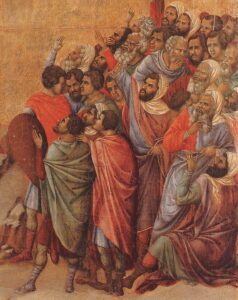
AS we have seen, Jesus was crucified on a hillock overlooking a main thoroughfare just outside the city of Jerusalem. The cross was set up so near the road that the passers-by could speak to the crucified. Unfortunately, this is exactly what many of them did. The Gospels identify them no further than to tell us that they were people who passed by. They were probably those leaving the city rather than those entering, as their mockery reveals that they were familiar with the accusations against Christ. By this time the affair had undoubtedly become the talk of the town. These people stopped momentarily, probably in small groups, and looked up at the three men hanging on their crosses. They ignored the two robbers. They were brigands who had finally been caught and brought to justice. But Jesus of Nazareth, that was different. He had pretended to be a prophet, even the Messias. He had spoken of himself as the Son of God. Only the preceding Sunday he had been welcomed into the city with acclaim and shouts of “Hosanna to the Son of David.” See now what he had come to. What further need had they of proof that he was an impostor? Looking up at him, they wagged their heads, to the Jews a sign of ridicule and derision, and called out to get his attention. The word they used, translated “vah” or “aha,” was an expression of admiration, but these people used it ironically. They jeered at his helplessness, crying, “Thou who destroyest the temple and in three days buildest it up again, save thyself.” (Matt. 27:40) They were familiar with the Temple. They had often seen its massive stone structure dominating the eastern ridge of the city, its pinnacles reaching up toward heaven. What a joke it was that this man, who had boasted that he could destroy it and rebuild it in three days, could not help himself, now that he was nailed to the cross. They had heard, too, that the Sanhedrin had condemned him for making himself out to be the Son of God, so they taunted him, saying, “If thou art the Son of God, some down from the cross.” (Matt. 27:40)
Some mocked Christ on the cross and passed by. Others mocked and remained. Among them were the chief priests, Scribes, and ancients, the principal enemies of Jesus. They had other things to do on what was, in their reckoning, the eve of the Passover. Their Passover meal should be eaten that very night. Even now they should be making preparations. But they could not tear themselves away from Calvary. They remained rooted to the spot. They gloated over their victory and enjoyed every evidence of suffering on the part of the crucified. But they were taking no chances, however slim, that something might still go wrong. They had thought they had Jesus in their clutches on many former occasions, and he had slipped from their grasp. It wouldn’t happen again, for this time they would wait and watch to the very end.
There was a difference in the mockery of the passers-by and of the leaders of the Jews. The former addressed Jesus directly. The latter spoke to one another, but loud enough for Jesus to hear. “He saved others,” they said; “himself he cannot save.” (Mark 15:31) They apparently admitted that he had saved others. The proof was too great to be rejected. But now he had evidently lost whatever power he had possessed. His present helplessness made him an object of derision.
Having ridiculed Christ’s miraculous powers, the Sanhedrists jeered at his Messianic claims. “If he is the King of Israel,” they continued, “let him come down now from the cross, and we will believe him.” (Matt. 27:42) They used “King of Israel,” the traditional form, rather than “King of the Jews,” the form used by Pilate. They were so sure that Jesus could not and would not come down from the cross that they promised to believe in him if he did.”


