
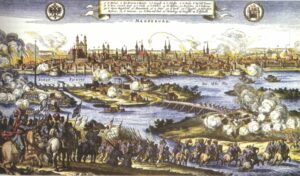
THE secular liberal state has often been justified by the claim that religion causes war, the so-called religious wars of Europe being cited in defense of this idea.
Is it true that Christendom was more violent than the age of modern democracy? In his book Liberty, the God that Failed (Angelico Press, 2012), Christopher A. Ferrara addressed this point:
What of the “religious wars” that preceded the age of democratic revolution? As William T. Cavanaugh has shown in his magisterial refutation of the “myth of religious violence,” the so-called wars of religion in the 16th and 17th centuries were really conflicts waged “by state-building elites for the purpose of consolidating their power over the church and other rivals.” Hence “these wars were the birth pangs of the state, in which the overlapping jurisdictions, allegiances and customs of the medieval order were flattened and circumscribed into the new creation of the sovereign state (not always yet nation-state), a centralizing power with a monopoly on violence within a defined territory.” Indeed, “the very distinction of politics and religion made possible by the rise of the modern state … was itself the root of these wars.” The result was a “transfer of the sacred from Christianity to the nation-state” and “the substitution of the religion of the state for the religion of the church.” Citizens would no be expected to lay down their lives in vast numbers not for Christ or the defense of the Faith, but for the Union or the Republic or the Confederacy.
Thus the “wars of religion” involved complex political alliances having nothing to do with mythical violent quarrels over points of Christian doctrine. Far more than merely clashes, they were “military expressions of economic grievances, regional and provincial particularism, competing lusts for power, shifts in class structure, and high rational policy.” They were power struggles in which Catholics sometimes allied with Protestants and even Muslims, Catholics fought against Catholics, the Holy Roman Emperor fought against the Pope and the Pope against the Emperor, and Catholic nations fought against Catholic nations. And with the exception of the Thirty Years War. these conflicts, fought largely by mercenaries or volunteer conscripts were on a miniscule scale compared to the world wars and genocides of the Age of Liberty that began in 1776. Not even the Thirty Years War, however, was a war over religion simpliciter, as opposed to a conflict over territories in which loyalties frequently crossed religious lines, combined with a German civil war — the central conflict — in which the demand of nobles for the right to become Protestant was expediently allied to their drive for political autonomy from the Hapsburg dynasty. The depiction of the War as a pan-European bloodfest between Catholics and Protestants arising from doctrinal differences is a cartoon presented to public school students as part of their indoctrination into the myth of religious violence. and the necessity of pluralist democracy to prevent it from ever erupting again.
What Cavanaugh dubs “the creation myth of the wars of religion” was essential to the establishment of the secular liberal state that will tolerate no interference by any religion or religious body. Cavanaugh’s remarkable study provides a startling reminder of what should have been an obvious historical truth: “religion as a distinct category of human activity separable from culture, politics, and other areas of life is an invention of the modern West.” That invention has been used precisely to justify what John Courtenay Murray called the “monism of power” in the secular state.
(pp. 35-37)


