
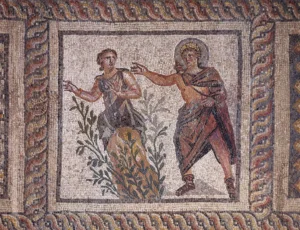
IN THE Princeton University Art Museum’s collection of Ancient Mediterranean Art, a stone mosaic floor from the 3rd century A.D. depicts the ancient Greek myth of Daphne and Apollo.
The beautiful stone floor is displayed in a prominent, backlit glass case so you can walk above it and examine it closely.
As retold by the Roman author Ovid in his Metamorphoses (I.438–567), the story, as you probably know, involves the god Apollo, who has been struck by an arrow from Cupid’s quiver. Under the influence of Cupid’s magic lance, Apollo falls in love with the beautiful nymph, Daphne. Unfortunately, she has vowed to remain a virgin. Daphne flees and Apollo follows, awed by her beauty.
Despite her not yet knowing who pursues her, Apollo seems to know exactly who she is, calling, “Wait nymph, daughter of Peneus, I beg you! I who am chasing you am not your enemy.” He comments that she is running from him as prey would from a predator, but tells her that he is spurred on by love and a desire to be with her, not destroy her, so she should have pity on him. He then says that he is worried that she will be injured in the chase and cause him guilt, so if she slows down he will too, but she continues. (Source)
Finally as the nymph approaches a river, she calls out for help to her father, the river god Peneus. Seeing his daughter’s predicament, he turns her into a laurel tree.
Apollo loves her still. As Ovid recounts it:
Even like this [Apollo] loved her and, placing his hand against the trunk, he felt her heart still quivering under the new bark. He clasped the branches as if they were parts of human arms, and kissed the wood. But even the wood shrank from his kisses, and the god said ‘Since you cannot be my bride, you must be my tree! Laurel, with you my hair will be wreathed, with you my lyre, with you my quiver. You will go with the Roman generals when joyful voices acclaim their triumph, and the Capitol witnesses their long processions. You will stand outside Augustus’s doorposts, a faithful guardian, and keep watch over the crown of oak between them. And just as my head with its un-cropped hair is always young, so you also will wear the beauty of undying leaves.’ Paean had done: the laurel bowed her newly made branches, and seemed to shake her leafy crown like a head giving consent.
And so the laurel became a symbol of victory and of Apollo’s devotion.
There is an interesting detail as to how this myth is depicted by the Princeton museum. When the stone floor was excavated from the site of an ancient villa in Antioch by a Princeton team of archaeologists and brought to the museum in the 1930s, it was originally titled simply “Daphne and Apollo.”
But the artwork was recently renamed. Now it is “Apollo trying to assault Daphne.”
Am I reading this too closely, or has Daphne now become a “battered woman,” a victim of “sexual harassment”? Has a famous love story, depicted by dozens of artists, has been transformed, by a few words, into a tale of male oppression of women? Imagine what it was like for a woman in ancient Rome where it was okay to decorate one’s home with images of sexual assault!
This may seem a negligible change to you, but it doesn’t to me. After all, Apollo does not wish to harm Daphne. He wishes to embrace her. The imperative of the modern museum is demotion and denigration of Western civilization. This is one small example. You have seen it yourself, I’m sure, many times.
A visitor to an art museum today must wear mental armor. If he doesn’t wish to be assaulted — here the word is appropriate — by the demonization of the makers and preservers of beauty, he must be prepared to defend the past. The museum is at war. This agenda does not bode well for the existence of many of our great museums. Enjoy them while they last. When the past is evil, the museum loses its purpose and no longer has a reason to exist.
Please stay tuned for more examples of museum warfare.


