The Principle of Non-Decoration at Work


Donna Karan by David Shankbone.jpg

  These two 21st century goddesses are fashion designer Donna Karan and her daughter Gabrielle, pictured in Karan’s vacation retreat in the Turks and Caicos Islands. The compound was featured in the December issue of Architectural Digest, along with the homes of Elton John and other celebrities. Karan’s beachfront buildings typify what might be called Sybaritic Minimalism, another exemplar of the Principle of Non-Decoration discussed in a previous post. There are enormous close-to-the-floor divans and chaises throughout and a canopy bed large enough for seven brides and seven grooms on the deck.

The Western woman’s infatuation with Eastern mysticism is on display in the infinity pool and yoga pavilion. No ostentation is disdained provided it is done in the name of inner enlightenment and wears the clean garb of simplicity. “Everything is honest,” says the designer of her over-sized furniture. “We hate fakery and pastiche.” Traditional Western forms of ornamentation are presumably “fakery.” Karan boasts that it is “an international environment.”

Behind all this studied minimalism – the builders erected a structure and tore it down when they didn’t like it – there is the innocent’s love of nature. “Collaborating with Donna is an intense experience,” Cheong Yew Kuan, the architect, says, “both visceral and cerebral. There was one constant in the flux of our ideas: the elemental way she wanted to live with nature. It was never about making a fashion statement.” Karan is more Alcyone, the Greek goddess of the Sea and Tranquility, than powerful fashion potentate who commands a restless empire.

Karan has made her wealth in New York and the capitals of the West. But where is she happiest? “Africa and Bali.”

(more…)

Comments Off on The Principle of Non-Decoration at Work

Two Views


TWO READERS below express conflicting views of Christianity and race.

D.H. writes:

I have been reading with what can only be described as a morbid curiosity as your conversations on race and interracial marriage unfolded. I don’t know how old you are, but I have lived a long time, seen a lot and the tone of the comments on your post struck me as the rantings of a bunch of people who frankly, need redemption from themselves. I want to keep this short f I can, so I will briefly touch on just a few of the ridiculous and sad commentary that was shared by you and your supporters.  (more…)

Comments Off on Two Views

Comments

  I was away from my computer yesterday. I have received interesting comments and will be posting them later this morning.

Comments Off on Comments

The Unfaithful Wife, cont.


Fitzgerald writes:

I was glancing through some of your older posts and found this entry on unfaithful women. I wanted to offer a few comments on the remark by a woman reader who said women have been forced to put up with male infidelity for eons.This is, sadly, very naive. While it may be true that men are more apt to cheat than women, it is not true that it’s the rare woman who cheats. This is a form of the same lie that says women don’t have sex drives, good girls don’t, women want commitment and use sex to get love… blah, blah, blah. Balderdash.bigstockphoto_Abstract_Pattern_2492330[1]


(more…)

Comments Off on The Unfaithful Wife, cont.

It’s a Wonderful Life


Fitzgerald writes:

I’m watching one of my all time favorites movies, “It’s a Wonderful Life”, and even though I’ve seen it easily 20 times I still find it compelling and most importantly, inspiring.

"It's A Wonderful Life" Jimmy Stewart 1947  RKO / **I.V. 

(more…)

Comments Off on It’s a Wonderful Life

The ‘White Race’ is a Dangerous Fiction


MRS. JOHNSON writes:

What your commenter A.M. is alluding to regarding whiteness is not Godly or Christian and is historically and culturally deceptive in terms of how complex culture is among “white” ethnic Americans. 

There is quite simply no ‘white race,’ not even in America. There is certainly no ‘white Christian race,’ again not even in America. What there are are European ethnic groups, who despite varying degrees of intermarriage retain many of their ancestral cultural values.  (more…)

Comments Off on The ‘White Race’ is a Dangerous Fiction

When a Husband Fails as a Man

  A reader takes strong exception to my advice to a woman who feels her husband is not manly. Laurence Butler, in his comments in the previous post, writes to the woman: If the leadership role has been temporarily vacated, you had better step in lest your children grow up to imitate a stoic but sorrowful mother doting on an unimpressive father. I think it’s totally appropriate for you to tell him you are dissatisfied with his behavior, with his composure, and with his unwillingness to supply the manly presence you fell in love with and pledged to spend the rest of your life with. If he ‘wishes’ for you to leave him alone and let him keep his femininity, I think you have an obligation to the both of you to not respect that wish. This isn’t to recommend incessant nagging or anything, but woman in her highest role, the heroines in the great plays remembered throughout history, did not sit idly by and watch their lord’s mind, body, and manor decay from the foundation while she put up nice curtains. Too frequently now are the women who allowed this, or worse those who encouraged the emasculation of men/the masculation of women, being reenacted by posterity.                                                                                                                     

Comments Off on When a Husband Fails as a Man

Married to a Wimp


Dear Thinking Housewife,

Men are not taught how to be men nowadays. What can I do about the fact that my husband is such a girl?

Regards,                                                                                   bigstockphoto_Ashberry_356525[1]

Anonymous (in an unspecified location)


Dear Anonymous,

I’m sorry, Anonymous, this question makes me mad. Not mad at you, but mad at this. In many ways, the debate over marriage is over, isn’t it? Women are already married to women. And, men are already married to men.

(more…)

Comments Off on Married to a Wimp

Intermarriage and Cultural Suicide


A.M. writes: 

I’ve followed your ongoing discussion on miscegenation with great interest. I come down on the side of Van Wyk, M. and Don Marco, and like many others, this topic provokes a visceral reaction in me.

It seems the side in favor is arguing from a standpoint of idealism, individualism and airy fairy abstractions, while the other side is defending concrete realities. One of your readers, I thought, had a good point when she said there are six interested parties to a marriage: the bride, the groom, their respective families, their unborn children, and society. I would like to add a seventh constituency, which perhaps is implicit in one of these groups: ancestors.

bigstockphoto_Floral_Texture_2414058[1]


(more…)

Comments Off on Intermarriage and Cultural Suicide

Health Care and Party-cide


The Democrats in Congress are committing “party-cide” by going ahead with the hugely unpopular transformation of American health care. Dick Morris and Eileen McGann, at Newsmax, write to Congress:

Civil rights, Social Security, women’s suffrage — all of Majority Leader Harry Reid’s metaphors — were popular and had broad approving majorities. This bill has the opposite: a nation paralyzed with fear for what you are about to do to its health care.

(more…)

Comments Off on Health Care and Party-cide

Schiacciate Integrali


As mentioned by Gail Aggen in the previous post, the industrial-grade pizza you find in your local supplier is a bastardization of the real thing. Italian bread, whether it be rustic pane Toscano, foccaccia, pizza, casatiello, ciabatta, or coccodrillo, carries a long and exalted tradition. It is the greatest bread, if not the greatest edible, in the history of the world.

The Romans learned to bake bread from the Greeks, who brought their immense dynamism to the art and worshipped bread through Demeter, the goddess of grain and abundance. In the Roman Empire, bread baking reached its zenith in the time of Augustus. In 25 B.C., there were 329 public bakeries in the city of Rome alone, according to Carol Field, a genius when it comes to Italian carbohydrates.

Field, in her wonderful book The Italian Baker, writes:

The big central bread market in Rome boasted round breads; breads notched into eight sections, which were easy to break off into individual pieces; breads shaped like keys, cubes, or braids; breads that looked like mushrooms; and breads that looked like wreaths. There was a bread for each social class – senators’ bread, knights’ bread, citizens’, people’s, and peasants’ bread. White bread was already a status symbol, even though some writers knew that darker, coarser loaves were healthier and gave sustenance to hard-working peasants and farmers. The rich ate siligo,the finest wheat flour, which was so white that the women of Rome powdered their faces with it. Pliny noted that “in some places bread is named after the dishes eaten with it, such as oyster bread, in others from its special delicacy, as cake bread, in others from the short time spent making it, as hasty bread, and also from the method of baking, as oven bread, or tin loaf, or baking pan bread.”

It is surprisingly easy to reenact the ancient traditions of Italian bread making in one’s own home. One doesn’t need a wood-fired oven or a fancy commercial mixer. One doesn’t need enormous wooden boards or the arm muscles of a 16th century peasant. One needs, at bare minimum, flour, salt, yeast and olive oil. I have made enormous loaves of peasant Italian bread that would look at home in a bakery on a side street in Tuscany, a place I have never visited beyond the confines of my own kitchen. They were a cinch. I used no fancy equipment to knead the dough beyond that with which God endowed me. I am very fond of kneading dough. It is a great form of release and if I were a psychotherapist I would write my clients’ prescriptions for bread recipes. I like throwing a wet Italian dough against the table. It does not mind in the least.

(more…)

Comments Off on Schiacciate Integrali

Pizza and the Annihilation of Food


Is pizza technically a foodstuff? I’m not referring to the artisanal pizza baked in wood-fired ovens and sold for $15 a bite. And, I don’t mean homemade pizza, which is easy to make and satisfying.

I mean the ubiquitous stomach-stuffers sold in pizza shops across America. In the town were I live, there are as many pizzerias as gas stations and pizza is the gastronomic equivalent of Regular Unleaded. These outlets sell the exact same product, which arrives on the table with pools of grease shimmering on the surface like petroleum residue on the road. It’s the Fix-a-Flat of the gastro-intestinal system, akin to cotton wadding or foam insulation blown into crawl spaces.

This material is too lifeless, too uniformly made, too commercially engineered to be anything but anti-food. Sad to say, it also invites anti-social behavior. Each diner grabs a slice from the table and then walks away. This isn’t just a post-food era. It’s post-meal.

Pizza has contributed to the quasi-destruction of the American body, to making us the fattest nation in the history of the world. Carbs kill, as a reader eloquently wrote in a previous post. Some people mistakenly believe pizza is relatively healthy because it’s not as fatty as meat. Pizza shops should team up with cardiologists and other medical specialists to offer package deals. Eat so many pizzas and get discount treatment in exchange.

There’s only three possible justifications for the existence of this nutritional simulacra. It’s cheap. It’s easy. And it’s fast.  It all ends forlornly with a large greasy box that doesn’t fit in the trash. We don’t have to do anything to produce it. We don’t even have to cut it. We just have to pay for it and get rid of the box. Our passivity is complete. Pizza is enslaving.


bigstockphoto_Pizza_290881[1]

(more…)

Comments Off on Pizza and the Annihilation of Food

Hello Young Lovers, Whoever You Are


Yul Brynner, Deborah Kerr in The King and I


Deborah Kerr’s portrayal of the English widow Anna Leonowens in the 1951 film of the Rodgers and Hammerstein hit, The King and I, is a great depiction of an interesting woman and the play is an enduring examination of the mysterious and ambiguous attraction between a man and a woman of divergent cultures and races.  Anna is a widow with a young son who comes to the magnificent Siamese court, where she has been hired as a tutor to the king’s many wives and children. She arrives in  hoop skirts, dignified and yet not aloof, with a combination of  British refinement and maternal affection for her new students. The King, immortalized by Yul Brynner, is a charming tyrant.

With the death of her husband, Anna’s life has taken a difficult turn.  She exudes no bitterness. She is the antithesis of many contemporary female roles, such as the character April Wheeler in the vile 2007 movie Revolutionary Road. April has everything – beauty, two young children, an attentive husband, a roomy house in the suburbs – and yet she kills herself because her husband declines to move to Paris.

Anna and her son are essentially alone in a foreign land and yet in one scene, she gazes at a young couple and, in them, is heartened to find the counterpart of her past:

When I think of Tom.
I think of a night,
When the earth smelled of summer
And the sky was streaked with white,
The soft mist of England
Was sleeping on a hill.

I remember this,
And I always will…
There are new lovers now
On the same silent hill,
Looking on the same blue sea.
And I know Tom and I are a part of them all —
And they’re all a part of Tom and me.

Hello young lovers, whoever you are,
I hope your troubles are few.
All my good wishes go with you tonight,
I’ve been in love like you.

(more…)

Comments Off on Hello Young Lovers, Whoever You Are

The Love of the Particular


N.W. writes:

I have been following the conversation on cultural relations at your site with great interest. It is heartening to see people discussing the matter in an honest straight-forward fashion. Perhaps we will prove Mr. Holder wrong after all.

I believe part of the problem in coming to terms with this issue is the common tendency to skip over the concrete particulars and instead firmly ground oneself in the cloudy abstracts. I may be tilting at windmills, granted, but nonetheless I shall begin my campaign against that stalwart bastion of the Enlightenment “the imperative to love all of humanity.” Now, this is a tall and dark fortress with innumerable passages, corridors and gates from which sally forth many a foolish knave, crying their challenge, “Halt foe, dost not thou love all and equally so?” to which I reply with a quixotic “How? How are we to love all of humanity?”

(more…)

Comments Off on The Love of the Particular

The View from An Interracial Home


Amanda writes:

I write as a child of an interracial marriage. My mother is white and my father is black. I know that my father and mother’s marriage is based upon love, not conquest. Both of them faced personal challenges and family relations were strained when they wed in the mid 1970s. Despite these difficulties, my parents pursued their love and have lived a life together that I both respect and admire.

Is their marriage functional? In a word, yes. My parents have been wed for thirty-three years. They have faced personal joys, tragedies and all of the bumps of the road of life. Despite all of this, they have remained faithfully married, no mean feat in today’s society. I look around in my circle of friends and acquaintances and I cannot point to more than a handful of unmixed couples who can claim the same. Is their marriage perfect? Of course not. We are all sinners. However, they seemed to have weathered the past thirty plus years better than a good number of their unmixed counterparts.

(more…)

Comments Off on The View from An Interracial Home

The Heel, the Serpent and the Housewife

  In this entry on marriage, race, and civilization, Kimberly, the preternaturally wise young mother, offers this advice to a man who says the war for traditionalism is lost: Like St. Augustine, I think he believes that the truth must be quite complex, beyond the reach of the common mind, and so he feels alone, and that would terrify anyone! But the truth is not complex. It is so simple, one must be very humble to understand it. His pride is blinding him, and in anxiety, he's banging on your door... Do you know who the army is? I'll bet you do. It's us. St. Louis de Montfort revealed this to me, I believe, but I'm no authority, so don't bet your soul on it. It's just my opinion. The way he describes the army that the Lord is building, it would make any housewife feel strong! The army is the heel of the Woman who is the Arc of the Covenant, the heel that "crushes the head of the serpent." This heel is unnoticed, unappreciated, and trodden upon.

Comments Off on The Heel, the Serpent and the Housewife

Race, Men and Women, and Crusoe


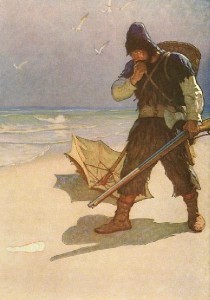
Please see Kimberly’s remarks in the entry, The Feminization of Race. I have urged housewives to read Robinson Crusoe, one of the greatest books of all time and a profound meditation on the metaphysical and practical tasks of home. Kimberly, a young mother, has followed my advice and, with truly brilliant insight, relates Crusoe to the issue of race. She also describes her own struggle to understand her husband’s approach to racial matters.

(more…)

Comments Off on Race, Men and Women, and Crusoe

Love and Race, Spirit and Matter


In the entry, The Golfer’s Wife, a reader accuses M., another male commenter, of insensitivity. He says M. denies the primacy of love over racial considerations in marriage and all personal relations. In his response to this criticism, M. gets to the heart of why these issues will always be troublesome and why they will never be absent of gray areas and blurred lines. He also succinctly describes the traditionalist viewpoint on the interconnection between spirit and matter in social affairs.

M. responds, in part:

“Look, I am not unconflicted about all of this. I think this is because we exist as human beings on several related but distinct levels at the same time, and what is considered Quality or Beauty or Excellence on one level may not be considered that way on another. 

At one level we are biological beings, animals, motivated by our survival and sexual drives. At a higher, related but distinct level, we are social beings, motivated by a need to be accepted, to gain fame and wealth and status. At yet a higher level, we are intellectual beings, motivated by a drive for truth, nobility, and idealism. And at yet an even higher level, we are spiritual beings, with eternal souls, living here to learn ineffable lessons and grow towards God. Each higher level is dependent on the lower levels for existence, but the values of each of the levels can be in conflict. 

So at a spiritual level, I agree with Rita in her interest in spiritual virtue and growth. And I even agree with liberals in their intellectual interest in what seems to be a noble ideal: the end of strife on earth due to racial identity. Who could disagree that, taken by itself, that is a noble ideal? I believe that when possible, the values of the higher levels must take precedence over the values of the lower levels.” 

Below is the exchange in full.

(more…)

Comments Off on Love and Race, Spirit and Matter