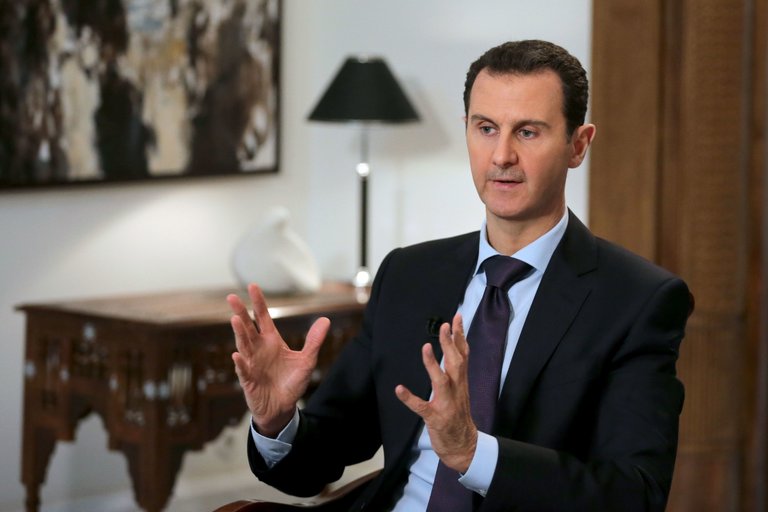
WHY did the United States attempt to destroy Syria’s most important airbase, a military base that was being used to fight Muslim terrorists?An explanation from Syrian President Bashar al-Assad, from an April 6th interview:
Concern about a war is unrealistic, because the reality is that we are living this war. But as for calling it a Syrian-Israeli war, you can assume in any case that these terrorists are fighting for Israel. Even if they are not a regular Israeli army, they are still fighting for Israel. And Israel shares the objectives with Turkey, the United States, France, Britain, Saudi Arabia, Qatar, and other states. They all share the same objective. It is a war that has taken a new form and uses new instruments. Practically, our victory over the terrorists is a victory over all those states put together. That’s why Israel is doing its best to support these terrorists in every place the Syrian Army advances. They attack in one way or another in order to provide support to the terrorists and in order to stall the momentum of the Syrian Arab Army in facing them.
Other quotes from the interview:
Those Western countries, led by the United States, in partnership mainly with Britain and France, and unfortunately some European countries which did not have a colonial history, do not accept independent states and do not accept peer relations. They want satellite states which implement their policies. (more…)
THE “America First” nationalists in the Trump administration (e.g. Steve Bannon) are being marginalized for the real power behind the throne: the Kushners, the Goldman Sachs bankers and the moronic warhawks. See Mike King’s report (salty language, indecent images):
We believe that Jared & Ivanka “won the battle” because the game was rigged against the Nationalists all along. The object of the game was to paint the Democrat Trumpstein as a born-again nationalist, then draw in Christians, pro-lifers, union workers, “angry White guys” and all the various sub-groups of “alt-right-wingers” (including us, though we always had some doubts), and then discard us all like used-up lemon rinds soon after the election — making it look like the result of a lost “power struggle,” rather than the calculated, pre-meditated betrayal it was intended to be all along.
Why anyone would be surprised at all this is … surprising. In general, don’t trust people who make their living in casinos or New York real estate or beauty pageants. Don’t trust people who brag about sleeping with married women and cheating on their own wives. And, call me prejudiced, but don’t trust people who build ugly skyscrapers. (more…)
Comments Off on President Jared and First Lady Ivanka
THE Resurrection of Jesus Christ met with skepticism from the very beginning. The Apostles and other disciples were the first doubters. When the women, who had gone to the tomb to anoint Jesus's body, found that it was empty and witnessed an angel, they then went to tell the Apostles, who did not believe them. When Christ appeared to the Apostles later they thought He was a spirit. People were not anymore inclined then than they are today to believe death can be reversed. The evangelists - Mark, Matthew, Luke and John - ultimately convinced vast multitudes of the veracity of their accounts. Could they have been fooled? Could they have made up the story for some ulterior purpose? This 1945 pamphlet by Rev. Martin J. Scott. S.J. provides brief answers to skeptics.
THIS excellent video was posted on Youtube by "Reason and Logic" with the quote: "Creative destruction is our middle name, both within our own society and abroad. We tear down the old order every day, from business to science, literature, art, architecture, and cinema to politics and the law. Our enemies have always hated this whirlwind of energy and creativity, which menaces their traditions (whatever they may be) and shames them for their inability to keep pace." Neocon Michael Ledeen
Iran’s president said on Saturday that “terrorists” were applauding his US counterpart Donald Trump for launching a missile strike on an airbase of his Syrian government ally.
But Hassan Rouhani backed calls for an independent inquiry into a suspected chemical weapons attack on a rebel-held town in northwestern Syria on Tuesday that Trump blamed on Damascus.
“This man who is now in office in America claimed that he wanted to fight terrorism but today all terrorists in Syria are celebrating the US attack,” Rouhani said in a speech on state television. (more…)
IN 1982, Oded Yinon, a journalist for the Jerusalem Post and former senior official with the Israeli Foreign Ministry, outlined a plan for Israeli regional supremacy. It involved expansion into the area between the Nile and Euphrates Rivers. This domination would come about by inflaming sectarian divisions in Arab countries and breaking apart these states through managed civil wars. The Yinon Plan provides essential background for the war in Syria. Read more here at Global Research. Why Trump violated international law and attacked Syria:
ROBERT PARRY writes at Consortium News: With the latest hasty judgment about Tuesday’s poison-gas deaths in a rebel-held area of northern Syria, the mainstream U.S. news media once more reveals itself to be a threat to responsible journalism and to the future of humanity. Again, we see the troubling pattern of verdict first, investigation later, even when that behavior can lead to a dangerous war escalation and many more deaths. Before a careful evaluation of the evidence about Tuesday’s tragedy was possible, The New York Times and other major U.S. news outlets had pinned the blame for the scores of dead on the Syrian government of Bashar al-Assad. That revived demands that the U.S. and other nations establish a “no-fly zone” over Syria, which would amount to launching another “regime change” war and would put America into a likely hot war with nuclear-armed Russia. Even as basic facts were still being assembled about Tuesday’s incident, we, the public, were prepped to disbelieve the Syrian government’s response that the poison gas may have come from rebel stockpiles that could have been released either accidentally or intentionally causing the civilian deaths in a town in Idlib Province. [cont.]
To understand why President Trump has launched military strikes against the Assad government of Syria one needs to understand that the master plan for Syria is to break the country up into ethnic statelets (i.e. Balkanize). This is the Zionist (Israeli) Likud plan, known as the Yinon Plan (1982), which calls for destroying the military forces of both Syria and Iraq and then breaking them up. To read more about the Zionist master plan for Syria, see yesterday’s posting: Why trust Al Qaida terrorists about the gas attack?
“U.S. IS ABETTING INTERNATIONAL TERRORISM”
Does this mean that Donald Trump’s cruise missiles were fired to help the Al Qaida terrorists, the same group he blames for 9/11, who are fighting to overthrow the government of Syria?
Yes, that is exactly what the result of the U.S. military action is. The U.S. is actually waging war against the elected government of Syria, illegally, on behalf of terrorists, which the U.S. designated as terrorists in March 2017! This is a “big mistake” for President Trump (and the U.S.) and proves the veracity of the expression, “The War on Terror is really a War of Terror.” (more…)
DONALD TRUMP started a new war in the Middle East yesterday — exactly one hundred years after the U.S entered World War I and less than three months into his presidency. He launched airstrikes against Syria late in the day, breaking his campaign promise to avoid foreign interventions and to put America first. Reports of an alleged chemical attack by Syrian President Bashar al-Assad on Tuesday, an allegation which defies belief, were the cause, Trump said. There was no time for investigation, certainly not for the level of investigation needed before going to war. [See CNN anchor berate Congressman Thomas Massie (R-Kentucky) for saying the perpetrators are not yet known.]
Trump is the neo con-man that some of us have always suspected him of being.
RON PAUL believes the alleged chemical attack by Assad is another false flag to provoke American aggression against Syria. There is "zero chance," Paul says, that Assad is responsible for the attack. And Trump reverses himself, fully supporting what is obviously "fake news:" Former UK Ambassador to Syria, Peter Ford, reacts to the alleged attack:
THIS IS AN ADDRESS written by Mark Glenn in 2013 to Abe Foxman, then executive director of the Anti-Defamation League, the pro-defamation organization which routinely spies on ordinary Americans, destroys careers, defames anyone who dares to criticize the most powerful people in the world as "haters" and is preparing the way for more serious criminal oppression. Many Jews are as brainwashed by the likes of the "vile and traitorous" ADL, which in any normal country would be forced to register as the agent of a foreign government, as their gentile brethren. "Anti-Semitism" is a lie. Learn more about the ADL here.
Reflect then, Christian reader, that our divine Savior is crowned with sharp thorns, to punish on his own head all your sinful deeds, but more especially the wicked thoughts, by which you have offended God, and have defiled his divine image impressed upon your soul. Numerous thorns pierce, and torture his divine head, because we have harbored in our mind many bad thoughts of different kinds. Our thoughts against faith and against hope, our thoughts of presumption, or despair, impious and blasphemous thoughts against God, have produced the longest and sharpest thorns that torment the most holy head of our divine Savior. Our habitual dissipation of mind, our forgetfulness of God's holy presence, our voluntary distractions in prayer, are the reeds with which, like his cruel executioners, we strike and more deeply press his thorny crown. Uncharitable thoughts against our neighbors, rash judgment, envy and jealousy against our fellow Christians, are the cruel thorns that torture our Savior's head. Those frequent thoughts of pride/ambition, vain-glory; that hypocrisy, that habitual disposition to overreach, and deceive our fellow men, so common in human society at the present time, those desires of revenge, sensuality and lust, have produced that terrible thorny bush from which the Crown of Thorns has been formed, that pricks and torment the head of the incarnate Son of God. Whilst, Christian reader, you are considering the sufferings of your Savior crowned with thorns, enter into your heart and…
JOHN VENNARI, a traditionalist Catholic writer, died yesterday at the age of 59. May he rest in peace. Here is an excerpt from Vennari's book The New Paganism and the War against Life: What is the New Paganism? There have been great men and women in the recent past who have warned in advance against the rise of the godless and anti-human period of history in which we now find ourselves. One of the most keen-eyed warnings came from the renowned Catholic historian Hilaire Belloc, in a magnificent essay he wrote in 1931 called “The New Paganism”. He makes this point: the central aspect of the Old Paganism was deep respect for tradition, and the defining element of the post-Christian paganism is a revolutionary contempt for Tradition. Belloc wrote: “The Old Paganism was profoundly traditional. Indeed it had no roots except in Tradition. Deep reverence for its own past and for the wisdom of its ancestry and the pride therein were the very soul of the Old Paganism; that is why it formed so solid a foundation on which to build the Catholic Church, and that is also why it offered so long a determined resistance to the growth of the Catholic Church. But the New Paganism has for its very essence contempt for tradition and contempt for ancestry. It respects perhaps nothing. But least of all does it respect the spirit of ‘Our Fathers have told us’.”1 Throughout history, our fathers…
Let him take up his cross, the one that is his. Let this man or this woman, rarely to be found and worth more than the entire world (Prov. 31, 10-31), take up with joy, fervently clasp in his arms and bravely set upon his shoulders this cross that is his own and not that of another; his own cross, the one that My Wisdom designed for him in every detail of number, weight and measurement; his own cross whose four dimensions, its length, breadth, thickness and height (Eph. 3, 18), I very accurately gauged with My own hands; his own cross which all out of love for him I carved from a section of the very Cross I bore on Calvary; his Cross, the grandest of all the gifts I have for My chosen ones on earth; his Cross, made up in its thickness of temporal loss, humiliation, disdain, sorrow, illness and spiritual trial which My Providence will not fail to supply him with every day of his life; his cross, made up in its length of a definite period of days or months when he will have to bear with slander or be helplessly stretched out on a bed of pain, or forced to beg, or else a prey to temptation, dryness, desolation and many another mental anguish; his cross, made up in its breadth of hard and bitter situations stirred up for him by his relatives,…
S.K. writes: Did this young woman benefit from having the 'right' to make her own 'decisions?' This is an accident of course, but infuriating. I've always hated those stupid eating contests. I think Lawrence Auster once said that the legacy of liberalism is a pile of dead young women; or something to that effect. Mrs. T. writes: Unfortunately, this event with Earth Day nuns is happening where I live.
Comments Off on Lenten Eating Contest and Eco-Nuns
MARK J. PERRY writes at the American Enterprise Institute:
The American Association of University Women (AAUW) and the National Committee on Pay Equity (NCPE) are major participants in the feminist propaganda machine that mobilizes forces every April and engages in statistical misrepresentations to publicize the annual feminist holiday known as Equal Pay Day. According to the NCPE, Equal Pay Day will fall on Tuesday, April 4 this year, based on a 20% unadjusted difference in median annual earnings for women and men in 2015 when absolutely nothing relevant is controlled for that would explain income differences like hours worked, marital status, number of children, education, occupation, and the number of years of continuous uninterrupted job experience. Therefore, Equal Pay Day on April 4 this year misleadingly represents how far into 2017 a typical woman will allegedly have to continue working to earn the same income that her male counterpart earned last year for doing the exact same job.
In fact, looking closely at statistics, it is clear that men are paid more as a group largely because they tend to work in less safe occupations (incurring a far greater on-the-job fatality and injury rate), work longer hours, take less time off, work in physically more demanding jobs and take fewer jobs with hours convenient to caring for children.
The public face of the “Equal Pay” campaign this year is Facebook CEO Sheryl Sandberg, who shamelessly contradicts herself in her article today in USA Today.She loads the beginning of the piece with misleading statements and then reverses these farther on in the propaganda piece, where most readers will probably have already moved on. She writes:
Today is Equal Pay Day. This means that on average, women in the United States had to work all of 2016 plus this far into 2017 to catch up to what men earned last year.
She later explains that more than half of the differential is due to occupation choices. The average woman does not face the average man in a losing battle for pay. Sandberg never acknowledges that many of these women supposedly struggling to catch up are also supported financially by men.
The Equal Pay campaign has always been based on patently fraudulent premises. But that doesn’t matter, folks! Feminism is not about reality or facts. It’s a form of mass psychosis. Millions of men, we should note, sit around and passively accept these lies and slanders against them. Sandberg writes:
A world where women ran half of our companies and countries and men ran half of our homes would be a better world.
Average American child eating dinner in feminist America
Our companies would be more successful,
The economy has gotten dramatically better under feminism!
our laws more just,
More fathers will be arrested — even though they are paid so much!
and our children would gain from their fathers’ care as much as they do from their mothers’.
In Feminist America, both Mom and Dad are working and children have “learning experiences.”
Thanks for the fantasies, Sheryl, you anti-gentile, Commie con artist and control freak! Only a very sick woman — only a loser — gets her kicks from making men and women hate each other. There’s a special circle in hell for people like you. It’s marked: EQUAL PAY. (more…)