
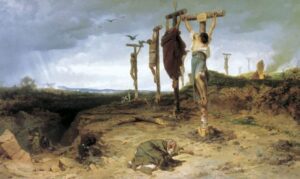
IN Ancient Rome, crucifixion was a punishment generally reserved for slaves, pirates, and those guilty of serious treason or military desertion.
Only rarely was a Roman citizen crucified, and Cicero strongly declaimed against any such thing. Crucifixion was the ultimate humiliation — and thus unworthy of a Roman. In his book, Crucifixion in the Mediterranean World, John Granger Cook assembled references to crucifixion in ancient archives. He shows, against criticism of new skeptics, that it was an approved practice by Roman authorities, possibly having been copied from Carthaginians. (It is still used in some parts of the world, more than 15 centuries after Constantine banned the practice in the West.)
To be exposed to the elements, usually naked and affixed by nails or ropes to a cross- or T-shaped post, after being beaten severely, all conducted in a public place in view of anyone who cared to look — here was a death sentence that came with a powerful message: The government is almighty and is prepared to dehumanize anyone who rises against it. The same spirit animated the institution of mass slavery, the gladiatorial games and mass slaughters committed by Romans in conquered territories.
Death often came slowly for the crucified. (That’s why Pontius Pilate expressed surprise when Jesus succumbed in three hours.) Crucifixion was not just execution; it was drawn-out torture.
Though Pilate was reluctant to execute Jesus — seven times he tried to persuade his accusers against it — the quintessentially Roman practice claimed Him and for all time, the manner in which Jesus was crucified is a testament to God’s implacable enmity to the state that rules without Him and that treats the lowly as worthless animals.
Though secondary to the message of redemption, it has perhaps especial meaning for our times.
Thanks for reading!


