
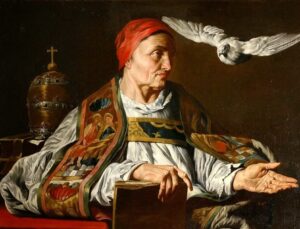
“It is better that scandals arise than the truth be suppressed.”
—- Pope St. Gregory the Great
FROM Dom Prosper Guéranger on Pope St. Gregory the Great (540-604), who was responsible for the conversion of England:
Such was the respect, wherewith everything he wrote was treated, that his very Letters were preserved as so many precious treasures. This immense Correspondence shows us, that there was not a country, scarcely even a city, of the Christian world, on which the Pontiff had not his watchful eye steadily fixed; that there was not a question, however local or personal, which, if it interested religion, did not excite his zeal and arbitration, as the Bishop of the universal Church. If certain writers of modern times had but taken the pains to glance at these Letters, written by a Pope of the 6th century, they would never have asserted, as they have done, that the prerogatives of the Roman Pontiff are based on documents, fabricated, as they say, two hundred years after the death of Gregory.
Throned on the Apostolic See, our Saint proved himself to be a rightful heir of the Apostles, not only as the representative and depository of their authority, but as a fellow-sharer in their mission of calling nations to the true faith. To whom does England owe her having been, for so many ages, the Island of Saints? To Gregory, who, touched with compassion for those Angli, of whom, as he playfully said, he would fain make Angeli, sent to their island the Monk Augustine, with forty companions, all of them, as was Gregory himself, children of St. Benedict. The faith had been sown in this land as early as the second century, but it had been trodden down by the invasion of an infidel race. This time the seed fructified, and so rapidly, that Gregory lived to see a plentiful harvest. It is beautiful to hear the aged Pontiff speaking with enthusiasm about the results of his English mission. He thus speaks in the twenty-seventh Book of his Morals: “Lo! the language of Britain, which could once mutter naught save barbarous sounds, has long since begun to sing, in the divine praises, the Hebrew Alleluia! Lo! that swelling sea is now calm, and Saints walk on its waves. The tide of barbarians, which the sword of “earthly princes could not keep back, is now hemmed in at the simple bidding of God’s Priests.” (Moral in Job. Lib. xxvii. Cap. xi.)
During the fourteen years that this holy Pope held the place of Peter, he was the object of the admiration of the Christian world, both in the East and West. His profound learning, his talent for administration, his position, all tended to make him beloved and respected. But who could describe the virtues of his great soul? that contempt for the world and its riches, which led him to seek obscurity in the cloister; that humility, which made him flee the honours of the Papacy, and hide himself in a cave, where, at length, he was miraculously discovered, and God himself put into his hands the Keys of Heaven, which he was evidently worthy to hold, because he feared the responsibility; that zeal for the whole flock, of which he considered himself not the master, but the servant, so much so indeed that he assumed the title, which the Popes have ever since retained, of Servant of the Servants of God; that charity which took care of the poor throughout the whole world; that ceaseless solicitude, which provided for every calamity, whether public or private; that unruffled sweetness of manner, which he showed to all around him, in spite of the bodily sufferings which never left him during the whole period of his laborious pontificate; that firmness in defending the deposit of the Faith, and crushing error wheresoever it showed itself; in a word, that vigilance with regard to discipline, which made itself felt for long ages after in the whole Church? All these services, and glorious examples of virtue have endeared our Saint to the whole world, and will make his name be blessed by all future generations, even to the end of time.
Read the epistles of St. Gregory the Great (604) here.
Thanks for visiting!


