
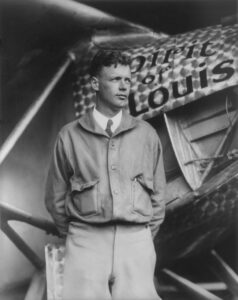
Observe that a man who advised Americans to mind their own business at home instead of get dragged into international adventurism is painted as a Bad Man — whereas men whose policies led to the death of thousands of American men and thousands of Japanese civilians (in 1945) are painted as Great Men. Even those who profess admiration for Lindbergh the pilot will accommodate claims that there was something wrong in his advocacy of self-defense for Americans instead of self-immolation. Such is the power of decades of propaganda and the credulity of people who are willing to be deceived.
*******
ALAN writes:
One of the few titles that my father kept in his modest collection of books was Charles Lindbergh’s The Spirit of St. Louis, the autobiographical account of his 1927 flight from New York to Paris. It stood there on his bookshelf for decades, but I was never smart enough to ask my father what the book meant to him. I had reason to regret that failure last month when I watched the 1957 motion picture based upon that book and with the same title.
My father was born only a decade after the Wright Brothers experimented with heavier-than-air flight. He was 14 when Lindbergh made his flight in 1927.
Now I sit here 99 years later, watching that movie and trying to imagine how my father must have felt at that age. St. Louis in those years had four daily newspapers, some of which cost two cents. I imagined my father must have read about Lindbergh’s flight in those newspapers. The flight and the courage it required must have made a big impression on my father, along with the St. Louis connection in the plane, the men who backed him, and the fact Lindbergh had flown many times out of Lambert Field in St. Louis County.
St. Louis sportswriter Bob Broeg was nine years old in 1927. Decades later, he wrote: “In May, along with our neighborhood (the Mount Pleasant neighborhood in south St. Louis)…I listened in fascination to radio bulletins about” Lindbergh’s flight. “In my home area, folks gathered outside Art Meyer’s filling station through the night as the radio boomed out messages describing the plucky pilot’s flight….” (Bob Broeg: Memories of a Hall of Fame Sportswriter, Sagamore Publishing, 1995, p. 11). And I wondered whether my father and his family listened to those same radio messages that night in their own neighborhood a few miles away.
A month later, Lindbergh’s tour of the nation brought him back to St. Louis. He was given a tumultuous welcome. He rode in a parade through the streets downtown that were lined with thousands of people. I wondered whether my father stood somewhere along that route. At age 14, he must have had a desire to see in person the man who had become a national hero.
Also by that age, my father had developed his lifelong love for the game of baseball. During that visit, Lindbergh attended a baseball game at Sportsman’s Park in north St. Louis, a fact that surely doubled my father’s interest. I imagine he saw in Lindbergh the same things millions of other American boys saw: Courage, determination, confidence, heroism, and masculine fiber.
(Fewer boys looked for those things after their parents agreed to have them feminized, a perversity I am confident neither Lindbergh nor my father ever imagined possible.)
On a wall in his apartment in the later decades of his life, my father kept a small likeness of the “Spirit of St. Louis” airplane. I am sure Lindbergh’s achievement was prominent in my father’s memory when he and I paid close attention to Project Gemini space flights in the 1960s. When Lindbergh died in 1974, my father clipped and saved lengthy newspaper articles about his life. Lindbergh was quiet, conservative morally-philosophically and politically, did not like chatter or ballyhoo, and did not go about showboating his achievements. Those characteristics must have impressed my father favorably. That is how they impressed me.
On Valentine’s Day in 1928, Lindbergh returned to St. Louis and was greeted by a huge crowd gathered on the riverfront downtown. About that day, Bob Broeg wrote: “…all schoolchildren were excused and transported by streetcar and bus to the riverfront. We lined the levee for miles. Lindy flew his ‘Spirit’ up the Mississippi, dramatically demonstrating his stunt and mail-pilot skills. He virtually skimmed the water before flying his plane under Eads Bridge. If I didn’t wet my pants, I certainly wanted to.” (p. 12) And I wondered whether my father, too, might have been there that day somewhere in that crowd.
All those things floated into my awareness as I sat there watching that 1957 motion picture. I tried to imagine how it was for my father when he went to see that picture when it was presented that year at one of the three movie palaces in St. Louis; and how he must have thought about it within the larger context of his memories of the event itself thirty years earlier. I imagined that he must have enjoyed the movie. I am certain he would have enjoyed the masculine confidence, courage, optimism, and “can do” frame of mind projected by actor James Stewart in his portrayal of “The Lone Eagle”.
In 1941, when my father was 28 years old, Charles Lindbergh spoke at the St. Louis Arena on behalf of the America First Committee and in opposition to Americans being dragged into the world war. The Original Four Principles of that Committee made frightfully good sense. What Americans in those years did not know is that Roosevelt’s administration was infested with Communists. Roosevelt tried to demonize Lindbergh because he spoke the truth when he named three groups of war-provocateurs. If Americans had acted on the advice of Lindbergh and America First, they could have kept hundreds of thousands of their most valuable men alive at home instead of being killed on other continents in a war engineered to make the world safe for Communists.
In an age when Big Lies are commonly asserted as truth, Americans are still told by their government and the mass communications industry that Lindbergh was a “racist”, “isolationist”, and “Nazi sympathizer”. For which groups is name-calling standard operating procedure? Communists and “Liberals”. The truth is of course quite different. Observe that a man who advised Americans to mind their own business at home instead of get dragged into international adventurism is painted as a Bad Man — whereas men whose policies led to the death of thousands of American men and thousands of Japanese civilians (in 1945) are painted as Great Men. Even those who profess admiration for Lindbergh the pilot will accommodate claims that there was something wrong in his advocacy of self-defense for Americans instead of self-immolation. Such is the power of decades of propaganda and the credulity of people who are willing to be deceived.
Consider how different the last 80 years might have been if Americans had recognized the wisdom in the America First Committee principles and thereby resisted a powerful central government that would drag them into endless wars decade after dedr–all of them spectacles of self-immolation claimed to be warranted by this, that, or another Big Lie.
Like most other Americans in those years, my father probably looked upon FDR the way the mass propaganda industry painted him: As a kindly, honorable man and president. I doubt my father would have believed that radio and newspapers would assert or rubber-stamp lies, or that Roosevelt would lie both about Lindbergh and about a “surprise” Japanese attack on Pearl Harbor as an excuse for dragging Americans into the war. I do not know whether my father could have imagined evil on that scale. I do know that he held more or less the conventional views about World War II. Did he have any inkling of such evil twenty years later when Americans could sit comfortably at home and watch American men being killed in Vietnam in living color on the nightly TV news? Or does it take a lifetime to understand that powerful men like Roosevelt and Johnson were two of the greatest liars of the twentieth century?
Only once and rather briefly did my father and I talk about World War II. We talked less about the facts of the war than the morality. We addressed the matter of Truman’s use of the atomic bombs. My father’s judgment was that Truman’s decision was proper and justifiable. I argued it was not. We agreed to disagree. Whether he believed FDR’s vicious lies about Lindbergh were justified, I do not know.
Opportunities to ask my father about his memories and judgments on all those things ….. lost forever.


