The Dumbing Down of Children’s Fairy Tales
0 Comments
March 31, 2026

“Netanyahu [on Israeli TV] accidentally reveals the REAL reason for the war. It has nothing to do with nukes. He admits the plan is to build oil pipelines through the Middle East straight to Israeli ports, completely bypassing Arab-controlled straits. It is all about money and control.”
FROM “‘Death Wish’ as Jewish Anti-Gentile Fantasy and Revenge Porn” by Karl:
In much the same way that a wannabe ‘tough Jew’ – and a former director of the ADL – named Nathan Perlmutter could boast in 1982 in a typically tone-deaf way about beating up an old German man on the street because he ‘was a Nazi’ (3) and get no push back from his fellow members of the tribe. The ‘tough Jew’ of Jewish fantasy is Benjamin, the so-called ‘Hebrew Hammer’ and the famous ‘Bear Jew’ of ‘Inglorious Bastards’; where the so-called ‘brave Jew’ gets to torture and murder helpless non-Jews in general – and ‘Nazis’ in particular – without any moral opprobrium attached to doing so ‘because Nazis’.
“EVERY morning of life we begin anew. We go forth from our doors to encounter a new day on its passage to eternity. It has much to say to us, and we to it; and it carries its tale to God at sunset, and its word is believed, and its message remembered till the doom. Would it not be an unproductive day in which we did not meet our Lord? For is not that the very meaning of our lives? If the day is meant for the sun to shine, it is but half a day, or rather it is night, if only the material sun shall shine, and the Sun of justice also rise not on us with health upon His wings. We go out to meet Jesus in every action of the day; but we require this fourth dolor (of Mary’s meeting Jesus on the path to Calvary) to admonish us that we must rarely expect to meet Him except with a Cross, and that a new one. When we are in sorrow, He Himself “draws near and goes with us,” as He did with the disciples on the road to Emmaus. That is the privilege of sorrow. It is an attraction to our dearest Lord which He can seldom resist. Provided we seek not other comfort, He is sure to draw near and comfort us Himself. Oh, if unwary souls did but know the graces which they miss by telling their griefs and letting their fellow-creatures console them, how saints would multiply in the Church of God! (more…)
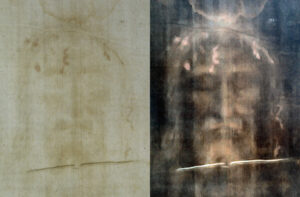
FROM “The Shroud of Turin: A Cumulative Case for Authenticity” by Peter S. Williams:
Scientific examination of the Shroud began in 1898, when it was first photographed and the image was found to be a photographic negative – it’s light and dark values were reversed when it was ‘printed’ on a piece of film. The resulting image was far more life-like than the faint original. (Above: negative shroud image on the left, positive image revealed in photographic negative on right). Then, in the 1970’s, microscopic examination of the cloth failed to find anything an artist would have used to paint the image. In 1976, a NASA image analyser connected to a computer discovered that the Shroud image contained ‘three dimensional’ information: ‘a wholly astounding and unexpected discovery, and one which still has no convincing explanation.
The Shroud is perhaps the most intensely investigated artefact in history, and has come under the scrutiny of a diverse group of scholars and researchers including: historians, archaeologists, chemists, physicists, botanists, engineers, doctors, forensic pathologists and experts in painting, photography, textiles, as well as philosophy, theology and apologetics.
“EARLY in the morning of this day, Jesus sets out for Jerusalem, leaving Mary His Mother, and the two sisters Martha and Mary Magdalene, and Lazarus, at Bethania. The Mother of sorrows trembles at seeing her Son thus expose Himself to danger, for His enemies are bent upon His destruction; but it is not death, it is triumph, that Jesus is to receive today in Jerusalem. (more…)
FROM the 1977 British TV series, Jesus of Nazareth, noted for the outstanding performance of actor Robert Powell, who played Jesus. The series can be seen in full here.
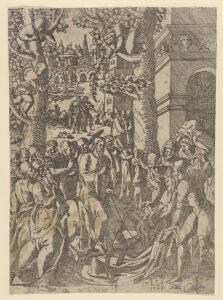
From Fr. Edward Leen’s book, Why the Cross? :
On the morning of the Sunday in the last week of His mortal life, Jesus entered Jerusalem amidst the enthusiastic acclamations of a multitude composed of citizens and strangers. His malignant enemies saw their snarling protests drowned in the tumult of rejoicing. They felt themselves to be like straws tossed helplessly on the swelling tide of popular favour on which the Nazarene was borne triumphantly. The Pharisees therefore said among themselves : ‘Do you see that we prevail nothing? Behold the whole world is gone after him.’ And yet, five days later, Jesus was hurried through the streets of the city of His triumph amidst the execrations of the multitude and the silent dismay of His friends. Such a sudden reversal in the fortunes of the prophet of Nazareth baffles human reason. Some explanation might be furnished by the ordinary laws of mob psychology, but the explanation is far from satisfying and, to a mind approaching the problem without prejudice, appears wholly inadequate.
[…]
Much has been made of the supposed devotedness of great numbers of the simple country people to the cause of the Saviour. The entry into Jerusalem is pointed to as the occasion on which this enthusiastic devotion overbore all opposition and had a free course. The mood of the populace is supposed to have undergone a complete change in the course of a few days, owing to the machinations and the skilful propaganda of the priests. It is undeniable that the Nazarene had some sincere and devoted followers, but they must have been comparatively few in numbers. They did not constitute the great throng that went out at the city gates, on the morning of Sunday, to welcome Him with loud acclamations and the waving of palms. (more…)
“COULD we live if God should us our real selves? We have need to be immortal before our hour of judgement comes.”
— Fr. Frederick William Faber, At the Foot of the Cross
EUROPEANS can be so arrogant in their holier-than-thou postmodernism, it’s hard sometimes to feel they deserve anything less than the destruction of their homelands.
See Koen Dejonghe’s version of the Stabat Mater for a case in point. Perhaps he himself is not truly European, I don’t know. I suspect he is not, but his audience is.
Stupid, ugly blasphemy — in a way only liberal, materialistic Europeans can delight in.
STABAT MATER
At the Cross her station keeping,
Stood the mournful mother weeping,
Close to Jesus to the last.
Through her heart, His sorrow sharing,
All His bitter anguish bearing,
Now at length the sword has passed.
O, how sad and sore distressed
Was that mother highly blessed,
Of the sole begotten One!
Christ above in torment hangs.
She beneath beholds the pangs
Of her dying glorious Son.
STABAT MATER
At the Cross her station keeping,
Stood the mournful mother weeping,
Close to Jesus to the last.
Through her heart, His sorrow sharing,
All His bitter anguish bearing,
Now at length the sword has passed.
O, how sad and sore distressed
Was that mother highly blessed,
Of the sole begotten One!
Christ above in torment hangs.
She beneath beholds the pangs
Of her dying glorious Son.
STABAT MATER.
At the Cross her station keeping,
Stood the mournful mother weeping,
Close to Jesus to the last.
Through her heart, His sorrow sharing,
All His bitter anguish bearing,
Now at length the sword has passed.
O, how sad and sore distressed
Was that mother highly blessed,
Of the sole begotten One!
Christ above in torment hangs.
She beneath beholds the pangs
Of her dying glorious Son.
“THE house of sorrow is always a house of love. This is what takes place in us regarding Mary’s dolors. One of the thousand ends of the Incarnation was God’s condescending to meet and gratify the weakness of humanity, forever falling into idolatry because it was so hard to be always looking upwards, always gazing fixedly into inaccessible furnaces of light. So are Mary’s dolors to her grandeurs. The new strength of faith and devotion, which we have gained in contemplating her celestial splendors, furnishes us with new capabilities of loving; and all our loves, the new and the old as well, rally round her in her agony at the foot of the Cross of Jesus. Love for her grows quickest there. It is our birthplace. We became her children there. She suffered all that because of us. Sinlessness is not common to our Mother and to us. But sorrow is. It is the one thing we share, the one common thing betwixt us. We will sit with her therefore, and sorrow with her, and grow more full of love, not forgetting her grandeurs,— Oh surely never! — but pressing to our hearts with fondest predilection the memory of her exceeding martyrdom.”
— Fr. Frederick William Faber, The Foot of the Cross, p. 85
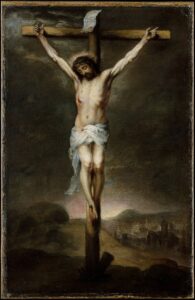
“WHEN God imposes a cross upon a just person, he may be sure that it is a blessing to him. It may be painful at times, but the pain purifies, enriches, and sanctifies the sufferer. Heaven requires purity of soul, and the cross purifies. Jesus says ‘He that taketh not up his cross and followith Me is not worthy of Me.‘ (Math. x. — 38) Let us then carry our crosses, ever obeying the will of our divine Redeemer.”
— Rev. B.J. Raycroft, A.M., Sermons on the Stations of the Cross, Imp. 1901
“AS we see but one side of the moon, so we see but one side of God: and what can we know of what we do not see? There is no end to the variety of the disclosures of His goodness, the inventions of His compassion, and the strangeness of His yearning over His own creatures. He has striven to fix our gaze upon these, but we will not have it so. We are busiest with what He wishes us to think least of. And we neglect to ponder all those numberless signs of our Heavenly Father’s love, which are personal things between Him and ourselves; positive and sensible touches of His unutterable affection.”
— Fr. Frederick Faber, All for Jesus, or the Easy Ways of Divine Love