
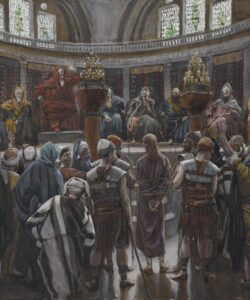
Ecclesiastical Trial before Annas and Caiaphas
“Here the ecclesiastical trial was about to take place since it pertained to the Jewish religious authorities to examine Jesus on what they called His assumed title of the Son of God. The Sanhedrim consisted of seventy members, at the head of which were the chief priests and their supreme head the High Priest, which office Annas had succeeded in obtaining for his five sons in succession, and then in the year of our Lord’s death for his son-in-law, Caiaphas. Faithless to their mission, these official representatives of the Jewish religion no longer looked for any Messias other than a warrior king who should deliver them by main force from the Roman yoke.
Our Lord was at first taken before Annas, the father-in-law as we have seen of the High Priest, but since he was no longer in office it was beyond his competence to judge our Lord when He appeared before him. The affair had been mismanaged and had to be referred to the tribunal of the real High Priest, Caiaphas. He awaited Jesus, in another wing of the Palace, seated, according to custom, with legs crossed, on a slightly raised platform. Around him on the ground, on cushions set in the form of a semicircle, were grouped the other priests. The proceedings were illegal because while they should have taken place in the daytime with witnesses present, it was actually two o’clock in the morning, and such witnesses as there were detected in flagrant imposture. Then Joseph Caiaphas, overpowered by rage, solemnly called upon our Lord to tell him if He were the Christ, a measure quite contrary to the Roman Law which in such a case invalidates the confession of the accused; and our Lord who had waited for this moment before speaking, formally declared His Divinity before the Jewish religious authority in full council assembled. They then found Him worthy of death, a sentence which He accepted since it was precisely His character as Son of God which enabled Him to give an infinite value to the sacrifice which He was about to offer to God the Father for His brethren, the sons of men.”
—- James Tissot, The Life of Our Saviour Jesus Christ


