FROM “The Shroud of Turin: A Cumulative Case for Authenticity” by Peter S. Williams:
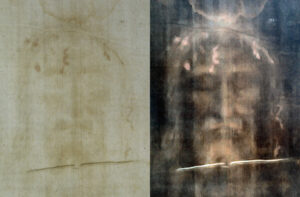
Scientific examination of the Shroud began in 1898, when it was first photographed and the image was found to be a photographic negative – it’s light and dark values were reversed when it was ‘printed’ on a piece of film. The resulting image was far more life-like than the faint original. (Above: negative shroud image on the left, positive image revealed in photographic negative on right). Then, in the 1970’s, microscopic examination of the cloth failed to find anything an artist would have used to paint the image. In 1976, a NASA image analyser connected to a computer discovered that the Shroud image contained ‘three dimensional’ information: ‘a wholly astounding and unexpected discovery, and one which still has no convincing explanation.
The Shroud is perhaps the most intensely investigated artefact in history, and has come under the scrutiny of a diverse group of scholars and researchers including: historians, archaeologists, chemists, physicists, botanists, engineers, doctors, forensic pathologists and experts in painting, photography, textiles, as well as philosophy, theology and apologetics.
Read more here.
The Shroud includes both authenticated dried blood, consistent with the wounds of Crucifixion described in the Gospels, and the photographic image of an entire body, as mentioned above. One of the great developments of history has been the discovery of scientific evidence in support of its authenticity.
See also Science and the Shroud of Turin by Robert J. Spitzer and “How Old is the Shroud of Turin?” [Please note: This is not an endorsement of the Modernist theology of the authors mentioned.]
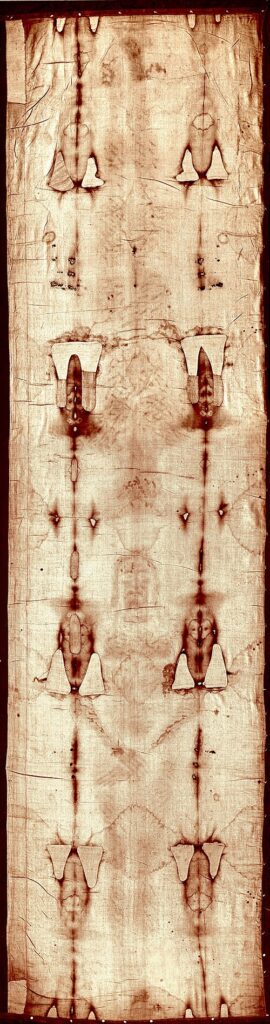
Full-length image of the Shroud: