
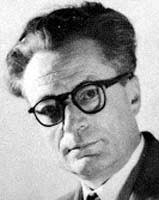
THE FRENCH professor Paul Rassinier (1906-1967) was one of the earliest scholars on what is known today as the Holocaust. What made Rassinier’s study invaluable was that he had been an inmate at Buchenwald himself and, as a Communist opposed to the Hitler government, his impartiality was not in doubt. He had no vested interest in defending the National Socialists.
In his book Did Six Million Really Die?, Richard Harwood describes Rassinier’s work for English-speaking readers:
Without doubt the most important contribution to a truthful study of the extermination question has been the work of French academic Paul Rassinier. The pre-eminent value of this work lies firstly in the fact that Rassinier actually experienced life in the German concentration camps and also that, as a Socialist intellectual and anti-Nazi, nobody could be less inclined to defend Hitler and National Socialism. Yet, for the sake of justice and historical truth, Rassinier spent the remainder of his post war years until his death in l966 pursuing research which utterly refuted the Myth of the Six Million and the legend of Nazi diabolism.
From 1933 until 1943, Rassinier was a teacher of history in the College d’Enseignement General at Belfort, Academie de Besancon. During the war he engaged in resistance activity until he was arrested by the Gestapo on October 30, 1943, and as a result was confined in the German concentration camps at Buchenwald and Dora until 1945. At Buchenwald, towards the end of the war, he contracted typhus, which so damaged his health that he could not resume his teaching. After the war, Rassinier was awarded the Medaille de la Resistance and the Reconnaisance Francaise, and was elected to the French Chamber of Deputies, from which he was ousted by the Communists in November 1946.
Rassinier then embarked on his great work, a systematic analysis of alleged German war atrocities, in particular the supposed “extermination” of the Jews. Not surprisingly, his writings are little known; they have rarely been translated from the French, although some of his writings appeared in English in 1978. His most important works are: Le Mensonge d ‘Ulysse (The Lies of Ulysses’, Paris, 1949), an investigation of concentration camp conditions based on his own experiences of them; and Ulysse ‘trahi par les Siens (1960), a sequel which further refuted the impostures of propagandists concerning German concentration camps. His monumental task was completed with two final volumes, Le Veritable Proce’s Eichmann (1962) and Le Drame des Juifs Europ’een (1964), in which Rassinier exposes the dishonest and reckless distortions concerning the fate of the Jews by a careful statistical analysis. The last work also examines the political and financial significance of the extermination legend and its exploitation by Israel and the Communist powers.
One of the many merits of Rassinier’s work is exploding the myth of unique German “wickedness” and he reveals with devastating force how historical truth has been obliterated in an impenetrable fog of partisan propaganda. His researches demonstrate conclusively that the fate of the Jews during World War Two, once freed from distortion and reduced to proper propertions; loses its much vaunted “enormity” and is seen to be only one act in a greater and much wider tragedy. In an extensive lecture tour in West Germany in the spring of 1960, Rassinier emphasised to his German audiences that it was high time for a rebirth of the truth regarding the extermination legend, and that the Germans themselves should begin it since the allegation remained a wholly unjustifiable blot on Germany in the eyes of the world.
THE IMPOSTURE OF ‘GAS CHAMBERS’
Rassinier entitled his first book The Lies of Ulysses in commemoration of the fact that travellers always return bearing tall stories, and until his death he investigated all the stories of extermination literature and attempted to trace their authors. He made short work of the extravagant claims about gas chambers at Buchenwald in David Rousset’s The Other Kingdom (New York, 1947); himself an inmate of Buchenwald, Rassinier proved that no such things ever existed there (Le Mensonge d’Ullysse, p. 209 ff). Rassinier also traced Abbe Jean-Paul Renard and asked him how he could possibly have testified in his book Chaines et Lumieres that gas chambers were in operation at Buchenwald. Renard replied that others had told him of their existence and hence he had been willing to pose as a witness of things that he had never seen (ibid, p. 209ff).
Rassinier also investigated Denise Dufournier’s Ravensbruck: The Women’s Camp of Death (London, 1948) and again found that the authoress had no other evidence for gas chambers there than the vague “rumours” which Charlotte Bormann stated were deliberately spread by communist political prisoners. Similar investigations were made of such books as Philip Friedman’s This was Auschwitz: The Story of a Murder Camp (N.Y., 1946) and Eugen Kogon’s The Theory and Practice of Hell (N.Y., 1950), and he found that none of these authors could produce an authentic eye witness of a gas chamber at Auschwitz, nor had they themselves actually seen one.
Rassinier mentions Kogon’s claim that a deceased former inmate, Janda Weiss, had said to Kogon alone that he had witnessed gas chambers at Auschwitz but of course, since this person was untraceable, Rassinier was unable to investigate the claim. He was able to interview Benedikt Kautsky, author of Teufel und Verdammte (‘Devil and the Damned’) who had alleged that millions of Jews were exterminated at Auschwitz. However, Kautsky only confirmed to Rassinier the confession in his book, namely that never at any time had he seen a gas chamber, and that he based his information on what others had “told him”.
The palm for extermination literature is awarded by Rassinier to Miklos Nyiszli’s Auschwitz: A Doctor’s Eye-Witness Account, in which the falsification of facts, the evident contradictions and shameless lies show that the author is speaking of places which it is obvious he has never seen (Le Drame des Juifs Europeen, p. 52). When Rassinier attempted to discover the identity of this strange “eye-witness” he was told that “he had died some time before the publication of the book.” Rassinier is convinced that he was never anything but a mythical figure.
Until his death in 1967, Rassinier regularly toured Europe in search of somebody who was an actual eye-witness of gas chamber exterminations in German concentration camps during World War Two, but he has never found even one such person. He discovered that not one of the authors of the many books charging that the Germans had exterminated millions of Jews had even seen a gas chamber built for such purposes, much less seen one in operation, nor could any of these authors produce a living authentic witness who had done so. Invariably, former prisoners such as Renard, Kautsky and Kogon based their statements not upon what they had actually seen, but upon what they “heard”, always from “reliable” sources, who by some chance are almost always dead and thus not in a position to confirm or deny their statements.
Certainly the most important fact to emerge from Rassinier’s studies, and of which there is now no doubt at all, is the utter imposture of “gas chambers”. Investigations carried out in the sites themselves have revealed that, contrary to the declarations of the surviving “witnesses” examined above, no gas chambers whatever existed in the German camps at Buchenwald, BergenBelsen, Ravensbruck, Dachau and Dora, or Mauthausen in Ausuia. This fact, which we noted earlier was attested to by Stephen Pinter of the U.S. War Office, has now been recognised and admitted officially by the Institute of Contemporary History at Munich. However, Rassinier points out that in spite of this, “witnesses” again declared at the Eichmann trial that they had seen prisoners at Bergen-Belsen setting out for the gas chambers.
So far as the eastern camps of Poland are concerned, Rassinier shows that the main evidence attesting to the existence of gas chambers at Treblinka, Chelmno, Belzec, Maidanek and Sobibor are the discredited memoranda of Kurt Gerstein referred to above. His original claim, it will be recalled, was that an absurd 40 million people had been exterminated during the war, while in his first signed memorandum he reduced the number to 25 million. Further reductions were made in his second memorandum. These documents continue to circulate in three different versions, one in German (distributed in schools) and two in French, none of which agree with each other. The German version featured as “evidence” at the Eichmann Trial in 1961. The Gerstein ‘Statement’ is reproduced in full as an Appendix to the most scholarly work to appear on this subject to date, The Hoax of the Twentieth Century by Dr A R Butz (Brighton, 1976).
Finally, Rassinier draws attention to an important admission by Dr. Kubovy, director of the World Centre of Contemporary Jewish Documentation at Tel-Aviv, made in La Terre Retrouv’ee, December 15th, 1960. Dr. Kubovy acknowledged that not a single order for extermination exists from Hitler, Himmler, Heydrich or Goering (Le Drame des Juifs europ’een, p. 31, 39).


