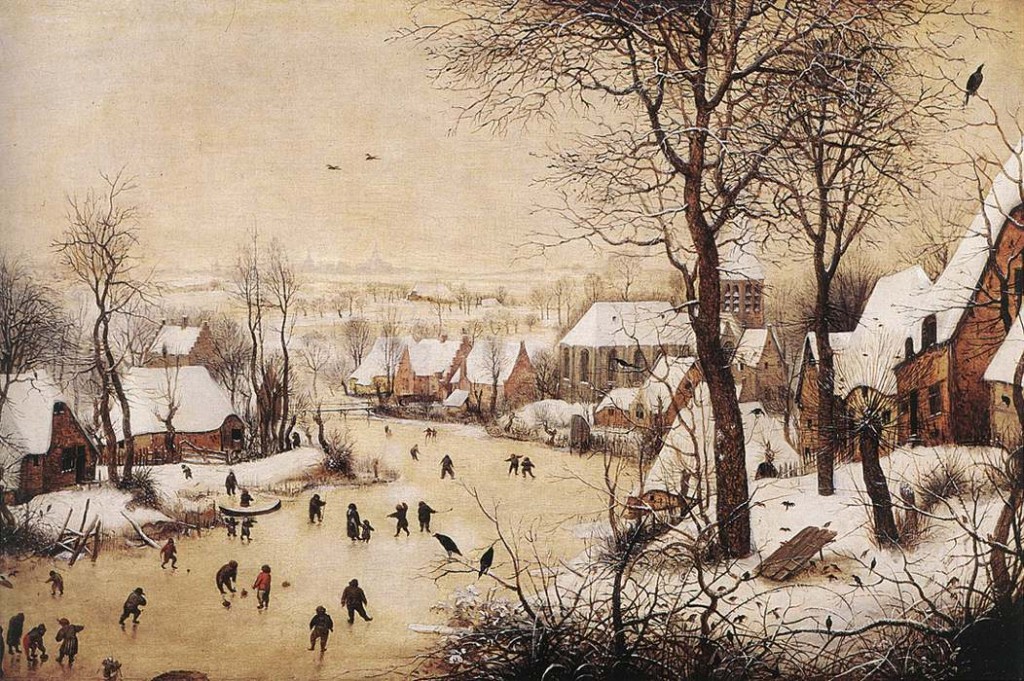
FEW PAINTERS have conveyed the muted beauty of a winter day as powerfully as Pieter Bruegel. In his Winter Landscape with Skaters and Bird Trap, painted in 1565, at a time when landscape paintings were rare, the frolicsome skaters are dwarfed by the whitened sky, trees and snowy bank, and yet it is as if nature is made for them. For Bruegel, winter is humane. It contains a muted holiness and joy.
Some of the Flemish painter’s scenes, such as Hunters in the Snow, are so often reproduced they are now difficult to see fresh. In 1949, Kenneth Clark wrote of Bruegel’s paintings:
Few works of art are less in need of commentary. They are like Handel’s Messiah and the Pilgrim’s Progress, amongst those very rare works of the first order which have a widespread, immediate appeal. His Hunters in the Snow has come to hold almost the same place in the popular imagination as was held by the madonnas of Guido Reni and Sassoferrato a hundred and fifty years ago, and in wintry weather people may be heard muttering the name of Breughel [sic] much as, in the eighteenth century, travelers invoked the name of Salvatore Rosa, and with a good deal more justice.
(more…)