
ALAN writes:
Several years ago I was talking with an acquaintance. She and I were close in age. She was a very pleasant woman, intelligent, articulate, was educated in Catholic schools, and had even earned a Ph.D. in American Literature. I made a cynical but mild remark about FDR’s “New Deal”. (What I said was far less biting than Dr. Revilo Oliver’s favorite characterization of FDR as “that loathsome creature in the White House”.) She was incredulous and said to me in reply, as if she thought I ought to know it, “Roosevelt saved the country.”
I did not agree, but I knew that what she said is what Americans are taught to accept in the official court history of those years.
I let the matter drop, for two reasons: Because she was such a good person and wonderful conversation partner, and because it was later than we thought. Unwelcome proof of that latter came on the day last year when I learned she died in her sleep at age 77. Very seldom did we disagree. We shared 70+ years of happy memories. So now I missed the sparkle and zest in the conversations we shared for more than six years in the twilight of her life and mine.
But what she said –“Roosevelt saved the country” –was (and is) the frame of mind held by most Americans. And that brings me to this:
How many readers of The Thinking Housewife would recognize the name Sterling E. Edmunds?
I thought so. I have never seen his name mentioned by any Conservative or Paleoconservative or Traditionalist writers or bloggers.
Sterling Edmunds was a newspaper reporter, editor, attorney, and law professor in St. Louis, with a particular interest in Constitutional law. He lived from 1880 to 1944. He was described as “a man who has won a host of friends because of his gentlemanly behavior”.
Like Albert Jay Nock and Garet Garrett, Mr. Edmunds was not thrilled at the prospect of expansionist, do-gooder government. He opposed it and said so often. FDR’s “New Deal” did not fill him with glee.
A progressive woman Democrat said in 1936 that he “has become to women’s groups the symbol of obstruction to progressive legislation.” (“Democratic Woman Leader Assails Sterling Edmunds”, St. Louis Post- Dispatch, July 30, 1936)
She was so-o-o-o right. Mr. Edmunds would not go along to get along. That made him a “disgruntled reactionary”, she said. Today, in addition to that, he would be called a Deplorable, a Fascist, a Nazi, a Racist, and a Xenophobe — clearly, a man after my own heart. Standard Communist agit-prop.
In 1899, he wrote about graft that flourished under city government in St. Louis. To punish him for writing the truth, three men assaulted him in a corridor in City Hall, doubtless members in good standing of the local political machine. He said he would like to have them arrested and charged, but he knew “it would be impossible to secure a conviction in the city courts…” — a keen assessment of justice in St. Louis that could have been written yesterday. (“Struck a Newspaper Man”, St. Louis Post-Dispatch, Nov. 16, 1899)
Writing in 1975, Pat Buchanan said that federal bureaucrats are “like an army of locusts…”. Mr. Edmunds thought and said the same thing forty years earlier: “Growth of Federal Power Attacked by Sterling E. Edmunds”, the St. Louis Globe-Democrat reported on May 28, 1933. In a nationwide radio address, he spoke about the threat to Americans’ rights and liberty posed by the multiplication of government boards, bureaus, and agencies — all of them claiming they wanted only to Do Good, of course.
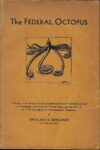
In his book The Federal Octopus (1932), he argued that civil and economic liberty was being eroded by “the rise of an all-embracing federal bureaucratic despotism” and “administrative bureaus that have embedded themselves in our federal system like malignant tumors…”. (St. Louis Globe-Democrat, April 27, 1932, p. 2A)
In the early 1900s, groups of zealous women agitated for giving the federal government power over parents, children, and families in such contrivances as the “Children’s Bureau”. Mr. Edmunds wrote about that at length in his book The Roosevelt Coup D’Etat of 1933-1940 (privately published, 1940; 125 pages, index). Progressives, Feminists, Communists, and Socialists took turns agitating for Big Government and Welfare Government. One of their leaders was Florence Kelley, a woman who exchanged sympathetic letters with Friedrich Engels in the 1880s. (You remember him…The Communist Manifesto of 1848…?) She was an exponent of Marxist Socialism. (pp. 38-39). She was influential in at least a dozen groups of women, including the Inter-Collegiate Socialist League, the American Association of University Women, and the National Council of Jewish Women.
Another woman deeply involved in that project was Anna Louise Strong, “a prolific writer of propaganda”. In 1919, she took part in a conspiracy to Sovietize the city of Seattle. (p. 49) In 1932, she married a Communist fellow worker. She lectured at many women’s colleges.
In its issue of May 11, 1912, The Woman’s Journal said, “We shall not be willing to let the establishment of the Children’s Bureau mean simply investigation–it must mean power to change things.” Decoded, what they meant was the power to change people….meaning especially those who balked at having bureaucratic, administrative, Socialist Government shoved down their throat and into their homes.
Yet another woman, a Communist associate of Lenin and Trotsky, made a pacifist lecture tour of the U.S. in 1916. A year later, she was back in Russia and “became Lenin’s first Commissar of Social Welfare, charged with the segregation of children from their parents…and the destruction of the institution of the family….” (p. 52)
Exactly how did that work? An assistant U.S. military attache described it thus:
“….If you want to visit your children…you will get a permit, because the children are not really yours at all… The younger generation….is systematically herded into freight cars and sent away from 800 to 1000 miles to completely isolated institutions, where they are trained in principles of Communism. ….the Soviet carefully destroys all records of birth and relationship…to completely isolate every child in Russia from all human ties, except those relations advocated by bolshevism.”. (p. 53)
Wasn’t that a swell idea? Want to visit your children? Easy: Genuflect and ask permission from your Communist Government.
Chapter IV is entitled “The Plan for Government Control in the Rearing of American Youth”.
“The determination of those at the head of the federal government to take the entire youth of the country….and to make guinea pigs of them in ‘Social experimentation’, is one of the strangest spectacles in our constitutional history…”, he wrote (p. 84).
Regarding a proposed “child labor amendment” in 1933, he wrote: “That this … amendment was drafted and introduced in Congress with the previous knowledge and encouragement of Russian communists was plainly attested by U.S. Senator William H. King in the Senate on May 31, 1924. He affirmed that while in Moscow eight months previously, a Communist educator had informed him that such an amendment was being prepared, gave him the names of its sponsors and asserted that it would be ratified; and that under it the Federal government would enter upon the same policy of colonizing children that the Soviet government had adopted….”. (Sterling E. Edmunds, Letter to the Editor, St. Louis Globe-Democrat, Dec. 5, 1933, p. 4A)
Remember also that the 1920s-’30s were years of militant agitation in favor of the Bolsheviks and the Great Russian Paradise. The Fabians played a role in that propaganda blitzkrieg, as did American Communist William Z. Foster, whose book Toward Soviet America was published in 1932.
In 1936 Mr. Edmunds got together with like-minded men and formed a group they named “The Jeffersonians”, inspired by Thomas Jefferson’s preference for small, local government as against powerful central government. Their goal was to oppose the “New Deal” and get FDR out of the White House. Of course they failed, but they had the right ideas.
And what would Mr. Edmunds think about modern suicidal policies like “open borders” and “inclusion”?
This was his judgment: American law, he wrote, was enacted for Americans — not “as a mantle of immunity for hostile aliens, flocking to our shores from all corners of the earth, to assault and, if possible, to destroy our institutions. The alien possesses no legal right to admission into this country….” (“No Room in This Country for Aliens Seeking to Force New Form of Government on Us”, St. Louis Post-Dispatch, Feb. 6, 1919)
Isn’t that terrible?! Isn’t that so exclusionary instead of inclusive…?!
The Roosevelt Coup D’Etat seems to be a little-known book. For several decades, I attended many book fairs and browsed among thousands of old books in many bookshops, but I never saw a copy. Perhaps in the 1940s, Roosevelt’s Fan Club — and that included Feminists, Progressives, Fabians, Communists, and social workers — dispatched members to go around seizing and destroying as many copies as they could find. (A far-fetched idea, you say? Think again: In 1918, the American Secretary of War made a list of 47 books that were to be removed from the libraries provided for American soldiers and sequestered or destroyed. “Books that gave reasonable accounts of the war in Europe (i.e., World War I) or were written in German were sequestered or destroyed in public libraries, and Federal thugs raided the offices of many publishers and destroyed the stocks of books that dissented from the government’s official lies….”. Thus wrote Dr. Revilo Oliver in a review of historian James J. Martin’s book An American Adventure in Bookburning (1988). (“The Beginning of the Present”, Liberty Bell magazine, Oct. 1989. See also Martin’s article in the Summer 1990 issue of The Journal of Historical Review.)
(Was the same done to Mr. Edmunds’ book The Roosevelt Coup D’Etat? I don’t know. But we do know that he dissented vigorously from Roosevelt’s Washington Party Line — and that 1918 proves there was a precedent for making books disappear.)
Fortunately for us, the book can still be read in a PDF online. The copy I read was buried deep in the Stacks of the St. Louis Public Library, where we can be sure it will remain unseen, unread, and unknown until some obedient apparatchik employee discovers that it has not been checked out within the last five years and should therefore be withdrawn from the library and sent to oblivion.
It is comparatively dry reading but a richly-detailed account of how Roosevelt’s expansionist, do-gooder government was sold to the American people with the aid of so many women’s groups who were militant in their advocacy of paternalistic government. I recommend the book highly for anyone seeking to understand the origins of the Federal Octopus to which Americans over the past nine decades have surrendered so much of their liberty and so many of their rights and in whose tentacles they are now so deeply ensnarled.
— Comments —
Kathy G. writes:
My mother was very much like Alan’s friend and fan of FDR. She used to say the same thing, that FDR “saved the country”, shocked that I didn’t know this, as if it were self-evident. I never understood World War 2 or Roosevelt’s affinity for “Uncle Joe” Stalin, and the allies handing so much of Eastern Europe over to the Soviets, only to be in a “cold war” with them 15 years later. Having been dutifully public skooled, I simply assumed I was too stupid to understand the history, and should simply listen to the “experts” in the media to explain and government experts to decide policy. As usually happens, with age comes “noticing”, pattern recognition, and wondering.
About 25 years ago I read Garet Garrett’s “The People’s Pottage”, and got another view of FDR. Then history began to make sense. Men like Garett, Revilo, Nock, Joe Sobran, the Old Right, the sane voices against communism, were basically outcast, “de-platformed” from the media, and conservatism became redefined by W.F. Buckley, a CIA asset, into the enabling wing of the American Uniparty.
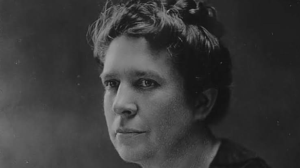
We live in a times of massive deceptions, and the “feminist” movement appears to be largely promoted by extremely masculine women, such as Florence Kelley (above). This is advantageous in many ways. People are less likely to become aggressive against someone they think is a woman, they would believe the concern for the children coming from a woman, it divides male and female, and she is more likely to be viewed as harmless and silly, not a threat. A charismatic masculine Judas goat posing as a woman would influence actual women, even subconsciously.
I’m afraid that Federal octopus is simply a socialist communist bureaucracy, and the masonic-jewish cabal have decided that America, founded by freemasonry to be the enforcer for them for world rule, can be openly sold off and dismantled, leaving Christian whites dispossessed, erased, and ultimately slaughtered.
The good part is that if we are actually in Satan’s little time of unbinding as the level of inversion in the world, signs of the times, suggests, the end may be near.


