
FROM Is Christianity Bankrupt? (1954) by Adrien Arcand:
All the cultures and all the civilizations which preceded Christianity are distinguished (but for extremely rare individual exceptions contradicting their time) by a theological constancy which contrasts with the luxuriant theological explosion of Christianity. Indeed, from all known antiquity until the arrival of Christ, philosophical and theological contemplation has dealt with only one domain: that of the substance and the essence of the divinity and of created things. This is the static period of the human mind, the era of still contemplation, of purely analytical mysticism. Substance and essence seem to be the only final fields of exploration.
Also, all other speculations of the human mind are affected, both scientifically and artistically. Mathematics, geometry, astronomy, physics, “chemistry”, physiology, are like inert things. Architecture is motionless. The plastic and pictorial arts, if they achieve extreme fidelity, are without inner expression. History and tragedy appear like frozen images from a stereoscope. All antiquity lived only its present, rarely emanating faint glimmers of the possibilities of the future, not even concerned with it.
Like a thunderclap on the human spirit, Christianity launches souls and hearts into an awakening and onto a path of true revolution. If St. John the Evangelist,” the Mild, gives a definitive solution to the problem of substance and essence with his “In principio erat Verbum’”,*’ St. Paul the violent ** penetrates beyond substance and catapults the human mind into the problem of the movement of energy, of divine dynamics. He puts an end to the long pre-Christian era of spiritual stasis, of this “inertia of the present”, of “passive waiting”, of the “contemplation of the promise realizable at any time”, to plunge into the torrential waters of the “realization begun that must be proclaimed”.
The essentially Christian notion of sanctifying grace, or sharing in divine life, creates an entirely new spiritual vision while producing a sensation of inner life never before experienced. The human soul is no longer contained, fixed and immobile, in a simple vision of bliss or nirvana, but propelled to impetuous movement of hectic life whose dynamism has no bounds.
Fifteen centuries of this spiritual activity, which eventually permeated the whole of the West, was bound to produce a parallel action in the observation of the material world. While it is true that man is in the image of God, it could also be true that the laws of nature are an image of other laws operating in the supernatural world.
This assumption, conscious or subconscious, emanating from Christianity, is the foundation of the whole scientific current, the movement-energy-dynamic of the modern world, which would never have come about without Christianity. Again, the notion of the extraordinary energies of grace, the phenomena of spiritual telepathy, telecommunications and television, were they not experienced by man before the invention™ of their physical counterparts?
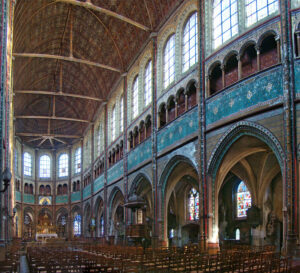
With Christianity, everything becomes alive, mobile and dynamic. Old mathematics awakes from its sleep and comes to life in formulas antiquity could never have suspected. The primitivity of astronomy is propelled into complex and dazzling developments; geometry is set in motion, mechanics captures and controls living forces; chemistry runs from secret to secret. The science of man, become almost alive through man who at last can have true life, generates other sciences, techniques give birth to new techniques, until we arrive at the vision of pure energy behind whose Seal only God can be found. In the arts, the same intensity, the same effervescence of the soul set free. The long nose cone, tapering toward the horizon, imitates momentum to infinity, imparting to the masses of stone a movement hitherto unknown.
Music soars to unheard-of heights and, with the uniquely Christian fugue, accesses an elusive fluidity. The Christian conception of justice creates a common law and a jurisprudence of incomparable beauty. Painting and sculpture are no longer content simply to reproduce the exterior aspect with fidelity; the soul, and interior pathos, are torn open and revealed. All the splendor of living philosophy takes shape in the unshakeable Scholasticism that all subsequent oppositions will never be able to even chip away at. Then, as an apotheosis of human genius bathing with joyful exaltation in the light of God, the sum of Catholic theology and its sumptuous commentaries answers all questions, calms all doubts, annihilates all objections. And all this because the Western world, thanks to Christianity, can live the new life of humanity by sharing in the life of Him who conquered death.


