
ALAN writes:
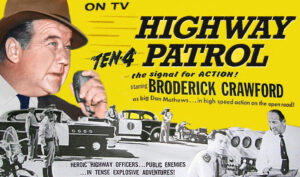
It must have been in 1955 or ’56 when my mother permitted me to stay up long enough to watch a TV police drama that was telecast in St. Louis at 9 or 9:30 p.m. She would likely have watched it anyway, even aside from my enthusiasm for it. It was a syndicated program called Highway Patrol. It featured tough-guy movie actor Broderick Crawford as the hero, Captain Dan Mathews. I was six to seven years old. Something in the program inspired my respect. I looked forward to it every week. But of course at that age, I could not articulate why it impressed me.
Now, seventy years later, it is perfectly clear. In recent months, I have watched dozens of episodes of Highway Patrol. The essence of that program lay in its moral-philosophical frame of mind. The stories were well-written and tightly edited. They were about good and evil. They embodied a code of moral standards that were shared by nearly all Americans in those years. There was no moral ambiguity or uncertainty in those episodes. The job of the Highway Patrol was to defend the lives, property, and rights of law-abiding citizens.
I was in the early years of parochial school when Highway Patrol inspired my respect. I enjoyed watching it and two other syndicated programs in those years — Rescue 8 and Sea Hunt — because they showed confident men doing heroic things to uphold a fixed code of moral-philosophical-cultural standards.
Uppermost in the stories presented in Highway Patrol were gravitas, masculine authority, and moral certitude. Try to find any trace of those in what are absurdly called law enforcement agencies today or in today’s “entertainment” in which feminized boy-men accommodate every excuse, fairy tale, or sob story concocted by criminals and their apologists.
Precisely those things are conspicuous by their absence in the frame of mind depicted in Highway Patrol. Officers did not apologize for doing their job, apprehending lawbreakers, tricking them, or shooting them or killing them in self-defense. They did not make deals with criminals. Enforcement of laws was not up for negotiation. There was no mush for people who broke the law. Officers did not take pains to avoid hurting their “feelings”.
The moral-philosophical high point of each episode was when Capt. Mathews had the criminals firmly in custody or dead. He had integrity. He was dead serious about doing his job right. He never spoke a word or made a gesture in sympathy toward lawbreakers. The idea of compromise between good and evil did not exist in those scripts or in the frame of mind and vocabulary spoken by him and his officers.
The stories did not accommodate taking orders from distant government agencies, or concern for the “rights” of lawbreakers, or concern about “officer-involved shootings”, or politically-correct language. Nearly all episodes involved crimes perpetrated by whites against whites.
But even episodes as morally-philosophically sound as those in Highway Patrol occasionally made a concession to the excuse-making and excuse-validating industries, as when a victim of attempted arson asks Mathews why arsonists do what they do, in reply to which he says he doesn’t know, but maybe a doctor could tell them. A remark like that crosses the line between morality and (pseudo)science. Such a tactic was rare in Highway Patrol but would become commonplace in police dramas in the 1960s and is now standard in all police dramas and, even worse, throughout the law, the courts, and all government. Of course “doctors” and “scientists” could not then and cannot now tell us anything about why lawbreakers and rule-breakers do what they do. The presumption that they could is nonsense. The answers to that lie in ethics, philosophy, and religion, not medicine or science. Nor is that the only mistake. The proper function of government and the law is not to “understand” why people break laws but to hold them accountable and punish them when they do. That they do such things is the only proper concern of the law, not why they do them.
It is a standard complaint of modern “Liberals” that old television shows and movies were not “realistic”. Highway Patrol gives the lie to that claim. Episodes were realistic indeed because they showed the contemptible things lawbreakers enjoyed doing in those years and are doing today even more brazenly and with all the confidence they enjoy because of what “Liberals” and Feminists have done to weaken law enforcement in the years since that program was telecast. The officers in Highway Patrol spoke in plain words whose meaning was clear to everyone. That was realistic. What is not realistic is to speak in weasel words in order not to hurt the feelings of criminals, parasites, opportunists, agitators, and liars. Today in St. Louis, the police and TV stations avoid plain words in favor of weasel words. They excel in concealing the truth about crime in St. Louis while claiming to report it. All of them lie by omission.
As novelist Taylor Caldwell wrote in her book On Growing Up Tough (Devin-Adair, 1972), American men in the 1950s were still proud of being men. Only a massive cultural and moral-philosophical revolution could weaken their masculine authority and confidence. When that revolution was intensified and when those men agreed to accommodate it instead of resist it, they would live, work, think, and speak henceforth within “the soft pink jello” (p. 98) that was being engineered for them (and for all of us) by “Liberals”, Feminists, Leftists, anarchists, and the architects of soft, lenient, apologetic, “compassionate” law enforcement policies typified by the law’s suicidal “partnership” with organized fakery called “behavioral science”.
Highway Patrol presents a moral-philosophical model for what law enforcement could be and ought to be — and was, before American men agreed to immerse themselves in that soft pink jello. The irony is that it was shown on television during the same years when the Warren Court and other “Liberal” groups were engaged in concerted efforts (a) to weaken law enforcement standards nationwide, (b) to promote sympathy and “understanding” for criminals, and (c) to expand the power and scope of government, in the name of doing good, of course.
Broderick Crawford was proud of his role in Highway Patrol, a role that enabled him to portray a character on the right side of the law for a change from many of his previous roles as a villain.
Gary Goltz is six years younger than me. When he was a boy growing up in Pittsburgh, he enjoyed watching reruns of Highway Patrol with his Russian Jewish immigrant grandmother. He remembered how she so admired the masculine authority and heroism of Broderick Crawford’s character and that of his officers. Having lived in Communist Russia, she probably saw examples of tyranny and anarchy and was therefore so gratified to see an American TV program in which policemen act to defend the rights and lives of law-abiding citizens, not attack them. Many years later, Mr. Goltz created an extensive archive of information about that program (highwaypatroltv.com). And he said he owed much of his high esteem for that program to his grandmother’s enjoyment of seeing the good triumph over the evil in every episode. In my case, I owed it to my mother, who so admired the unapologetic enforcement of rules and laws.


