
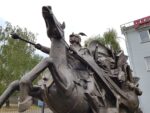
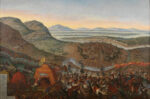
ON THIS day in 1683, the Ottoman Empire’s centuries-long efforts to conquer Europe were decisively and permanently defeated in the Battle of Vienna. The combined forcs of the Holy Roman Empire and the Polish-Lithuanian Commonwealth under the command of the Polish King Jan III Sobieski changed the course of history, a fact often forgotten when the survival of Europe for so long is taken for granted or even regretted. In 2024, the city of Vienna rejected a proposal for a statue in honor of Sobieski on the ground that it would be “Islamophobic.”
Before the battle almost 60,000 men, women and children were taken into slavery in the village of Perchtoldsdorf outside Vienna when it was captured by the Turks as preparations for the final siege of the city were underway. The villagers were among the hundreds of thousands — more than 1.25 million in all, according to historian Robert Davis — of Europeans who ended up as slaves in the East. The residents of Perchtoldsdorf, thousands of whom were killed, had surrendered after being promised their lives and safety.
Capturing the city of Vienna had long been a strategic aspiration of the Ottoman Empire, due to the control the city had over the Danube and the overland trade routes to Germany and the Eastern Mediterranean. During the years preceding the siege, the Ottoman Empire, under the auspices of the Grand Vizier Kara Mustafa Pasha, undertook extensive logistical preparations, including the repair and establishment of roads and bridges leading into the Holy Roman Empire and its logistical centers, as well as the forwarding of ammunition, cannons, and other resources from all over the Empire to these centers and into the Balkans. The Siege of Szigetvár in 1566 blocked the advance of Sultan Suleiman the Magnificent towards Vienna and stopped the Ottoman advance towards Vienna that year. Vienna was not threatened again until 1683. In 1679 plague had been raging in Vienna. (Source)
Protestants in league against the Holy Roman Empire would join with the Turks to undermine their common enemy.
In the final battle, despite their greater numbers, the Ottomans would lose about half of their force (estimated to be 120,000 at the start of the siege) to death and desertion, leading to humiliating defeat on the evening of September 12.
Today’s Feast of the Holy Name of Mary was instituted in gratitude for a victory attributed to divine intercession.
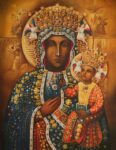
Since Sobieski had entrusted his kingdom to the protection of the Blessed Virgin (Our Lady of Częstochowa) before the battle, Pope Innocent XI commemorated his victory by extending the feast of the Holy Name of Mary, which until then had been celebrated solely in Spain and the Kingdom of Naples, to the entire Church… (Source)
If thou follow her, thou wilt never go astray. If thou pray to her, thou wilt never have need to despair. If thou keep her in mind, thou wilt never wander. If she hold thee, thou wilt never fall. If she lead thee, thou wilt never be weary. If she help thee, thou wilt reach home safe at the last and so thou wilt prove in thyself how meetly it is said And the virgin’s name was Mary.
Thanks for visiting!


