
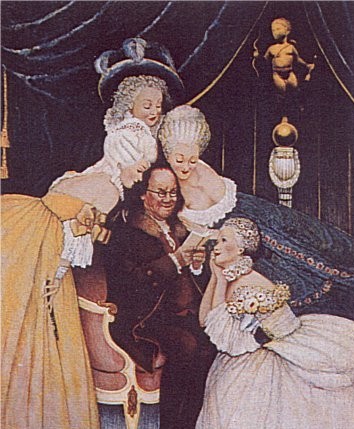
“MADAME Helvetius had seen the whole world pass in review before her in her salon, she knew all the peculiarities of her century, she had love for every one she met, except for women who were always her pet aversion, and she thought there was no more novelty in life left for her. But she had not counted on Franklin. The novelty of this man, who was so serious and ironic, so rustic and exquisite, so reserved and so audacious, was unbelievably delightful. She was mad about Franklin and showed her fondness for him in a hundred ways. When he entered the room she would hold out her slender hand to be kissed, indicate the most comfortable armchair to sit in, and then she would flatter and tease him. If he stayed to luncheon she would gorge him with that thick whipped cream Abbe Morellet liked so much. She had moles and wrinkles and didn’t wash her face every day; her salon with all the dogs and cats was more like a stable than anything else; and she had such little regard for her furniture that she let the abbes drive nails into the chairs to make experiments. She was constantly kissing her favorite little dog, Poupou, whether Poupou merited kissing or not, and she kissed Franklin almost as often, not only on the cheek but on his forehead too. She would press his hands as she did so, or put her arm around his neck, and then, when she was tired, she would indolently lie on the sofa, and with the hem of her petticoat negligently wipe up the traces of Poupou.
“Although she had the manners of a peasant she kept the air of a queen. And queens are always young, especially to gallants of eighty years. Franklin loved her and wrote one little story after another for her amusement. It was so lovely to visit ‘Our Lady of Auteuil’, to hear her ‘little stars’ of girls sing, to be chided and petted by her. For Madame Helvetius had a strong, clearly marked character, a precise brain and sharp wit, and a robust body. When he was near her, he felt like a little boy, who is always protected even when he is whipped, and his need of affection made itself felt once more. This clever energetic woman reminded him of his good Debby, who had also been so energetic and so agreeable in her rusticity.
“He dreamed of Madame Helvetius so much that one fine day he proposed to her (178o). She was overwhelmed and weakly leaned against the mantlepiece, unable at first to answer. She almost knocked over the little plaster model of Helvetius’ tomb — a woman weeping over a funeral urn — and taking it in her hands she mutely showed it to Franklin in sweet reproach. He was wise enough not to accept this as a refusal, and after vainly insisting for another answer, he took his leave, and they bade each other farewell with more than usual tenderness. During the feverish night that followed he wrote a charming apology: his ‘Descent to Hell.’ According to the tale, he met with Helvetius, who was glad to see him in the infernal place, and happy at being married again on the other side of the tomb. But his wife was no other than the late Mrs. Franklin, and when Franklin had reproached her gently, she answered with a flash of her old spirit: ‘I was your wife for almost half a century; be content with that.’ Then came the moral, or rather the conclusion to Franklin’s fable: ‘Here I am. Let us have our revenge!’
“The heart of Madame Helvetius, which should have been calm after all these years, suddenly beat with delicious violence. Such a great force seemed to push her to Franklin. The next day, however, she left in her coach for the same place she visited every day, though she alighted more dreamily than was her wont. Then she climbed the stairs of her old friend’s house slowly, in a tender reverie. She told Monsieur Turgot of Franklin’s proposal, how surprised she had been, and of all her trouble and hesitation. Her old friend leapt up in consternation. This fine marriage of a gallant of eighty with a shepherdess of sixty-five seemed like a caprice of second childhood to him. Madame Helvetius was almost shocked at his intense opposition, but she blushed when he warned her of the consequences. He told her she should do as she liked, but that if she did marry Franklin she was certain to lose her salon. Madame Helvetius left, still somewhat troubled, and took a long ride in her coach. When she had returned in the evening she was calm and decided: she never could do without her friends. Franklin could talk of love as much as he wanted and she would always answer with a gentle smile— and give him an extra helping of whipped cream.
“But, at length, too much whipped cream became tiresome. France had roused all of Franklin’s ardor, it had developed tastes in him that he had never known he possessed, and he was eager to satisfy them. He was eighty when he finally met the woman who was not only to give him the most love, but the most tender love.”
To be continued.
Bernard Fay, Franklin: The Apostle Of Modern Times (pp. 663-664); Kindle Edition


