
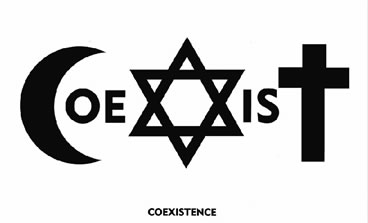
FROM “Indifferentism, the Heresy that All Religions are Equal” by Rev. Bertrand L. Conway, C.S.P, 1929:
Is not one religion as good as another? Are not creeds in themselves unimportant, and conduct the one thing essential? Do we not frequently meet men who believe in Christ and all His teachings, and yet day by day do things that would bring a blush to a pagan’s cheek?
One of the most common heresies outside the Catholic Church in our day and country is the heresy of indifferentism. [Ed.: Conway is not speaking here of the Vatican II Church, which is inherently indifferentist and promotes this heresy everyday and everywhere.] The indifferentist will speak patronizingly of religion as a police force to keep the discontented in check, or as an outlet for the emotions of pious sentimentalists. He will praise all religions for the virtuous men they have produced; he will maintain that intelligence and good breeding alike call for a kindly toleration towards all creeds, and churches; he will vehemently denounce the Catholic Church as bigoted, intolerant and autocratic, because she claims obedience under sin as the infallible mouthpiece of a divine revelation. There are many roads, he informs you, leading to the kingdom of heaven, and an honest man may travel any one of them with the conviction that he is pleasing God.
You meet the indifferentist everywhere. In educational matters he is a secularist, who marvels greatly at the determined effort made by Catholics to educate their children in separate Catholic schools; in politics he wants the State to ignore religion entirely, and becomes indignant when Church and State work together for the common good; in social questions he advocates many principles subversive of Christian morality, and tells the Church to keep her hands off such questions as divorce, birth control, labor problems and such like issues. In religion he believes that all creeds are equally true and equally helpful–perhaps, down in his heart equally false–and that their acceptance or rejection is as unimportant as the cut of a man’s clothes or the customs of his peculiar nationality.
The Catholic Church condemns in most unequivocal terms this modern heresy of indifferentism. She asserts that it is the most subtle enemy of religion, harder to combat successfully than the most bitter prejudice and bigotry. A man who hates the Catholic Church because he thinks she stands for everything unintelligent, ignoble and autocratic, may be led to love her, once he learns that he has been misled by the parents he loves and the teachers he respects. A good hater like St. Paul, who, as he says himself, acted “ignorantly and in unbelief,” became, after his conversion, one of the greatest lovers of Jesus Christ. But an indifferentist, who declares God indifferent to truth simply because he himself is indifferent, and who glories in a self-made religion free of all obligation and restraint, is hardly apt to consider the claims of a divine, infallible teaching Church, which requires absolute faith in all the revelation of God, and enforces her divine doctrine and law under penalty of sin.
Is it not strange, however, that the very man who worries night and day over his business troubles, and who sacrifices health and comfort in his pursuit of money, political preferment, or the interests of science, should at the same time be utterly indifferent to the truth of God? “Seek ye first the kingdom of God,” said Jesus Christ (Matt. vi. 33). “What doth it profit a man if he gain the whole world and suffer the loss of his own soul? Or what exchange shall a man give for his soul?” (Matt. xvi. 26.)


