
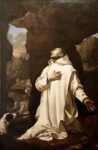
“While the world changes, the cross stands firm.”
—- St. Bruno, (1101 A.D.) founder of the Carthusian Order of Monks
The Monastery of the Grande Chartreuse
by a Carthusian monk, 1893
“Most Catholics are aware that a Carthusian monastery consists of a number of little houses all grouped together, and that each monk has a little establishment of his own. He has a bed-room, a study, and an eating-room, all as bare and plain as can be. The eating-room was also originally a kitchen, but it was found that so much time was taken from prayer and study by the duties of cookery, that a common kitchen supplied the meals of all by means of a little sort of turn about, where the monk finds his meals at stated hours. He has also a work-room for manual labour, and a little garden of his own. There is no denying that the life is a very trying one: the perpetual silence, the monotony, the abstinence from all fleshmeat, the long night Offices, render it impossible to all save those who have from God the privilege of a Carthusian vocation. But it is a very happy life to the faithful son of St. Bruno, and what is more, a very healthy one ; the average longevity is far in excess of the world outside. The Carthusians have had centenarians not a few, and the general health is remarkably good. The law respecting flesh-meat is an absolute one; not even to save his life, or under most urgent medical advice, is a Carthusian allowed to let it pass his lips.
“The spirit of the Carthusian Order consists in the cultivation of solitude and contemplation, not of meditation strictly so called, but rather of contemplation on the ground that praise is better than prayer. The solitude is the means of which the end is to draw near to God by means of contemplation. God Himself, writes Dom Masson, is essentially alone, alone by His nature, alone in His operations, alone in His sovereign rule. The Carthusian thus finds in the Godhead the model of the solitude that St. Bruno put in practice.
“In the Life of our Lord the model is again reproduced. He chose solitude as the fit place for prayer and contemplation. Above all [writes Dom Guigo] Jesus Christ, our God and Saviour, who needed not the help of solitude for His sanctification, nor had any reason to fear obstacles thereto in the life of the world, chose to be tempted in the desert for our example. Scripture, moreover, relates how He would pray alone upon a mountain top, and how, when the time of His Passion was at hand, He withdrew from His disciples to pray alone, thus teaching us how favorable solitude is to prayer, since He would not pray in the company even of His Apostles. Nor can we pass over in silence a mystery worthy of our deepest consideration, which is that our Lord and Savior has vouchsafed to give us, in His own person, a glorious and living model of the Carthusian calling; when, alone in the wilderness, He gave Himself up to prayer and the exercises of the interior life, mortifying His body also, by fasting, watching, and penance.”


