
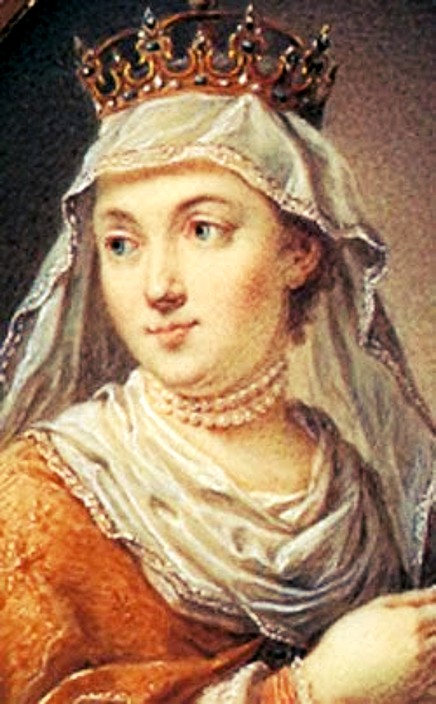
THE liturgical calendar brings us today another great heroine of Western civilization, Saint Hedwig of Silesia, now modern Poland.
Married at the age of 12, she bore six children in rapid succession before she and her spouse, Henry, Duke of Silesia, took vows of continence. Henry was wounded in battle and imprisoned. He became ill not long after his release and died despite her devoted care. Her eldest son was also killed in battle.
As Dom Gueranger wrote:
The Mongols were already inundating Silesia, when, in the plains of Liegnitz, they found themselves confronted by an army of thirty thousand warriors, headed by the Duke of Silesia, Heinrich the Pious. The encounter was terrible; the victory remained long undecided, until at length, by the odious treason of some Ruthenian princes, it turned in favor of the barbarians. Duke Heinrich and the flower of the Polish knighthood were left dead upon the battlefield (April 8, 1241). But their defeat was equal to a victory. The Mongols retired exhausted, for they had measured their strength with the soldiers of the Latin Christianity.
It is Poland’s happy lot, that at each decisive epoch in its history a Saint appears to point out the road to the attainment of its glorious destiny. Over the battlefield of Liegnitz shines the gentle figure of St. Hedwig, mother of Duke Heinrich the Pious. She had retired, in her widowhood, into the Cistercian monastery of Trebnitz founded by herself. Three years before the coming of the barbarians, she had had a revelation touching the future fate of her son. She offered her sacrifice in silence; and far from discouraging the young Duke, she was the first to animate him to resistance.
She gave herself, after raising her children, to prayer and caring for the sick and poor.
Among her maxims was this: “The greater one is by birth, the greater one must be in virtue, and the more distinguished we are in station, the more we must distinguish ourselves by our conduct, in order to be a bright example to others.” Source
By the miracles attributed to her intercession and her inspiring example, St. Hedwig, contrary to the feminist scheme of history and its disdain for spiritual values, was, and is, one of the most powerful women in history.
Thanks for visiting!


