The Feminine Mystique

Comments Off on The Feminine Mystique
February 26, 2010

ALL SELF-HELP advice is not “psycho-porn.” There is decent counsel to be had in this sad world. You just won’t likely find it on the bestseller list or in a therapist’s office.
For women seeking to live and love as neither the playthings of their own emotions or of men, there is one excellent source of advice, the blog What Women Never Hear, the work of an unnamed elderly gentleman who is a former naval officer and university professor. None of the Elizabeth Gilberts or Lori Gottliebs writing today offer the truths to be found in this man’s tips and insights on courtship, love and marriage. His writings include the input of his wife of 55 years.

Sarah Palin isn’t against big government. She isn’t anti-abortion in any politically meaningful sense. She isn’t a foe of feminist entitlement. And she isn’t very bright. What is she? In the words of Newark Star-Ledger columnist Paul Mulshine, Palin “is not so much a political figure as a sort of national fertility symbol.”

Christ was not tempted in the towns or among the multitudes. During His forty days in the inhospitable void, He allowed himself to be approached. This was no accident. When individuals separate themselves from others, physically or intellectually, they encounter temptation. Satan despises those in the desert. He loathes the emptiness of contemplation. He hates it when we set off on our own.
Gail Aggen writes:
I was fascinated by the commenter Jake Jacobsen who relayed his experiences working in professional kitchens. From the way he described it, these kitchens are no place for the faint of heart or delicate of constitution. I had not put that together in my mind when wondering why there were so few women chefs. But now that I think back on my own experiences waitressing as a young woman, I cannot remember any kitchen staff being female, including those who wash dishes. (more…)
THE DEMOCRATS could have their health care reform. They could summon the votes if they abandoned the hope of government-funded abortion. Why don't they concede on an issue ancillary to the goal of nationalized medicine? On the Stupak amendment, Lawrence Auster writes: It's fascinating that the campaign to nationalize health care, which Stupak otherwise supports, is crashing in a heap because most of the liberals who demand the state funding of health care also demand the state funding of abortions. The lesson is that liberalism is unable to stop itself from driving over a cliff, because its inherent egalitarian logic compels its votaries to seek not only material equality, meaning in this case the equal provision of medical insurance, but moral equality as well, meaning the elimination of moral standards and the state subsidization of immoral behavior.
IN THIS EXCELLENT piece by Matt Labash, Father Rick Frechette buries the dead of Haiti. Labash writes:
Haiti might be the only place where death with dignity entails being buried five-to-a-cardboard coffin. But it is moving and beautiful. Yet, I suggest to Frechette, it seems futile. Why do this? However horrible their lives were, this isn’t going to change that. Why spend so much time and energy serving people who’ll never know they’ve been served?
Frechette thinks about it a long while, then says, “If the dead are garbage, then the living are walking garbage.”
JOHN LOFTON, a former Republican advisor who hosts the American View radio show, attended a question-and-answer session with Maryland lawmakers and grilled them on their understanding of the Constitution and oath of office. The ensuing exchanges are a disturbing glimpse into a mad, mad, mad, mad world.
The 1995 film version of Giacomo Puccini's Madame Butterfly, directed by Frédéric Mitterand and filmed in Tunisia by Martin Scorcese, is haunting and beautiful. The Chinese soprano Ying Huang does not look Japanese and her singing is not powerful but she is unforgettable, her character changing from a romantic girl to a mature and principled woman. If you have never watched a full-length opera, this famous tale of the geisha who is bought by an American soldier as his temporary bride is a great place to start. On her wedding day, the fragile geisha realizes she has left her people behind and she enters a lonely realm. Some people complain that Butterfly is anti-American, but one could just as easily say it is anti-Japanese. Cio-Cio-San is sold to the soldier, Lieutenant Pinkerton (Richard Troxell), by a Japanese procurer.
LYDIA SHERMAN writes about the almost imperceptible motions of the experienced homemaker:
Some women make people run to the far corners of the house because of their aggressive attack on housekeeping; others can do it in such a way that it becomes poetic. I had a friend in my early days that fascinated me by her approach to homemaking. Though she never appeared to “do” much, she was always moving about, picking up things and straightening, and never sat down until she had briefly gone through the room and put it aright. (more…)
"Women don't have jobs either, but women aren’t abusive, most of the time." --- Harry Reid, Feb. 22, 2010 The nice thing about being female is that you are presumed innocent. You can even shoot your brother, as Amy Bishop did, and not face charges. Men aren't born saints, but it's time we laid to rest the view that women are. I recommend Erin Pizzey's memories of growing up with an abusive mother to anyone who believes domestic violence is the exclusive preserve of men.
HERE’S A SURPRISE. Amy Bishop, the woman who murdered three professors at the University of Alabama, did not have adequate credentials to be granted tenure, according to scientists interviewed by the New York Times. Bishop had filed a sex discrimination suit against the university and her failure to win a position as full professor of biology was seen as possible motivation for her crime. (more…)
FITZGERALD WRITES:
Once again, I’m chagrined at the crass content of this Spearhead article, but the author, Dr. Paul, makes two really solid points that stand out and almost demand highlighting. He writes:
“Fake self esteem, like 98% of everything else that is marketed just to females, has become the psycho-porn of the Western woman, with profits that would put a twinkle in Bill Gates eyes. How much profit exactly is anyone’s guess.”
“Psycho-porn” is a brilliant turn of phrase as women all around are ingesting super-sized doses of narcissistic self adulation on a daily basis. I love how he shreds the self-esteem industry and skewers it. (more…)

WHY IS IT that women seem to be on average better musicians, better singers, better painters, better sculptors, better poets, better novelists, better artists, and yet the vast majority of artistic geniuses are men? How can this be? Is patriarchal conspiracy, some active repression of female talent, responsible for the low representation of women at the apex of artistic creation?
In fact, this strange contradiction makes sense. It is perfectly consistent with the dichotomy in male and female ability in many areas. Men tend to be the worst and the best. Women tend to fill the middle. This is the curse of female mediocrity. But it is only a curse in the eyes of the greedy and envious. Women may seldom be geniuses, but they also tend to be less represented among history’s abject failures. To be average is better than being awful. Women are amply compensated in the long sweep of history by having escaped the ruinous consequences of intense competition and masculine focus, and by the ability to excel in areas that will never garner Nobel Prizes. Besides, artistic endeavor is as much a feminine as a masculine thing.
Sage McLaughlin writes:
The notion that women have been deprived of the opportunity to express genius, and that this is the reason for the near total absence of female genius in the arts, is a long-standing meme among modern feminists. It runs up against the little problem that there’s no real evidence for it, and that it is based at an emotional level upon envy, as you say, and on an intellectual level of the facially absurd assumption that men and women are not very different. No self-respecting endocrinologist or neurologist would tell you that men and women are essentially alike in their mental and behavioral makeup. In short, despite their strong implications to the contrary, modern thinkers and scientists have provided precisely zero evidence for this idea of latent female genius, long-suppressed. (more…)
IF A WOMAN cannot find Mr. Wrong, she can always marry herself. Elizabeth Gilbert, author of the fantastically popular Committed: A Skeptic Makes Peace with Marriage, describes a friend who does just that:
On the morning of her fortieth birthday, my friend Christine went down to the northern Pacific Ocean at dawn. It was a cold and overcast day. Nothing romantic about it. She brought with her a small wooden boat that she had built with her own hands. She filled the little boat with rose petals and rice – artifacts of a symbolic wedding. She walked out into the cold water, right up to her chest, and set that boat on fire. Then she let it go – releasing along with it her most tenacious fantasies of marriage as an act of personal salvation. Christine told me later that as the sea took away the Tyranny of the Bride forever (still burning), she felt transcendent and mighty, as though she were physically carrying herself across some critical threshold. She had finally married her own life, and not a moment too soon.
Carrying herself across the threshold? And people say feminism has made women happy.
A READER argues here that the talent of female artists and composers was long suppressed and that's why we have no woman Mozarts. I disagree. The hackneyed idea that women could have created works of genius if only given the chance is rooted in envy.
WOMEN HAVE reacted with outrage at the proliferation of books and Internet sites recommending Game and pickup strategies for men. At the same time, many women pursue their own reductionist romancing.
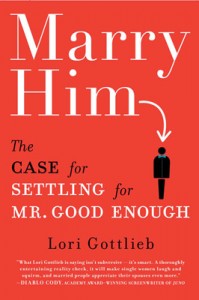
Lori Gottlieb, the author of the new book Marry Him: The Case for Settling for Mr. Good Enough, has made a big hit with her advice. Here is a venomous critique of the book at The Spearhead website. By the way, Gottlieb is the perfect modern authority on love: She dated for 25 years and finally conceived a child through artificial insemination. In the words of the writer Obsidian:
Gottlieb’s book no doubt will be viewed as “dating advice;” perhaps even as “self-help”-and in any event, such books are marketed in droves to Women, for years. All kinds of truly dehumanizing language and allusions are made to Men, such as the very title of the book we’re discussing; we’re rated and objectified, ranked and given the heave-ho for the slightest imperfection, infraction or just the misfortune of being human -a necessary evil all in the name of the Precious Ladies’ search for “Mr. Right”…
The sheer arrogance, hubris and out and out megalomania, that this Woman exudes is something the likes of which I’ve never set my eyes on before-and believe you me, I done seen a lot of stuff…