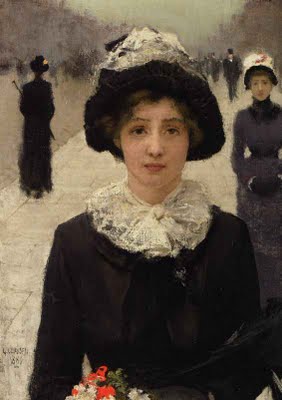
WHILE FEMINISM has been widely attacked for making the lives of mothers more difficult and for destroying perfectly decent marriages, it has generally remained immune from criticism regarding the condition of the unmarried woman without children. It is here that feminists who harbor doubts remain absolutely certain of progress.
The unmarried woman once faced shame and ostracism. If she hadn’t found a man by the time she was 25, she was designated an old maid. She could only teach or work as a nurse or secretary. She didn’t go to bars alone or travel to ashrams in Asia and, most horrific of all, she likely never had a sex life. She didn’t eat, pray and love.
All that has changed. Today, she is not a spinster but a success. She can be a CEO or lawyer. She lives not with her parents, but in a house of her own, complete with the sort of household niceties married women have, such as full sets of china and antique dining tables. She’s just as likely to read Martha Stewart and host fancy dinner parties. People hardly ever ask her why she never married. They’re more interested in her job, and she is most certainly not a virgin.
But this rosy picture is misleading. Does the unmarried woman have it better today? Yes, she may be richer, but is she happier?
When my maternal grandmother was raising her four daughters, she sternly told them that she was not “running a school for spinsters.” That’s because there was a long and exalted line of spinsters in my grandfather’s family. These women lived well and served as tempting role models. There was one difference between them and their contemporary counterparts. They lived in the bosom of their families and in the heart of vital communities. They knew no more real loneliness than anyone else.
Three of my grandfather’s sisters, Marge, Clare and Agnes, took up residence together as adults. Clare and Agnes worked to put my grandfather and his brother through medical school. Marge kept house. They were later joined by their sister Dot; her husband was a prison warden who was shot by an inmate a year after the wedding.
They lived in a Victorian house on a hill, immaculately tended and amply decorated with cut-glass candy dishes, doilies and lace. They had a poodle who begged for chocolate kisses. To a child, theirs was a world of feminine enchantment, filled with a crystalline delicacy that can only be created by true female celibates.
(more…)

![bigstockphoto_Apple_Tree_Black_And_White_Eng_6429051[1]](https://thinkinghousewife.com/wp/wp-content/uploads/2010/02/bigstockphoto_Apple_Tree_Black_And_White_Eng_642905112-102x150.jpg "bigstockphoto_Apple_Tree_Black_And_White_Eng_6429051[1]")
![bigstockphoto_Eiffel_tower_2728727[1]](https://thinkinghousewife.com/wp/wp-content/uploads/2010/02/bigstockphoto_Eiffel_tower_27287271-75x150.jpg "bigstockphoto_Eiffel_tower_2728727[1]")
![bigstockphoto_Abstract_Pattern_2492330[1]](https://thinkinghousewife.com/wp/wp-content/uploads/2010/02/bigstockphoto_Abstract_Pattern_24923301-150x150.jpg "bigstockphoto_Abstract_Pattern_2492330[1]")
![bigstockphoto_Apple_Tree_Black_And_White_Eng_6429051[1]](https://thinkinghousewife.com/wp/wp-content/uploads/2010/02/bigstockphoto_Apple_Tree_Black_And_White_Eng_64290511-102x150.jpg "bigstockphoto_Apple_Tree_Black_And_White_Eng_6429051[1]")

![bigstockphoto_Red_flower_6588759[1]](https://thinkinghousewife.com/wp/wp-content/uploads/2010/02/bigstockphoto_Red_flower_658875911-150x124.jpg "bigstockphoto_Red_flower_6588759[1]")
![bigstockphoto_Floral_Cross_3116033[1]](https://thinkinghousewife.com/wp/wp-content/uploads/2010/02/bigstockphoto_Floral_Cross_31160331-149x150.jpg "bigstockphoto_Floral_Cross_3116033[1]") This is a powerful story of one family’s encounter with the compulsion to play.
This is a powerful story of one family’s encounter with the compulsion to play.![bigstockphoto_Red_flower_6588759[1]](https://thinkinghousewife.com/wp/wp-content/uploads/2010/02/bigstockphoto_Red_flower_65887591-150x124.jpg "bigstockphoto_Red_flower_6588759[1]")