
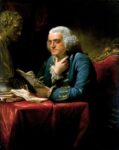
See also “Benjamin Franklin, Master Propagandist“
FROM Bernard Fay’s Revolution and Freemasonry, 1680-1800 (Little, Brown and Company, 1935):
It was by no means easy for America to break away from England — the only logical center for all colonies of English origin as well as for English people living on all continents.
There were thirteen small settlements separated by such distances that it took three weeks for a letter from Georgia to each Massachusetts; their governments were quite different; there was no unity or uniformity in their administrations, their religious affiliations, their customs and social standards, or even their racial composition.
[…..] Masonry alone undertook to lay the foundation for national unity in America, because, through the very nature of its organization, it could spread throughout all the colonies and work steadily and silently. It created in a limited but very prominent class of people a feeling of American unity without which the American liberty could not have developed — without which there would have been no United States.
[….] Contact amongst lodges became closer every year and any Mason traveling through the country found a welcome in the lodges of the cities he visited. There, he met the most prominent citizens of the town, who were ready to help him, while he himself was always glad to put some business into their hands, as [Benjamin] Franklin notes in a curious document found later amongst his papers. Thus, a kind of economic and social aristocracy was established in America on a national scale. When young Colonel Washington left his native Virginia on a trip to Boston, good Mason that he was, he visited the lodges of Philadelphia, New York, Boston and all the places where he stopped. Everywhere he was treated with great respect and dignity by the brethren. Franklin, who was also a good Mason and also traveled a great deal because of his functions as Deputy Postmaster General for the English Colonies in America, met Masonic colleagues everywhere, and everywhere made friends through them and built up for himself an extraordinary popularity which outshone that of all other Americans between 1750 and 1770. Franklin did more: he was influential in bringing American Freemasonry to imitate English Freemasonry and develop its influence by the same means that the Grand Lodgeof England had employed. Desaguliers had been the intermediary between the Grand Lodge of England and the Royal Society; Franklin was the intermediary between teh Grand Lodgeof Pennsylvania and the American Philosophical Society, which was not a Masonic body, but could properly be called a Masonic extension. Like Freemasonry it was continental and national in its scope. The majority of its memebers were Masons, and it worked to spread amongst the ignorant crowds the bright light of Masonic wisdom and the soft warmth of Masonic philosophy. During the whole course of the eighteenth century, this strong Masonic spirit of the American Philosophical Society was noticeable. It was a great help to Masonry, for it spread its principles amongst people who otherwise would not have been reached. It was also very good for Franklin, whose prestige was greatly enhanced by the achievements of the American Philosophical Society.
To be continued
From Bernard Fay’s Revolution and Freemasonry, 1680-1800 (Little, Brown and Company, 1935); pp 231-233


