THREE days of fasting and abstinence this week — today, Friday and Saturday — mark the traditional observance of Ember Days.
Fasting cures our illnesses, dries up the excess humors in our bodies, drives out demons, casts out evil thoughts, purifies the spirit, cleanses the heart, sanctifies the body, and raises people to the throne of God. Finally, fasting is the food of angels, and those who practice it can be considered among those blessed spirits.
“HER prevision of all her sorrows, at least from the moment of St. Simeon’s prophecy, was so vivid and real, that, without a peculiar succour from the omnipotence of God, it must have separated her soul and body. She could not have lived under so dense a shadow. She could not have breathed in so thick a darkness. She must have been suffocated in the deep waters in which her soul was continually sinking. It was impossible in so perfect a creature that her reason should be perturbed. It was impossible that peace should ever be dislodged from a heart in such transcendently close union with God. But her beautiful life might have been, nay would have been, extinguished by excess of sorrow, unless God had worked a perpetual miracle to hinder this effect, just as through her whole life she was always on the point of dying from excess of love, and when His appointed moment came, and He withdrew His extraordinary succour, she did in fact die of simple love. What then must that sorrow have been, which required a standing miracle not to force body and soul asunder; and this too in a sinless soul, where remorse could never come, where doubt never harassed the judgment, unless it were once during the Three Days’ Loss, and where perpetual peace reigned amid the quietness and subordination of all the passions?”
“NOW our Lady’s whole being was flooded with light. Not only did a reason and intelligence of the most consummate perfection illuminate every faculty, and secure the utmost excellence in the exercise of it; but she lived within herself in a very atmosphere of supernatural air and light. In her dolours this light was a torture to her. We may well suppose that no one, except our Blessed Lord Himself, ever fully understood the Passion, or grasped all its horrors in their terrible and repulsive completeness. Yet Mary’s knowledge of it is the only one which came at all near to His, and simply because of the excess of heavenly light which shone unsettingly upon her sinless soul.
[…]
“Ignorance is so completely our atmosphere, that we can conceive less of an excess of spiritual light, an intellectual effulgence, than of anything else. So here again the extent of our Lady’s sorrows escapes us, as we have no means of measuring the supernatural enlightenment to which they were proportioned, or which perhaps rendered them co-extensive with itself.”
“TWICE over to say the least, if not a third time also, did He crucify her, once by His Human Nature, once by His Divine, if indeed Body and Soul did not make two crucifixions from the Human Nature only. No martyrdom was ever like to this. No given number of martyrdoms approach to a comparison with it. It is a sum of sorrow which material units, ever so many added together, ever so often multiplied, do not go to form. It is a question of kind as well as of degree; and hers was a kind of sorrow which has only certain affinities to any other kinds of sorrow, and is simply without a name, except the name which the simple children of the Church call it by, the Dolours of Mary.”
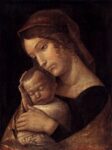
NOW that it’s time to sleep,
sleep, son, and don’t cry;
for the time will come soon enough
when crying is needed.
O my dearest, my heart:
lullaby and sleep now.
Close those divine eyes
as other babies do;
for soon a dark veil
will deprive the sky of light
O my dearest, my heart
lullaby and sleep now.
Or take this milk
from my immaculate breasts;
for a cruel magistrate
is preparing vinegar and gall for you.
O my dearest, my heart
lullaby and sleep now.
“HOW true it is that in the day of judgment many will be known to have wrought great achievements within the dominions of Christ’s kingdom, who passed for insignificant and useless persons in the world, arid were held in no repute even amongst good men. And as true it is, that the great and wonderful deeds of many which made so much noise and rendered those who wrought them so famous, will be found empty, full of the self-seekings of nature, and devoid of the Spirit of God.”
Lord, have mercy. Lord, have mercy. Christ, have mercy. Christ, have mercy. Lord, have mercy. Lord, have mercy. Christ, hear us. Christ, graciously hear us.
God the Father of heaven, have mercy on us. God the Son, Redeemer of the world, have mercy on us. God the Holy Ghost, have mercy on us.
Holy Cross, whereon the Lamb of God was offered for the sins of the world, Deliver and save us.
Hope of Christians, Save us, O Holy Cross* [Repeat after each asterisk below]
Pledge of the resurrection from the dead,* Shelter of persecuted innocence,* Guide of the blind,* Way of those who have gone astray,* (more…)
“This festival was instituted in commemoration of the day on which the holy Cross of Christ, was, with great solemnities, brought back to Jerusalem. Chosroes, king of Persia, had invaded Syria with a powerful army, and had conquered Jerusalem, the capital. He caused the massacre of eighty thousand men, and also took many prisoners away with him, among whom was the Patriarch Zachary. But more painful than all this to the Christians was, that he carried away the holy, Cross of our Saviour, which, after great pains, had been discovered by the holy empress, St. Helena. (more…)
“… HE and his people [descendants of Noah] therefore, erected this [Tower of Babel] against the Lord, and so gave expression to their impious pride; and justly was their wicked intention punished by God, even though it was unsuccessful. But what was the nature of the punishment? As the tongue is the instrument of domination, in it pride was punished; so that man, who would not understand God when He issued His commands, should be misunderstood when he himself gave orders. Thus was that conspiracy disbanded, for each man retired from those he could not understand, and associated with those whose speech was intelligible; and the nations were divided according to their languages, and scattered over the earth as seemed good to God, who accomplished this in ways hidden from and incomprehensible to us.”
“MULTIRACIALISM is social engineering designed to eliminate the superiority of White people by eliminating White people through biological mixing and ecological replacement in the world’s most desirable nations made desirable by the superiority of the White race.
“The Right won’t acknowledge this because the Right is committed to human equality.”
“OUR latest research in 2009 has brought us to a series of remarkable discoveries in the collection of victim stories. What began as an insightful look at the CNN.com 9/11 Victim Memorial, the original source of the death reports, turned into realization after realization that the entire body of victims – from the airplanes, to the Pentagon, to the World Trade Center – had all been created at the same time by an ‘identity generating’ software program which creates ‘digital’ people with (oft improbable) fictitious names. Anyone armed with a little patience and a discerning attitude should be able to realize that the CNN Victim Memorial is a preposterous list of counterfeit identities. As a result, the full extent of the 9/11 simulation – heroes, victims and villains – is revealed as the absurd, fabricated drama that it is.
“To understand how computer-assisted false identities can take the place of both false events and society’s “normal” functions (including the role of news anchors or even the role of those allegedly investigating the simulation!) please view the full body of the CNN.com 9/11 Victim Memorial Pay particular attention to the invariably sappy and contrived comments/tributes posted by alleged “families and friends”; note the endlessly recycled patterns of those messages of condolence – almost invariably addressed in first person to the ‘dead’ as if they could read their own tributes from Heaven; note also the farcically poor quality of hundreds of portraits – as if all these families had no better picture of their loved ones to offer. Then read the Vicsim Report. After this exercise, you should feel equipped to tackle the increasing challenge of distinguishing between computer-generated sims and real people.”
“TO uphold and perpetuate the myth of the 9/11 victims, a grand traveling circus was set up since day one and is still maintained to this day: A bunch of actors and actresses have been contracted to play the role of mourning family members, all of which get constant/extensive press & TV coverage. Hard to believe? Well, in this video – “911 ACTORS” – I have analyzed a number of public appearances of a few alleged “mourning family members”, such as Bob Mc Ilvaine and Donna Marsh O’Connor, who claim to have lost a son or daughter on 9/11. I trust that anyone who has taken acting classes will easily see that Bob and Donna are nothing but (rather poor) actors reciting a ‘theatrical drama script’- over and over again: September Clues – 911 ACTORS
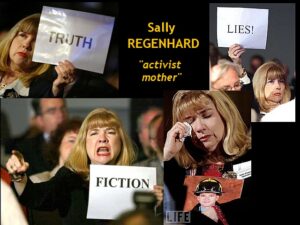
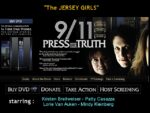
“An early team of 9/11 widows gained instant international fame: They were credited of forcing the government to set up the 9/11 commission: The so-called Jersey Girls were portrayed as left-wing activists who asked inconvenient questions. Of course, it was all a comedy of smoke and mirrors, a dog and pony show for public consumption.”
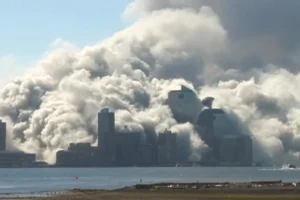
“ON the morning of 9/11, multiple military-grade smoke machines were switched on, engulfing all of lower Manhattan in smoke.
“The entire area was inundated with smoke. Nobody could see a damn thing. Visibility was virtually zero. Anyone holding one of the rare cameras or camcorders available in 2001 found themselves filming nothing more than a thick, blinding wall of gray smoke.
“This is key to understanding the Truth about 9/11.
“They want you to think that everyone had a clear view of the towers, a clear view of the planes, a clear view of the ACTION.
“But that is FALSE. In reality, the entire area was evacuated and subsequently engulfed in an intense smokescreen that lasted all the way from morning until night. Obscuring the view of their covert operation from anyone trying to get a peek. (more…)
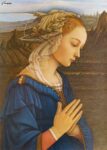
“LET us speak a little about this name, which is said to mean “star of the sea,” and which so well befits the Virgin Mother. Rightly is she likened to a star. As a star emits a ray without being dimmed, so the Virgin brought forth her Son without receiving any injury. The ray takes naught from the brightness of the star, nor the Son from His Mother’s virginal integrity. This is the noble star risen out of Jacob, whose ray illumines the whole world, whose splendor shines in the heavens, penetrates the abyss, and, traversing the whole earth, gives warmth rather to souls than to bodies, cherishing virtues, withering vices. Mary is that bright and incomparable star, whom we need to see raised above this vast sea, shining by her merits, and giving us light by her example. (more…)
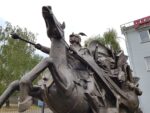
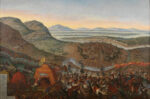
ON THIS day in 1683, the Ottoman Empire’s centuries-long efforts to conquer Europe were decisively and permanently defeated in the Battle of Vienna. The combined forcs of the Holy Roman Empire and the Polish-Lithuanian Commonwealth under the command of the Polish King Jan III Sobieski changed the course of history, a fact often forgotten when the survival of Europe for so long is taken for granted or even regretted. In 2024, the city of Vienna rejected a proposal for a statue in honor of Sobieski on the ground that it would be “Islamophobic.”
Before the battle almost 60,000 men, women and children were taken into slavery in the village of Perchtoldsdorf outside Vienna when it was captured by the Turks as preparations for the final siege of the city were underway. The villagers were among the hundreds of thousands — more than 1.25 million in all, according to historian Robert Davis — of Europeans who ended up as slaves in the East. The residents of Perchtoldsdorf, thousands of whom were killed, had surrendered after being promised their lives and safety.
Capturing the city of Vienna had long been a strategic aspiration of the Ottoman Empire, due to the control the city had over the Danube and the overland trade routes to Germany and the Eastern Mediterranean. During the years preceding the siege, the Ottoman Empire, under the auspices of the Grand Vizier Kara Mustafa Pasha, undertook extensive logistical preparations, including the repair and establishment of roads and bridges leading into the Holy Roman Empire and its logistical centers, as well as the forwarding of ammunition, cannons, and other resources from all over the Empire to these centers and into the Balkans. The Siege of Szigetvár in 1566 blocked the advance of Sultan Suleiman the Magnificent towards Vienna and stopped the Ottoman advance towards Vienna that year. Vienna was not threatened again until 1683. In 1679 plague had been raging in Vienna. (Source)
Protestants in league against the Holy Roman Empire would join with the Turks to undermine their common enemy.
In the final battle, despite their greater numbers, the Ottomans would lose about half of their force (estimated to be 120,000 at the start of the siege) to death and desertion, leading to humiliating defeat on the evening of September 12.
Today’s Feast of the Holy Name of Mary was instituted in gratitude for a victory attributed to divine intercession.
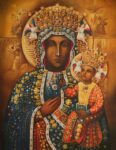
Since Sobieski had entrusted his kingdom to the protection of the Blessed Virgin (Our Lady of Częstochowa) before the battle, Pope Innocent XI commemorated his victory by extending the feast of the Holy Name of Mary, which until then had been celebrated solely in Spain and the Kingdom of Naples, to the entire Church… (Source)
Our Lady of CzestochowaThe Ottoman Army surrounds Vienna, by Frans Geffels
If thou follow her, thou wilt never go astray. If thou pray to her, thou wilt never have need to despair. If thou keep her in mind, thou wilt never wander. If she hold thee, thou wilt never fall. If she lead thee, thou wilt never be weary. If she help thee, thou wilt reach home safe at the last and so thou wilt prove in thyself how meetly it is said And the virgin’s name was Mary.
9/11 is but a giant – and still ongoing – money-making scam. It rotates around the most well-funded and profitable hoax of modern history. Everyone involved in the scheme is reaping a sizeable return from their ‘investment bond’ which, naturally, has “SILENCE” printed all over it. For anyone to ‘speak out’ would be both ruinous and suicidal – a most distasteful option. To be sure, ‘suicidal heroics’ only exist in journalistic fairy-tales such as the outlandish newsmedia’s narrative of 9/11 and its “nineteen religious fanatics”.
The skeptics objecting that “too many people would have had to be in on this” fail to account for the most fundamental aspect of human nature: our survival instinct. The master plan of 9/11 was to demolish the redundant, asbestos-filled WTC complex in Lower Manhattan – 9 buildings in all. The area would naturally be evacuated (as for all such demolitions) in order to prevent a slaughterhouse of dreadful proportions – not a good idea at all. To be sure, this was no mass murder scheme – just a formidable opportunity for massive financial gains and military propaganda. The military (and its various intelligence affiliates) would manage the ground logistics, such as securing the area, raising smokescreens to hide the proceedings from public view, and last but not least, electromagnetic countermeasures to keep any private cameras from filming the mayhem. The WTC complex was thus ‘safely’ destroyed in bright daylight. It was a magician’s trick, pulled off by sleight of hand to fool the few (the NY onlookers) – and with computer graphics to fool the world (the TV viewers). The rest was (and still is to this day) a gigantic simulation staged and upheld by the complicit news media propaganda machine.