
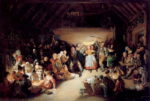
One hears too often from the secular world that “Hallowe’en is a pagan holiday” — an impossibility because “Hallowe’en,” as said, means “All Hallows’ Evening” which is as Catholic as it gets. Some say that the holiday actually stems from Samhain, a pagan Celtic celebration, or is Satanic, but this isn’t true, either, any more than Christmas “stems from” the Druids’ Yule, though popular customs that predated the Church — such as the use of holly to decorate — may be involved in our celebrations (it is rather amusing that October 31 is also “Reformation Day” in Protestant circles — the day to recall Luther’s having nailed his 95 Theses to Wittenberg’s cathedral door — but Protestants who reject Hallowe’en because pagans do things on October 31 don’t object to commemorating that event on this day).
FROM Fisheaters:
31 October and 1 and 2 November are called, colloquially (not officially), “Hallowtide” or the “Days of the Dead” because on these days we pray for or remember those who’ve left this world.
The days of the dead center around All Saints’ Day (also known as All Hallows’) on November 1, when we celebrate all the Saints in Heaven. On the day after All Hallows’, called “All Souls’ Day,” we remember the saved souls who are in Purgatory, being cleansed of the temporal effects of their sins before they can enter Heaven. The day that comes before All Hallows’, though, is one on which we unofficially remember the damned and the reality of Hell. The schema, then, for the Days of the Dead looks like this:
31 October: Hallowe’en: unofficially, per folk custom, recalls the souls of the damned. Practices center around recognizing and remembering the reality of Hell and how to avoid it.
1 November: All Saints’: set aside to officially honor the Church Triumphant (the souls in Heaven). Practices center around recalling our great Saints, including those whose names are unknown to us and, so, are not canonized
2 November: All Souls’: set aside officially to pray for the Church Suffering (the souls in Purgatory). Practices center around praying for the souls in Purgatory, especially our loved ones
The earliest form of All Saints’ (or “All Hallows'”) was first celebrated in the 300s, but originally took place on 13 May, as it still does in some Eastern Churches. The Feast first commemorated only the martyrs, but came to include all of the Saints by 741. It was transferred to 1 November in 844 when Pope Gregory III consecrated a chapel in St. Peter’s Basilica to All Saints (so much for the theory that the day was fixed on 1 November because Irish pagans had harvest festivals at that time).
All Souls’ has its origins in A.D. 1048 when the Bishop of Cluny decreed that the Benedictines of Cluny pray for the souls in Purgatory on this day. The practice spread until Pope Sylvester II recommended it for the entire Latin Church.
The Vigil of — i.e., the evening before — All Hallows’ (“Hallows’ Eve,” or “Hallowe’en”) came, in Irish popular piety, to be a day of remembering the dead who are neither in Purgatory or Heaven, but are damned, and related customs spread to many parts of the world. Thus we have the popular focus of Hallowe’en as the reality of Hell, and hence its scary character and focus on evil and how to avoid it, the sad fate of unsaved souls, etc.
One hears too often from the secular world that “Hallowe’en is a pagan holiday” — an impossibility because “Hallowe’en,” as said, means “All Hallows’ Evening” which is as Catholic as it gets. Some say that the holiday actually stems from Samhain, a pagan Celtic celebration, or is Satanic, but this isn’t true, either, any more than Christmas “stems from” the Druids’ Yule, though popular customs that predated the Church — such as the use of holly to decorate — may be involved in our celebrations (it is rather amusing that October 31 is also “Reformation Day” in Protestant circles — the day to recall Luther’s having nailed his 95 Theses to Wittenberg’s cathedral door — but Protestants who reject Hallowe’en because pagans do things on October 31 don’t object to commemorating that event on this day).
Happy Halloween!
Halloween, by the way, is a day of fasting and abstinence in the Catholic Church because it is the Vigil of All Saints’ Day (Hallow Even). That means: one meatless meal for the day with possibly two small snacks.
Some Catholics, erroneously accepting a Protestant Puritanism about Halloween, require that children dress up as saints. This is mixed up; it confuses All Hallows Eve with All Saints Day, which are separate things.
Although Halloween is not a pagan holiday in origin, it obviously is given to pagan excesses. Keeping this simple fast, saving candy for the next day, is a way to reclaim it.
More from Fisheaters:
After teaching your children about the frightening realities of Hell and the fate of the damned, and after giving them a good, fun, appropriate-to-their-level-of-maturity scare, reassure them by telling them that the Evil One has already been conquered! He can tempt, obssess, and oppress us, but Satan has no ultimate power over those who are in Christ, and mocking him and his minions is a way of demonstrating this; teach your children how to call on the power of Christ and His Church to protect themselves from the Evil One’s snares. Warn them that occultic magick (the art of performing actions beyond the power of man with the aid of powers other than the Divine) is real, that there is no such thing as “white magick,” that playing with the occult — whether by occultic divination, necromancy, the casting of spells, playing with Ouija boards, etc. — is an invitation to demons to respond, and that it is from demons that magick gets any power it has. Remember St. Michael to them, teach them about the power of sacramentals and prayers that ward off evil when piously used ….. Teach them to call on the Holy Name of Jesus, the Blessed Virgin, their Guardian Angel, and/or St. Michael when they are afraid, etc.


