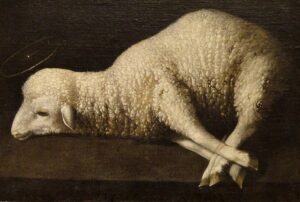
“GOD is a Lamb that avails you not, my Christian, if you become not also a lamb of God. The cross on Golgotha redeems not from evil, if it is not also erected in thee. The dear Christ’s death aids you not, until in Him and for Him you also have died.”
“SINCE the day when he gained his first victim, Abel, he has swept off Countless generations; but never has he held in his grasp a prey so noble as this that now lies in the tomb near Calvary. Never has the terrible sentence of God, pronounced against our first parents, received such a fulfilment as this; but, never has death received such a defeat as the one that is now preparing. It is true, the power of God has, at times, brought back the dead to life: the son of the widow of Naim, and Lazarus, were reclaimed from the bondage of this tyrant death; but he regained his sway over them all. But his Victim of Calvary is to conquer him for ever, for this is He of whom it is written in the prophecy: ‘O death! I will be thy death!’ [Osee, xiii, 14]. Yet a few brief moments and the battle will be begun, and life shall vanquish death.”
— Dom Prosper Guéranger, The Liturgical Year, Easter Sunday
“4. IS IT not right, it is often repeated, indeed, even consonant with duty, that all who invoke the name of Christ should abstain from mutual reproaches and at long last be united in mutual charity? Who would dare to say that he loved Christ, unless he worked with all his might to carry out the desires of Him, Who asked His Father that His disciples might be “one.”[1] And did not the same Christ will that His disciples should be marked out and distinguished from others by this characteristic, namely that they loved one another: “By this shall all men know that you are my disciples, if you have love one for another”?[2] All Christians, they add, should be as “one”: for then they would be much more powerful in driving out the pest of irreligion, which like a serpent daily creeps further and becomes more widely spread, and prepares to rob the Gospel of its strength.
“SATISFACTION consists in the cutting off of the causes of the sin. Thus, fasting is the proper antidote to lust; prayer to pride, to envy, anger and sloth; alms to covetousness.”
AS we have seen, Jesus was crucified on a hillock overlooking a main thoroughfare just outside the city of Jerusalem. The cross was set up so near the road that the passers-by could speak to the crucified. Unfortunately, this is exactly what many of them did. The Gospels identify them no further than to tell us that they were people who passed by. They were probably those leaving the city rather than those entering, as their mockery reveals that they were familiar with the accusations against Christ. By this time the affair had undoubtedly become the talk of the town. These people stopped momentarily, probably in small groups, and looked up at the three men hanging on their crosses. (more…)
Comments Off on The Mockery of Christ on the Cross
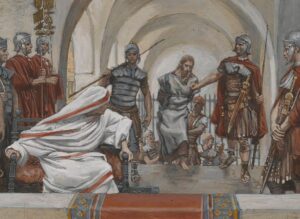
“But it was Rome, of whom Palestine was at that time a dependency, that had the sole power of life and death. It was necessary to refer a case of this kind to the Roman Procurator and our Lord was taken to the Judgment Hall of Pontius Pilate, in the fortress of Antonia. Here the Jews did not enter, since in the house of a pagan they would have contracted legal defilement, at this time of the Passover Feast. Our Lord’s civil trial was, in its turn, about to commence. But before this new tribunal a political charge was a necessity. In the Jewish view the Messias was to be an earthly monarch, so they accused Jesus, who said that He was the Messias, of being a rival king to Caesar.
“On this new ground was reproduced, point by point, the same procedure as that of the night before, the same silence of our Lord in the face of false witnesses, the same formal assertion of His spiritual kingship before the pagan world, represented this time by those who actually held the world power; the same ill-treatment by subordinates, in this case the Roman soldiery. Our Lord, who in reality guided the whole proceeding, would be condemned only as the Son of God and King of souls. He put the question again on religious ground, when He said : ‘My kingdom is not of this world.’
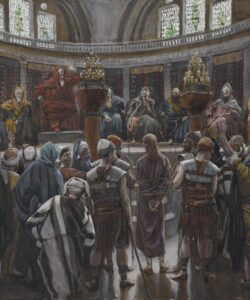
“Here the ecclesiastical trial was about to take place since it pertained to the Jewish religious authorities to examine Jesus on what they called His assumed title of the Son of God. The Sanhedrim consisted of seventy members, at the head of which were the chief priests and their supreme head the High Priest, which office Annas had succeeded in obtaining for his five sons in succession, and then in the year of our Lord’s death for his son-in-law, Caiaphas. Faithless to their mission, these official representatives of the Jewish religion no longer looked for any Messias other than a warrior king who should deliver them by main force from the Roman yoke.
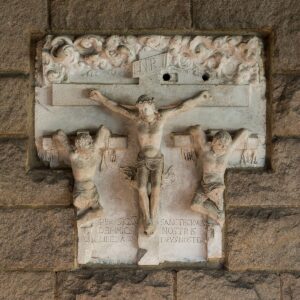
The Crucifixion (from Scenes from the Passion of Christ), early 16th century French,The Metropolitan Museum of Art, New York, The Cloisters Collection, 1925
“WITH profound reverence and sincere contrition of heart, we gather here to meditate on the seven last words of our Saviour on the cross. That we may better dispose ourselves to derive choicest graces from this meditation, let us go back in spirit to the first Good Friday and in spirit take our position on the hill of Calvary, called the Skull. Here we become spectators of the world’s supreme drama—the crucifixion of our Lord. We are not alone. A large congregation has assembled, not to pray and worship, but to blaspheme and persecute. The trial of Jesus had come to an end. Pontius Pilate, the cowardly Roman governor, had pronounced the death-sentence: ‘Take Him away and crucify Him.’ No time was lost. In anticipation of His certain doom, a ponderous cross had been selected for Him. Its crushing weight—symbol of the world’s guilt—now bears heavily on His bruised shoulders, and we see a dismal procession now winding its cruel tortuous way up the steep and rocky road to the summit of the hill. No death-march ever had its equal. Crowned with thorns, covered with wounds, streaming with blood, and staggering under His burden, comes the Saviour, followed by the two condemned thieves, all three tightly bound and closely guarded. Pressing close upon them are the numerous enemies of Jesus, a jostling mob, rending the air with frightful yells, curses and blasphemies. (more…)
Comments Off on Meditations on the Seven Last Words
Faithful cross, above all other, One and only noble tree: None in foliage, none in blossom, None in fruit thy peer may be. Sweetest wood and sweetest iron, Sweetest weight is hung on thee!
“IT is bad news for the Arabs to find that Soviet Communism and Israeli Zionism are two claws of one and the same world revolutionary movement — but it is the interests of the whole world which are now at stake, as the scene is set for an East-West conflict designed to draw to their final destruction as national and cultural entities all the peoples of the West and to usher in the kind of totalitarian one-world order which a globally concentrated financial power must have if it is to survive.
“That, for the peoples of the West, is the real meaning of what is happening in the Middle East — or, as Alexander Solzhenitsyn warned: ‘All of us are standing on the brink of a great historical cataclysm, a flood that swallows up civilisation and changes whole epochs.'”
Mr. Matatics holds the correct position — a position strongly advised by faithful priests back in the 1960s — that Catholics must not participate in the Vatican II rites; must stay at home, pray the Mass and make acts of Spiritual Communion (and avoid Traditionalist groups that, inventing unprecedented breaches of authority, operate without papal mandate and outside the juridical structure of the Church).
But where is the Eucharist today? Does it still exist on any altars in the world?
Mr. Matatics, who is not invoking his own authority but the authority of Scripture and nearly 2,000 years of papal and patristic teaching, explains that it does exist, on the private altars of priests validly ordained in the 1960s or 1970s, and perhaps on the altars of those ordained under special dispensations Pope Pius XII granted to bishops in Communist countries. He discusses the status of valid Eucharists in the Eastern Orthodox churches too.
The discussion goes off into side issues, but he makes many excellent points. I highly recommend it.
SING, my tongue, the Saviour’s glory,
Of His Flesh, the mystery sing;
Of the Blood, all price exceeding,
Shed by our Immortal King,
Destined, for the world’s redemption,
From a noble Womb to spring. (more…)
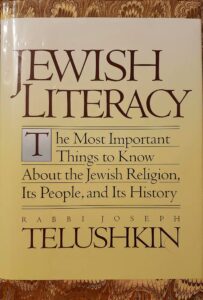
“THE most important thing to know about the Pharisees is that they are the ancestors of all contemporary Jews. The other sects that existed contemporaneously with them died out shortly after the Second Temple’s destruction. Once they disappeared, the Pharisees no longer were called by that name; their religious practices became normative Judaism. Unfortunately, at the very time all Jews were increasingly identifying as Pharisees, the word began to acquire a new highly-pejorative meaning. The New Testament repeatedly depicted the Pharisees as small-minded religious hypocrites. Eventually, the word ‘pharisees’ came to be synonymous in English with ‘hypocrite,’ a distortion as obnoxious to Jews as the expression ‘to jew’ — meaning to bargain down or to cheat. In actuality, the greatest teachers of Talmudic Judaism, men like Hillel, Rabbi Yokkanan ben Zakkai and Rabbi Akiva, were Pharisees.”
— Rabbi Joseph Telushkin, Jewish Literacy, the Most Important Things to Know about the Jewish Religion, Its People, and Its History (1991)
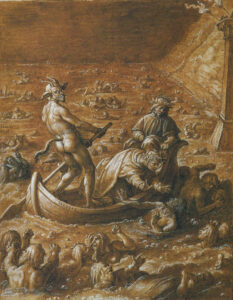
“AUGUSTINE Virgil,” author of a new book, Inferno,reimagines Dante’s famous hellscape as a journey through modern media and alt-media, with dizzying circles of “truths and untruths; dialectics and kayfabes; influencers and assets.” From an excerpt on Substack:
To understand the media spectacle in its totality then one could do far worse than beginning with Dante’s vision of Hell. Lamenting expulsion from his much loved Tuscan homeland, the good Florentine envisaged an underworld of concentric rings of torment: when the world seemed strange and foreign to the Poet, he sought to descend through the mire in the hope of finding eventual respite in the summum bonum, the highest good. Which modern searcher of truth could not relate? Naturally for his guide he chose the most modern of the ancients, Virgil, to shepherd him through the fire and ice of a Hades where fraud and treachery, naturally, occupy the lowest circles.
It is a not a perfect but nonetheless useful analogy to conceive of what is best termed the simulacrum – namely the media and alt-media (composed of the largely online podcast based “truthers”) – of occupying similarly a malign Inferno. It is one comprised of concentric rings, burning not with fire but with narrative. Each has their varying degrees of torment reflecting their varying degrees of fraud and treachery. Or, if one would prefer (for optimism’s sake): each possessed of varying degrees of “truth”, floating spectral throughout the ether of the respective rungs of this Hadean ladder. It is pertinent at this point to add that each ring, whilst operating as a discrete and deliberate pen of isolation, also can facilitate mobility to other rings: one may find one’s way to one rung of this waking Hell only to then be shepherded by a denizen of that ring to another ring unawares, as we shall see.