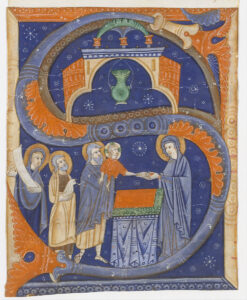
NEW Year’s Day is a secular holiday, but it has beautiful mystical significance as well. Today is the Feast of the Circumcision of Our Lord. A little primer:
Why is this day so called?
Because the secular year begins with this day, as the ecclesiastical year begins with the first Sunday of Advent.
What should we do on this day?
An offering for the new year should be made to God, asking His grace that we may spend the year in a holy manner, for the welfare of the soul.
Why do we wish each other a “happy new year?”
Because to do so is an act of Christian love; but this wish should come from the heart, and not merely from worldly politeness, otherwise we would be like heathens, (Matt. v. 47.) and receive no other reward than they.
There is a massacre of innocents going on, and though we do not hear the cries of mothers or the moans of little children, yet the slaughter is more cruel than that of King Herod recorded in St. Matthew’s Gospel, for it deprives of physical and spiritual life; it sends children unbaptized into eternity, and brings about race suicide. And not only is thie destruction of the child’s life within the nine months before its birth a fearful deed forbidden by the fifth commandment of God, but any wilful act or desire to prevent human life, in any shape or form, is a crime against Nature which the God of Nature will visit with dreadful punishments. The small family, brought about by the effective wish of husband and wife, is an immoral condition which ruins souls and bodies. Those who set limits to divine Providence by preventing the offspring, violate the holy laws of God, defeat the end for which marriage was instituted, brutalize the sacred relations between man and wife, and criminally contribute to the physical, mental and moral degeneracy of the nation.
Lorenzo Maitani and Associates; The Slaughter of the Innocents
Hymn: Salvete Flores
All Hail! ye infant Martyr flowers,
Cut off in life’s first dawning hours:
As rosebuds snapt in temptest strife,
When Herod sought your Saviors life.
You, tender flock of lambs, we sing,
First victims slain for Christ your King:
Beside the very altar, gay
With palms and crowns, ye seem to play. (more…)
It is rather as if a man had found an inner room in the very heart of his own house, which he had never suspected; and seen a light from within. It is if he found something at the back of his own heart that betrayed him into good. — G.K. Chesterton
[N]o other story, no pagan legend or philosophical anecdote or historical event, does in fact affect any of us with that peculiar and even poignant impression produced on us by the word Bethlehem. No other birth of a god or childhood of a sage seems to us to be Christmas or anything like Christmas. It is either too cold or too frivolous, or too formal and classical, or too simple and savage, or too occult and complicated. Not one of us, whatever his opinions, would ever go to such a scene with the sense that he was going home. He might admire it because it was poetical, or because it was philosophical or any number of other things in separation; but not because it was itself. The truth is that there is a quite peculiar and individual character about the hold of this story on human nature; it is not in its psychological substance at all like a mere legend or the life of a great man. It does not exactly in the ordinary sense turn our minds to greatness; to those extensions and exaggerations of humanity which are turned into gods and heroes, even by the healthiest sort of hero worship. It does not exactly work outwards, adventurously to the wonders to be found at the ends of the earth. (more…)
FROM New Heaven, New War
– —- by Robert Southwell, S.J. (Above, the poem is part of Benjamin Britten’s Ceremony of Carols)
This little babe, so few days old,
Is come to rifle Satan’s fold;
All hell doth at his presence quake.
Though he himself for cold do shake,
For in this weak unarmèd wise
The gates of hell he will surprise.
With tears he fights and wins the field;
His naked breast stands for a shield;
His battering shot are babish cries,
His arrows looks of weeping eyes,
His martial ensigns cold and need,
And feeble flesh his warrior’s steed.
I oftentimes encounter those who argue that it would take so many people who were “in on it” to pull off a massive operation like COVID. This is simply wrong. It takes a handful of people who know how all the pieces fit together—all of whom are likely carefully monitored and possibly even blackmailed (remember Epstein?). Everyone else falls victim to compartmentalization. They might notice something is wrong—and may even speak up about it—but their failure to connect all the dots to see the big picture won’t lead to some grand realization about the operation. If they do get too close to the target, they can be banished to the dark corners of the internet or even physically targeted. When false paradigms and bad business practices are normalized over time, operations like COVID naturally feel like some kind of blunder when they’re anything but that.
The John Hancock Life Insurance Christmas Carol Booklet
[Reposted]
“TALES OF CHESTER” continues here with a few words from my husband, A. Wood, on the season of Advent:
EVERY self-respecting kid in Chester was a school resister, possessing an instinctive and deeply-rooted sense of the dignity of human freedom. But Sonny Trenjic [pronounced TRENCH-ick] raised the art of dodging school to a new level.
One day in early December, Sister St. Reginald (they called her “Reggie”) asked Sonny’s sister, Babe, why he was absent from his eighth-grade class. Babe said that a terrible mishap had occurred at home. Sonny was conducting an extra-curricular science experiment. He was attempting to electrocute a spider — for the greater cause, of course — and the spider bit him, seriously injuring his hand.
In the annals of truancy, this was a dazzling masterpiece.
But, even artistry at this exalted level could not disarm the hardened prejudices of Sister Reggie. She stopped what she was doing and left her class in the charge of a student proctor.
She marched to the Trenjic house. She knocked on the door. Without further ado, she snagged the un-injured Sonny by the collar. The fugitive was then escorted back to class. This was all part of a nun’s job profile. She physically, as well as spiritually, battled the forces of evil. The profane waged its ceaseless war with the sacred in the streets and living rooms of this small industrial city by the rat-gray Delaware River. Reggie and the other sisters were the shock troops.
The profane weakened during the four-week liturgical season of Advent. Our small, darkened minds were uplifted with greater frequency to the supernatural as the lamps in row houses brightened the encroaching night. Expectation was in the air. Let’s be clear: It was anticipation, not fulfillment. Thanksgiving was still Thanksgiving. It wouldn’t have remotely crossed our minds to go shopping for Christmas on the day after Thanksgiving. Black Friday was not yet black. We didn’t put up Christmas trees or wreaths during Advent. We didn’t have parties until Christmas week. (more…)
“THERE is surely something inexpressibly touching in this presence of the inferior animals at the nativity of the Incarnate Creator. In the Incarnation God has been pleased to go to what look like the uttermost limits of His divine condescension. He has assumed a material, although a rational, nature; and, according to our understanding, it would not have been seemly that He should have assumed an irrational nature. Nevertheless He is not unmindful of the inferior creatures. Their instincts are in some sort a communion with Him, often apparently of a more direct character than reason itself, and bordering on what would commonly be called the supernatural.
“At times there is something startling in the seeming proximity of the animal kingdom to God. Moreover all the inferior animals, with their families, shapes, colours, cries, manners, and peculiarities, represent ideas in the divine mind, and are partial disclosures of the beauty of God, like the foliage of trees, the gleaming of metals, the play of light in the clouds, the multifarious odours of wood and field, and the manifold sound of waters. (more…)
TWO became three, then four and five.
What joy, every year, they all seemed so alive
On a holly-decked card that came in the mail.
Five Christmas grins were proof without fail,
That all was well with the Stumper-McLeans,
Despite hidden tensions and financial strains.
The babies in time became soccer players,
Riders of bikes and violin slayers.
The family grew taller and the cards still came.
The haircuts grew crooked, but who was to blame?
The Boy Who Laughed at Santa Claus
by Ogden Nash (1902-1971)
In Baltimore there lived a boy.
He wasn’t anybody’s joy.
Although his name was Jabez Dawes,
His character was full of flaws.
In school he never led his classes,
He hid old ladies’ reading glasses,
His mouth was open when he chewed,
And elbows to the table glued.
He stole the milk of hungry kittens,
And walked through doors marked NO ADMITTANCE.
He said he acted thus because
There wasn’t any Santa Claus.
Another trick that tickled Jabez
Was crying “Boo” at little babies.
He brushed his teeth, they said in town,
Sideways instead of up and down.
Yet people pardoned every sin,
And viewed his antics with a grin,
Till they were told by Jabez Dawes,
“There isn’t any Santa Claus!”
WEDNESDAY, Friday and Saturday in the third week of Advent are known as “Ember Days” in the Catholic Church and are traditionally days of fast and partial abstinence from meat (full abstinence on Friday).
Every person who fasts or abstains even a bit from food at this time makes a mockery of the deluge of materialism that surrounds us. Feed the body less; feed the soul more.