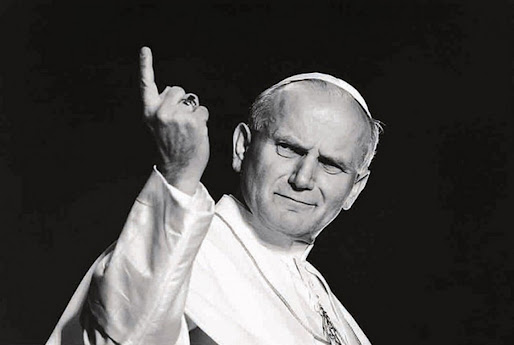
ATPro Deo et Pontifice, an ongoing series examines the extensive ‘heresies, errors and novelties” in the catechism introduced by Karol Wojtyla, otherwise known as Pope John Paul II, another anti-Vicar of Christ who was a committed enemy of the very institution he supposedly led.
Don’t miss the links at the end of the post, which also include dozens of entries on the heresies and deliberate distortions in the Vatican II documents. The idea that the Council did not explicitly reject Church teaching and was only misinterpreted is, as you can see, nonsense. Use your browser’s translator to read in English.
Robert Prevost (right) at a peace rally in Rome in 1983, organized by a coalition of pacifist groups, including organizations connected to the Italian Communist Party.
IF IMAGE and celebrity were everything, if truth was determined by vote or acclaim, than Robert Prevost would be pope of the Catholic Church, Vicar of Jesus Christ on earth.
But truth does not always correspond to image.
The truth is that Prevost is not Pope. He is not even Catholic. A basic familiarity with the beliefs of the Catholic Church for almost 2,000 years can easily discern this fact. Prevost is an aging Marxist hippie who looks nice in papal dress and uses the remaining wealth of the true Church and the resources of the gullible, hoodwinked and uninformed masses to promote a One World religion that proclaims the “People of God” their own messiah, obviating the need under this system for any pope at all. He and his predecessors in this religion are smooth-talking Bolsheviks who have smashed Catholic altars to smithereens and obliterated the entire juridical structure of the Church. Their popularity and success mean absolutely nothing in the eyes of God. It doesn’t matter how many babies they’ve kissed, how many hands they’ve shaken, how many books they have produced, how many countries they’ve visited, how many celebrities they’ve welcomed through their doors, how many times they have claimed to say Mass, how many packed auditoriums or stadiums they have addressed. It doesn’t matter how many millions are so scandalized by this difficult truth that they reject it. All this is nothing. Catholicism is a religion of the cross, and the vast majority, like the Pharisees of old who refused to accept a Messiah who would not be an earthly king, refuse it. Their Church must be a glorious earthly kingdom with a celebrity at its head, or they will not have it. The biblical prophecies, the teachings of the saints and Fathers of the Church who said everything would be taken away from them before the end, do not impress.
Then who is pope? Do we have a pope?
Yes, we do.
Pope Pius XII, who died in 1958, rules still during this extended vacancy of the papal chair that began that same year. He rules through his living legacy, the cumulative and infallible decrees of all of his predecessors. He is today the true pope of the Catholic Church, not physically in power, but morally and supernaturally.
Papal supremacy is the “cohesive center” that holds not just the Catholic world together, but all of human life. From “Pastor Aeternus“:
An Apostle from the Transfiguration, Matthias Grunewald; 1511
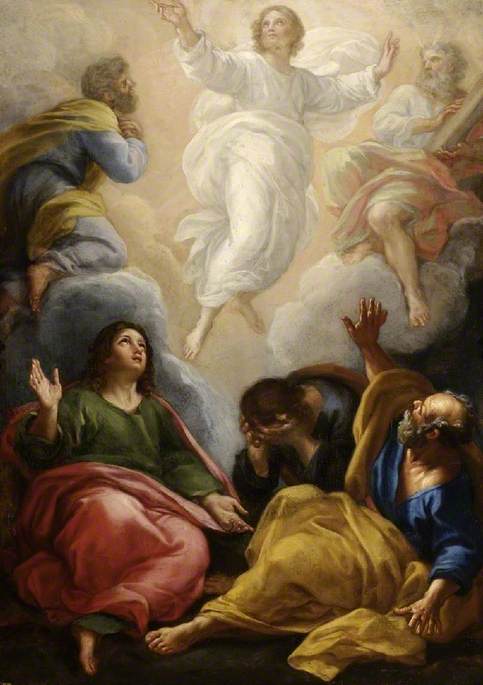
“CONSIDER 3dly, how St. Peter being out of himself, with the joy of this vision, was desirous to be always in the same happy situation, and always enjoying the like glory; and therefore he cried out, ‘Lord it is good for us to be here; not knowing, saith St. Luke, what he said, cn. x. 33. Because though it was inconceivably delightful to see and enjoy (though for a short time) the least glimpse of heavenly light and glory; yet as this present life was not to be the time of enjoyment, but of labours and of sufferings; and the Son of God Himself was to enter into His glory, by labours and sufferings (Luke xxiv. 26.); it was inordinate to desire here for a continuance, that which was reserved for here after: and for such only as should be entitled to it by labours and sufferings. Learn from hence, O my soul, with regard to divine consolations, and such like favours, that though thou art to receive them when given, with humility, gratitude and love, admiring the goodness and bounty of God, who is pleased thus to look down upon thee, the most unworthy of sinners: yet art thou not to set thy heart upon them, nor to be disturbed and discouraged, when they are taken away: for merit and perfection consists not in them, but in working, suffering and loving; and for the time of this mortal life, ordinarily speaking, it is far better for thee to be with thy Lord upon Mount Calvary, than upon Mount Thabor.
“Conclude instead of being eager after these transitory consolations, which at the best are but as small drops of water that fall from the clouds of Heaven, to refresh us for a moment in this dry desert, through which we are now travelling; to aspire rather continually after that great overflowing river above, which gives joy without end to the City of God; and which alone is capable quenching thy thirst and satisfying thy soul.”
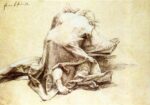
An Apostle from the Transfiguration, Matthias Grunewald; 1511
“BUT we must again remark upon the very astonishing predilection which the Adorable Jesus showed for the hidden life during the years in which He lived in public and conversed with men. It was His delight to pass whole nights in prayer in secluded spots; if He sees Himself surrounded by a multitude, He withdraws and escapes into the mountains; if He would repose from His labours, He retires into the desert. He keeps aloof from towns and large assemblies; He enjoins silence on those who witness His greatest miracles. If He goes into the Garden of Olives, to suffer there an agony inexpressible, He takes with Him but three of His disciples; and again He separates Himself even from them, that His Father alone may behold His exceeding sorrows. True it is that on Thabor He manifested some rays of His glory, but observe: it is in a place apart, and, His mind and heart being all the while on Calvary, He discourses only on the ignominies of His Passion. It would seem as if He wished to veil the brilliancy of His glories with the intensity of His humiliations. Moses and Elias appear with Him on this holy mountain, and, instead of descanting with admiration and astonishment on the splendour, the beauty, and the glory of the Adorable Jesus, they are occupied only with the dreadful sufferings of His cross, and speak of nothing else. Jesus Himself (as has been already remarked) seems desirous, by discoursing immediately afterwards on the shame and ignominies of His death, to remove from the minds of His most favoured Apostles the memory of what they had seen.”
“WHILE the face of Jesus shone as the sun, His garments became white as snow. Now these garments so snow-white, as St. Mark observes, that no fuller on earth could have bleached them so, are the just men, the royal ornament inseparable from the Man-God, the Church, the seamless robe woven by our sweet Queen for her Son out of the purest wool and most beautiful linen that the valiant woman could find. Although our Lord personally has now passed the torrent of suffering and entered forever into his glory, nevertheless the bright mystery of the Transfiguration will not be complete until the last of the elect, having passed through the laborious preparation at the hands of the Divine Fuller, and tasted death, has joined in the Resurrection of our adorable Head. O Face of our Savior that dost ravish the heavens, then will all glory, all beauty, all love shine forth from thee. Expressing God by the perfect resemblance of true Son by nature, thou wilt extend the good pleasure of the Father to that reflection of his Word, which constitutes the sons of adoption, and reaches in the Holy Ghost even to the lowest fringes of his garment which fills the temple below him.”
—- Dom Prosper Guéranger, “Transfiguration of Our Lord,” The Liturgical Year
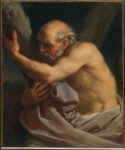
Head of St. Peter, Washington Allston (Study for ”The Angel Releasing Saint Peter from Prison’); 1814
“IF his shadow as a visitor was so healthful, what is his chain now that he bindeth and looseth. If his empty image in the air had healing power, how much power must have been contracted from his body by those chains, whose iron weight sank into his holy limbs during his suffering. If, before he testified, he was so mighty to aid them that called upon him, how much mightier is he now since his victory. Blessed were the links, doomed to be changed from fetters and shackles, into a crown, which by touching the Apostle, made him a Martyr. Blessed were the chains, whose prisoner left them for the Cross of Christ, and which brought him thither, not as the instruments of condemnation, but of sanctification.”
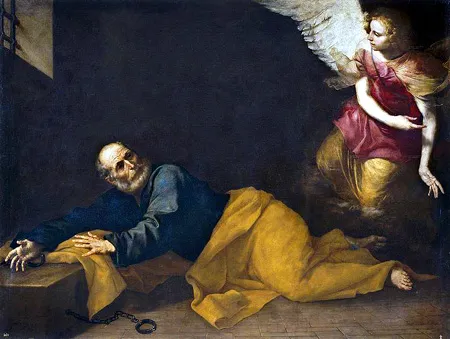
AND when Herod would have brought him forth, the same night Peter was sleeping between two soldiers, bound with two chains: and the keepers before the door kept the prison.
And behold an angel of the Lord stood by him: and a light shined in the room: and he striking Peter on the side, raised him up, saying: Arise quickly. And the chains fell off from his hands.
And the angel said to him: Gird thyself, and put on thy sandals. And he did so. And he said to him: Cast thy garment about thee, and follow me.
Acts of the Apostles, 12:6-8
*******
PETER, whatever thou shalt bind on earth, The same is bound above the starry sky; What here thy delegated power doth loose, Is loosed in heaven’s supremest court on high: To judgement shalt thou come, when the world’s end is nigh.
Praise to the Father, through all ages be; Praise to the consubstantial sovereign Son, And Holy Ghost, one glorious Trinity; To whom all majesty and might belong; So sing we now, and such be our eternal song. Amen.
All the cultures and all the civilizations which preceded Christianity are distinguished (but for extremely rare individual exceptions contradicting their time) by a theological constancy which contrasts with the luxuriant theological explosion of Christianity. Indeed, from all known antiquity until the arrival of Christ, philosophical and theological contemplation has dealt with only one domain: that of the substance and the essence of the divinity and of created things. This is the static period of the human mind, the era of still contemplation, of purely analytical mysticism. Substance and essence seem to be the only final fields of exploration.
Also, all other speculations of the human mind are affected, both scientifically and artistically. Mathematics, geometry, astronomy, physics, “chemistry”, physiology, are like inert things. Architecture is motionless. The plastic and pictorial arts, if they achieve extreme fidelity, are without inner expression. History and tragedy appear like frozen images from a stereoscope. All antiquity lived only its present, rarely emanating faint glimmers of the possibilities of the future, not even concerned with it. (more…)
“MAN is a subject made for an object, and nothing can satisfy him but the object for which he is made. It is, therefore, impossible to know what he is as a subject until we know for what object he is made. When he finds his true object, he understands himself. When the question is asked: Is life worth living? it can only be answered by him who understands what is the true object and the final end of life. The object of life and the final end of life are one and the same. There may be, and there are, intermediate objects of life, in which our present duties are involved; but to the man who knows God, and whose mental eyes are clear, the final object of life shines through them all. Those intermediate objects, as he knows from the light that beams from God as his final end, must be either overcome or be so mastered as to become the means to help him on to the one true object of his life. This is the solution of the trials and contests of our present life in this world.”
Pieter de Hooch; A Woman with a Baby in Her Lap, and a Small Child 1658
Now it came to pass as they went, that he entered into a certain town: and a certain woman named Martha, received him into her house. And she had a sister called Mary, who sitting also at the Lord’s feet, heard his word. But Martha was busy about much serving. Who stood and said: Lord, hast thou no care that my sister hath left me alone to serve? speak to her therefore, that she help me.
And the Lord answering, said to her: Martha, Martha, thou art careful, and art troubled about many things: But one thing is necessary. Mary hath chosen the best part, which shall not be taken away from her.
St. Luke, 10:38-42
***
On the banks of the Rhone, Martha was still the same: full of motherly compassion for every misery, spending herself in deeds of kindness. Always surrounded by the poor, says the ancient historian of the two sisters, she fed them with tender care, with food which heaven abundantly supplied to her charity, while she herself, the only one she forgot, was contented with herbs; and as in the glorious past she had served the Head of the Church in Person, she now served Him in His members, and was full of loving kindness to all. Meantime she delighted in practices of penance, that would frighten us. Martyred thus a thousand times over, Martha with all the powers of her holy soul yearned for heaven. Her mind lost in God, she spent whole nights absorbed in prayer. Ever prostrate, she adored Him reigning gloriously in heaven, Whom she had seen without glory in her own house. Often, too, she would travel through towns and villages, announcing to the people Christ the Saviour.
“NOW, when we say that Americans are being held in mental bondage, what do we mean? We mean that every newspaper, radio station, television station, magazine and stage and screen play has been edited by Jewish agents to remove any reference to their crimes and to keep the gentile masses in a condition of sleep. This would be a fantastic statement, if we did not have at hand the annual reports of the organizations which perform this censorship. Foremost is the Anti-Defamation League of B’nai B’rith, with the American Jewish Committee and the American Jewish Congress as other important agents of censorship.
“These groups issue annual reports in which they document the fact that their agents check every public presentation of any kind, written or staged, and delete any references to Jewish misdeeds. As a writer, I have followed the ADL operations closely for twenty years. If I submit a story to the Saturday Evening Post, an ADL staff member, whose salary is paid by the magazine, checks the story for any reference to Jewish activities, and also checks a blacklist to see if my name is there as a critic of the Jews. Even if the story contains no reference to the Jews, it is rejected because my name is on the Jewish blacklist, and I must be prevented first, from earning any money from my writings, and second, from reaching an audience.
“IN 1945, the United States stood alone as the supreme military power in the world, the only industrial nation whose plants had not been destroyed by the Second World War. Militarily and economically, America was the master of the world, and the world waited for our command. We had only to raise our hand, and our command would be obeyed. England, France, Italy, Russia, and Germany, and in Asia, Japan, lay in ruins, their factories but heaps of rubble.
“But we gave no command. Why? Because the parasites and their shabez goi ** wretches had but one desire, to rebuild Communist Russia. Dean Acheson proposed that vast new loans be made to Russia, through his law firm, Covington and Burling, which so ably represented nine Communist nations at our Federal trough. The American postwar economy was hamstrung by Communist Jews such as David Niles, a notorious homosexual who bragged that Harry Truman never made a decision without consulting him, and who had one sister in Israeli Intelligence in Tel Aviv, and another sister high in the Soviet Intelligence in Moscow. Harry Dexter White, a Lithuanian Jew and lifelong Communist agent, also supervised Truman’s decisions as President of the United States.
[C]HRISTIAN joy does not depend on anything sensible: it has its seat in the centre of the soul, where often it is not perceived in the inferior region, not even in its reasonable part. It abides there hidden, in order that it may be maintained in all its purity; for its Sowings over into the sensitive region, which sometimes happen, are greatly exposed to the danger of self-love, through the satisfaction which thence proceeds. It is quite compatible with sadness in the inferior region, as is evident in the person of our Lord Jesus Christ. The Apostle, when he says that he exceedingly abounds with joy in all his tribulations, does not the less avow (1 Cor. L 8) that they afflicted him, ‘out of measure,’ so that he was ‘weary even of life’: which shows plainly that we must understand him to mean the joy which is in the supreme region of the soul; otherwise he would be in contradiction with himself. We do not thereby deny that the inferior and sensitive part of his soul had a share therein at certain times; we say only that it is sufficient that the joy should be in the summit of the soul, which finds her satisfaction in the order of God’s dealings with her, although, so far as feeling is concerned, she experiences only an overwhelming sadness.
“Neither does this joy prevent even moderate complainings in the inferior region, when the senses feel nothing but affliction and lament accordingly; our Lord regarding them as little children who cry when they are chastised. To prevent their weeping would be to stifle them. (more…)
Comments Off on Christian Joy — and the Science of the Cross
“MINORITY White youth born into a normalized multiracialism where the greatest ‘evil’ is White preservation are now pairing up with nonwhites of the opposite sex at astonishing rates never before seen in the U.S. Utterly convinced that this behavior is not only normal, it’s moral in the centuries long struggle to unite the races and end racism.
“To say the Right has failed to educate White youth on the genocidal intent of multiracialism would be the understatement of the year.
“The assumption that it’s just a small percentage of White people who would behave interracially is no longer the case when the multiracialism has been normalized for decades and minority White youth are growing up among American-born nonwhites in a mixed ecosystem where everyone speaks English.”
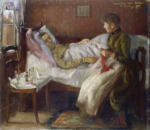
The Artist’s Father in his Sickbed; Lovis Corinth, 1888
“[F]EW persons become better for the infirmities of sickness. The reason is that they do not make a Christian use of them. Make, then, a good use of these afflictions, and to this end learn that the grace of bodily ailments is a very great one. “God,” says St. Catherine of Genoa, “converts the bodies of sick persons into a present Purgatory.” Learn that it is so great a grace that it is sufficient to bring a soul to a high degree of sanctity, as we read of many saints, whose life was one of unceasing bodily ailment. What works did these persons so eminent for sanctity perform? Did they visit the poor? Did they preach? What were their exercises and employments except this — to be sick and ailing. Seek help from Heaven, that you may obtain the gift of great patience; it is very necessary in maladies which are attended with acute pains or which are of long duration. Remember that ailments which last a long time ought to be carefully utilized for Eternity; it is the occupation which Divine Providence assigns to persons thus tried for gaining Heaven. Let them give good heed to make a faithful use of them; for usually their prolonged duration renders them wearisome.
“Further, keep a watch over the stratagems of self love, which insinuates itself everywhere; it will not fail to furnish you in this case with a multitude of pretexts, wearing even a plausible colouring of the glory of God: in order to render your maladies irksome to you, it will suggest to your mind that your infirmities make you a burden to those you live with, but God who wills these infirmities wills all the consequences of them. We too, then, must will them, and not disquiet ourselves, although we may be a burden and a trouble to others. It will represent to you that you are useless in the world; and especially, if you live in a community, it will try to sadden you with the thought; but be assured that sick persons who are true Christians are not useless, as is imagined by those who look at things only with the eyes of the flesh. Oh, what sweet mercies do these suffering souls draw down from Heaven on the houses where they dwell; and how incomparably more good they do there than is done by those busy, active persons who have so many schemes and projects, and abound in natural resources, and who are generally regarded as the mainstays of communities!”
“ST. Teresa declared that our Lord sent most crosses to those whom He most especially loved. She had learned this doctrine from the very mouth of the Son of God, who had said to her, ‘My Father sends the heaviest trials to those whom He loves most.’ It is sufficient to know the facts of our holy faith to be thoroughly persuaded of this truth. Never was any one more beloved by the Eternal Father than the Divine Jesus; and never did any one suffer so much. Next to Jesus, the most holy Virgin surpasses all creatures in graces, and at the same time she surpasses them in sufferings. The measure of our happiness must therefore be taken from the measure of our crosses. Happy he who suffers; more happy he who suffers much; most happy he who is weighed down with all sorts of sufferings, whose daily food is the Cross, who spends his whole life thereon, after the pattern of our gracious Saviour and His holy Mother, and at last thereon expires.”
“IF you commit a sin and take pleasure in it, the pleasure passes but the sin remains. But if you do something virtuous even though you are tired, the tiredness passes but the virtue remains.”
These words of wisdom come from St. Camillus de Lellis, (1550-1614) an Italian war veteran who gave up a life of dissipation to care for the sickest of the sick
O God, Who, to succour the souls of the dying in their last agony, didst ennoble the holy Camillus with an extraordinary grace of charity, we beseech thee to pour into our hearts, for his sake, the Spirit of thy love, that we may worthily prevail against the enemy in the hour when we depart hence, and pass to receive a crown of glory in heaven.
Through Jesus Christ, thy Son our Lord, Who liveth and reigneth with thee, in the unity of the Holy Ghost, God, world without end.