
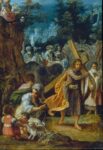
“This festival was instituted in commemoration of the day on which the holy Cross of Christ, was, with great solemnities, brought back to Jerusalem. Chosroes, king of Persia, had invaded Syria with a powerful army, and had conquered Jerusalem, the capital. He caused the massacre of eighty thousand men, and also took many prisoners away with him, among whom was the Patriarch Zachary. But more painful than all this to the Christians was, that he carried away the holy, Cross of our Saviour, which, after great pains, had been discovered by the holy empress, St. Helena. The pagan king carried it with him to Persia, adorned it magnificently with pearls and precious stones, and placed it upon the top of his royal throne of pure gold. Thus was the holy Cross held in higher honor by the heathen king, than Martin Luther would have manifested; for, in one of his sermons, he says of it: “If a piece of the holy Cross were given to me and I had it in my hand, I would soon put it where the sun would never shine on it.”
“Heraclius, the pious emperor, was greatly distressed at this misfortune, and as he had not an army sufficiently large to meet so powerful an enemy, he made propositions for peace. Chosroes, inflated by many victories, refused at first to listen to the emperor’s proposal, but at length consented, on condition that Heraclius should forsake the faith of Christ and worship the Sun, the god of the Persians. Indignant at so wicked a request, the emperor, seeing that it was a question of religion, concerning the honor of the Most High, broke off all negotiation with his impious enemy. Taking refuge in prayer, he assembled all the Christian soldiers of his dominions, and commanded all his subjects to appease the wrath of the Almighty, and ask for His assistance, by fasting, praying, giving alms and other good works. He himself gave them the example. After this, he went courageously, with his comparatively small army, to meet the haughty Chosroes, having given strict orders that his soldiers, besides abstaining from other vices, should avoid all plundering and blaspheming, that they might prove themselves worthy of the divine assistance.
“Taking a crucifix in his hand, he animated his soldiers by pointing towards it, saying they should consider for whose honor they were fighting, and that there was nothing more glorious than to meet death for the honor of God and His holy religion. Thus strengthened, the Christian army marched against the enemy. Three times were they attacked by three divisions of the Persian army, each one led by an experienced general; and three times they repulsed the enemy, so that Chosroes himself had at last to flee. His eldest son, Siroes, whom he had excluded from the succession to the throne, seized the opportunity, and not only assassinated his own father, but also his brother, Medarses, who had been chosen by Chosroes as his associate and successor. To secure the crown which he had thus forcibly seized, Siroes offered peace to Heraclius, restored to him the conquered provinces, and also sent back the holy Cross, the patriarch Zachary, and all the other prisoners of war. Heraclius, in great joy, hastened with the priceless wood to Jerusalem, to offer due thanks to the Almighty for the victory, and to restore the holy Cross, which the Persians had kept in their possession during fourteen years, to its former place.”
— The Exaltation of the Holy Cross by Father Francis Xavier Weninger, 1876


