
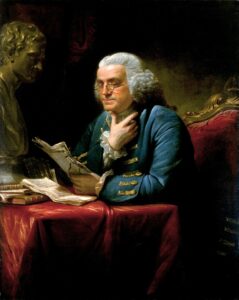
“AS to Jesus of Nazareth, my Opinion of whom you particularly desire, I think the System of Morals and his Religion, as he left them to us, the best the World ever saw or is likely to see; but I apprehend it has received various corrupting Changes, and I have, with most of the present Dissenters in England, some Doubts as to his Divinity; tho’ it is a question I do not dogmatize upon, having never studied it, and think it needless to busy myself with it now, when I expect soon an Opportunity of knowing the Truth with less Trouble. I see no harm, however, in its being believed, if that Belief has the good Consequence, as probably it has, of making his Doctrines more respected and better observed; especially as I do not perceive, that the Supreme takes it amiss, by distinguishing the Unbelievers in his Government of the World with any peculiar Marks of his Displeasure.
“I shall only add, respecting myself, that, having experienced the Goodness of that Being in conducting me prosperously thro’ a long life, I have no doubt of its Continuance in the next, though without the smallest Conceit of meriting such Goodness.
— B. Franklin
“P.S. I confide, that you will not expose me to Criticism and censure by publishing any part of this Communication to you. I have ever let others enjoy their religious Sentiments, without reflecting on them for those that appeared to me unsupportable and even absurd. All Sects here, and we have a great Variety, have experienced my good will in assisting them with Subscriptions for building their new Places of Worship; and, as I have never opposed any of their Doctrines, I hope to go out of the World in Peace with them all.”
— Benjamin Franklin, A letter to Ezra Stiles, president of Yale College
Thanks for visiting!
— Comments —
Kathy G. writes:
I find your posting on the Tolerant Mr Franklin to be very interesting. He speaks positively of a worldwide system of Christ-instituted morals and religion, the best system the world is likely to see, “as he left them to us”.
At the time of Jesus’ crucifixion, there was hardly such a system, the Gospels were spread worldwide through the Apostles afterward, and was followed by tremendous persecution before such a system was instituted. He then acknowledges that there are corrupting changes happening to that system “left to us”, but at the same time claims studying Christian theology was too much trouble. I find that hard to believe — Franklin, a polymath and international intellectual, probably knew the doctrine well through Freemasonry, if not through his own (strangely lacking) curiosity.
His mocking sentence about “the Supreme” not punishing Unbelievers does not sound like he is talking about the Triune God.
Laura writes:
What he says is pure Freemasonry. It’s rejection of Christianity in the language of benevolence and tolerance.
Of course, if Christ was not divine then his moral system could not be good. It would be based on lies. Even considering what Franklin professes to be an inadequate knowledge of theology, it makes no sense to say Christ was a great moral leader and a liar or a crackpot who said he was God.
The moral system can never be separated from the supernatural element. Franklin fancied himself a scientist and a philosopher. He didn’t need to study theology to know that the natural world is filled with wonders neither science or natural philosophy can explain. He didn’t need to study theology to know that an entire civilization had been Christian. He didn’t have time to study theology (he said), but he did have time to establish a nation based on certain theological principles. One of those principles was that God doesn’t matter and the nation’s leaders owe no respect whatsoever to Jesus Christ.
I think Mr. Franklin had indeed studied theology. If he had stated his conclusions more openly, however, that would have alienated the many Americans who held the divinity of Christ as a first principle. Their beliefs were weak enough to allow a system of evasion, indifferentism and supposed tolerance but not so weak to allow frank atheism.
Franklin was an atheist in disguise.
” The god of indifferentism is not a God to be adored by rational men. God is Essential, Absolute and Eternal Truth; He is likewise Essential. Absolute and Eternal Holiness. A God of Truth and Holiness, He cannot be equally pleased with truth and error, with good and evil. To assert, therefore, that God does not care what men believe, is indeed blasphemous. A man indifferent to truth–a liar, in other words,–cannot have the respect of his fellows. A God indifferent to truth could not demand the homage of thinking men. No wonder, then, that those who formed so low a concept of the Deity finally denied Him altogether. Indifferentism is merely atheism in disguise.” (Source)


