
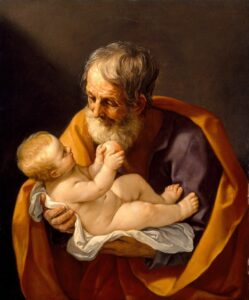
ST. JOSEPH, the greatest of saints whose feast day is today, is depicted in many artworks as a gray-haired, bearded man of advanced age. Though these works often convey the wisdom, dignity, affectionate nature and profound sanctity of the man, they are most probably not realistic as to his age. There is good reason to believe Joseph was in the prime of life — about forty years old — at the time of his betrothal to Mary and had a physical appearance of noticeable manly beauty.
His relative youthfulness, compared to the common view, meant that he was fully able to fulfill his role as father, guardian and protector and be an appropriate spouse and companion in the eyes of the world to Mary. Marriages between old men and young women have always in all times suggested coercion, material motives or ambition, not mutual attraction. Though Mary and Joseph took vows of virginity, they were still husband and wife, filled with tenderness and deepest affection for each other.
More on this from The Life and Glories of St. Joseph by Edwin Healey Thompson (1888):
WE must pause here awhile to give a few words of consideration to the disputed question as to the age of Joseph at the time of his espousals with Mary. Three opinions have been held, one of which would make our saint far advanced in years. This opinion was accepted by some of the Fathers and ancient ecclesiastical writers, chiefly Greek; and in support of it has been urged the custom prevailing among painters of representing St. Joseph as an aged man, sometimes as almost decrepit. This view has, however, been strongly opposed, not only because it had no other ground to rest upon than the statements of Pseudo-Gospels which were current in the third and fourth centuries, and were coupled with the assertion that Joseph was a widower with many children, an assertion forcibly condemned by St. Jerome and a host of other Fathers and theological writers down to the present time, but also as in itself presenting insuperable difficulties. As we have already observed, these apocryphal writings, while probably recording some true traditionary facts, are entirely devoid of authority, and contain, moreover, much that we naturally reject as both improbable and unbefitting.
In the absence, then, of any authentic document on the point, it is reasonable to have recourse to arguments drawn from suitability and decorum. Now, when the tender age of Mary at the time of her espousals is considered, and the providential object of that marriage, which was to shield her reputation aud to hide for a time the mystery of the Incarnation ; to provide her also with a fitting companion and protector, who was to be an aid and a support to her, especially during their flight into Egypt and in all the labours and sufferings which their exile must have entailed; it would seem surprising, not to say incredible, in the absence of any solid proof, to suppose that it pleased God to select for her husband a man weighed down by the burden of years. Again, as regards the evidence to be drawn of Joseph’s great age from pictorial representations, we may say that it has become quite valueless ever since patient research has brought to light monuments of much earlier date in the sculptures and paintings of the very first centuries. St. Joseph, the Cavaliere de Rossi tells us, is portrayed in the most ancient marbles and ivories as very young and almost always beardless. Later on, he was given a thick beard and a more mature and even aged appearance. Of the youthful representations he mentions many examples, one of which is even supposed to belong to the sixth century. However, it was in about the fifth century that the habit of depicting the saint of, at least, a mature age seems to have commenced. Clearly, then, as De Rossi observes, the most ancient monuments, those of the third and fourth centuries, are so far from following the apocryphal legend that, on the contrary, they picture to us the spouse of the Virgin in the flower of his youth.
[…]
This notion being set aside, it remains for us to choose between the two … views that is, whether St. Joseph was as young as he is represented in the early monuments, or whether he had already attained a mature age at the time of his espousals. In the absence of all direct evidence, it would seem that those who have given the subject the fullest consideration, and weighed and compared probabilities, consider that at the time of his marriage with Mary he was, most likely, approaching his fortieth year, and, therefore, of an age which can be reckoned neither young nor old, but in the prime of his strength, whether of mind or body.
Thompson goes on to discuss St. Joseph’s attractiveness, the reasons for assuming it and the private revelations that support this view:
… in beauty and in bodily appearance he was most like to our Lord; and this was fitting, in order that no suspicion might be entertained respecting his paternity or the virtue of the mother of the Divine Child. Whence we may gather that, next to Jesus and Mary, Joseph was the fairest of the children of men.


