
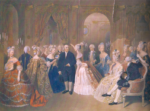
THIS next excerpt from Bernard Fay’s book Revolution and Freemasonry, 1680-1800 (Little, Brown and Company, 1935) is a glimpse into the strategies Freemasons used in the United States and France to spread a civil religion of progress, with the tantalizing objectives of fraternity, freedom and equality. Benjamin Franklin, representing in his person a prophetic and heady mixture of science, philosophic rationalism, good fellowship and “philanthropic sentimentality,” energized during his visits to France ideas of utopian social transformation that would ultimately overturn the existing established order, including the lives of the nobility who had warmly embraced Franklin.
Franklin was highly influential not just for the American Revolution but for the French Revolution and for later messianic liberalism. In the Masonic lodges of the 18th century, intellectuals, clerics even and political figures prepared for the ultimate triumph of justice and benevolence on earth, with Masonic mysticism replacing for some any dogmatic anxieties about man’s duties to God, while for others these duties could be reduced to something like a personal hobby undertaken in the privacy of their own homes and churches. See previous excerpts from Fay’s book here and here.
Our latest installment:
Such was the way in which Franklin the Quaker, Franklin the American, whom many in France considered as a savage, came to be the guide of the most intellectual, the most daring and the most influential [Masonic] lodge of Europe. The Lodge des Neuf Soeurs was the pride of the Parisian lodges and the beacon for all provincial lodges. It was the crucible for Masonic doctrine, the laboratory for the philosophical spirit, and Franklin was its chief.
Due to his influence, literary and artistic meetings became more frequent and a larger public attended them. On these occasions the Lodge authorities often allowed the doors to be opened to women and the enthusiasm of the charming ladies for Franklin induced them to spread Masonic ideas far and wide. At a time when people, tired of lengthy discussion and pedantic logic, had stopped attending lectures at the Sorbonne, which was repellent even to students, Franklin had the clever idea of establishing through the Lodge des Neuf Soeurs and at the Lodge des Neuf Soeurs the first lay university of France. It was called at first “Société Apollonienne,” then it attained such importance that it parted from the Lodge des Neuf Soeurs and became an independent organization. Under the names of “Musée de Paris” and “Lycée de Paris”, it gave courses on history, literature, politics, philosophy, sciences and even aeronautics, as the director at that time was the balloonist, Pilâtre de Rozier. The organization flourished for about fifty years, not without some mishaps, but with great glory. There Lasharpe delivered his lectures on literary criticism, which set a standard for the nineteenth century. There Laplace, the great astronomer, came from his province to teach science. The halls were always filled with people of all ages and conditions, but mostly young gentlemen and beautiful ladies; here Benjamin Franklin and his grandsons, Temple, Franklin and Benjamin Franklin Bache, who came from America, sat by rthe side of young Mr. Benjamin Constant, who came from Switzerland and Glasgow, and Madame de Charrière, who came from Holland, and many other strangers from all over Europe. It was the starting point of French lay education.
The Lodge des Neuf Soeurs was untiring in launching new ideas. It has been one of the most ardent and assiduous preachers of he gospel of Americanism, during the War of Independence, and it never disavowed it. Even when Franklin left France the Lodge des Neuf Soeurs remained faithful. It instituted a literary contest, the topic of which was a eulogy of Franklin. The winner was the receive six hundred livres, a very large sum for 1787. At the same time, urged by one of its most distinguished memebers, the Président du Paty, Member of the Parliament of Bordeaux, the lodge started a campaign in favor of four unfortunate people who had been broken on the wheel without a trial. The Lodge des Neuf Soeurs used this campaign to call for a reform of the French judiciary system and even suggested a plan for its reform. It was not mere talk, the Lodge had been able to gather an exceptional team of pamphleteers and propagandists, and it had influence. …..
…. The most curious genius, the most imposing authority of the lodge, was Monsieur Court de Gébelin, who had written an important book called “Le Monde Primitif.” Monsieur Court de Gébelin had boldly delved into the deepest studies in his efforts to outline the trend of centuries and to scrutinize the origins of all religions. This was, in fact, the problem which since Boulainvilliers had haunted the dissatisfied nobility and which since Desgauliers had become the obsession of Masonry. Towards the end of the century the good Mason, Court de Gébelin, offered as a solution a theory which was at the same time, mystical, historical and rational. He announced the dogma of progress by stating that nothing of the past had disappeared because all the past was till alive in the present and could be easily discovered by the perspicacious mind. The Lodge des Neuf Soeurs, which had managed the reconciliation of philosophic rationalism and philanthropic sentimentality, served also as a meeting ground for the Masons who were led bytheir logical instinct and the Masons who were dominated by their mystical needs. Monsieur Court de Gébelin provided food for both; and the frequent readings of his works which he gave at the Lodge attracted many great men and won new prestige for the Lodge.
The Lodge des Neuf Soeurs gathered within its walls the most complete and purest elements of Masonry. At its meetings one could hear wisdom and virtue extolled, one could practice piety and study this “Catholic religion” of Freemasonry, which claimed to be older, more beautiful and more philosophic than any of the other organized churches. There, people prepared the reign of justice and benevolence on earth and fought in a practical way for the improvement for tribunals and justice. But the greatest pride of the Lodge was to be forever looking ahead and preaching progress, such as the Revolution in the United States had proved could be attained. Towards established powers the lodge was prudent and polite; it celebrated duly the birth of the eldest son of the King, the churching of the Queen. It drank toasts to the King, the Queen and the royal family, and it played its share in the celebration of national victories and peace.
The Lodge knew how to use both wisdom and audacity. At the same time, it displayed a proper deference for public powers, it went ahead praising Voltaire the philosopher and Franklin the Republican. But the most dangerous intiatives were not taken at the meetings of the Lodge itself, which were devoted to ceremonies too grave and mild to be disturbed by politics. When the Lodge des Neuf Soeurs wanted to go far and to start a sharp offensive it did it either through associated bodies created for that purpose or through one of its leading and most experienced members who received the full support of the brethren. Thus was founded the Société des Amis des Noirs (Society of the Friends of the Blacks). As the most philosophical members of the Lodge des Neuf Soeurs wished to take advantage of the spirit of universal friendship and democratic zeal that the American Revolution had spread throughout France, they could find nothing better for their purpose than to create this society, outside their lodge, but under its protection, with the avowed purpose of putting an end to the slavery of Negroes throughout the world and more especially in the French colonies…..
….The most interesting feature of [this society] was the way [it] was organized to spread Masonic influence without being entirely Masonic. It was a typical method used by the Masons in the eighteenth century.
(pp. 269-272)


