Comments Off on
June 26, 2014

IT is not surprising that the ideal of the dual-income household has corresponded with a decline in overall wealth for the middle class and lower income families. The dual-income model is much easier to maintain at the higher levels, where nannies and paid services can be hired and income from investments cushion the loss of domestic order.

THOMAS F. BERTONNEAU writes:
Aristotle remarked in The Poetics that man is the most imitative of all animals. Two-and-a-half millennia later, picking up where Aristotle left off, René Girard developed an entire “Fundamental Anthropology,” drawing on Greek tragedy and the four Gospels, which argues (among other essential propositions) that the thing that people are most prone to imitate is the delusory impression that other people enjoy a degree of pure being greater than their own, which, as with all “mediated objects,” they strive to appropriate. Old sayings express the same observation. Thus “the grass is always greener on the other side of the fence.” That is, my neighbor is better off than I am, and I can’t bear it. Biblical morality, as Girard notes, enjoins imitation, as in the Tenth Commandment and for the good reason that imitation unchecked runs to covetousness and so gives rise to conflicts in the community. Biblical religion, especially Christianity, offers consolation for the ascetic gesture of opting out of the wicked deliciousness of coveting things. It encourages people to develop their internal, or spiritual, resources. All of traditional Western high culture has the same aim – through ritual, philosophy, literature, and the arts to cultivate the soul by cultivating the virtues.
What has all of this to do with tattooing and the current craze for it?
DAN R. writes:
I live in a small rural town in Michigan where it seems as though every second or third woman from the age of 18 to 70 has adorned herself with a tattoo. I sometimes wonder whether nowadays there are even more women wearing tattoos than men. Today, however, took the cake. A high-functioning mentally-retarded man of about 40, who works in a local supermarket, has a new tattoo covering much of one forearm.
Are any additional words necessary?
ANTI-GLOBALIST EXPATRIATE writes:
From the Associated Press:
Responding to a major case of research misconduct, federal prosecutors have taken the rare step of filing charges against a scientist after he admitted falsifying data that led to millions in grants and hopes of a breakthrough in AIDS vaccine research.
Investigators say former Iowa State University laboratory manager Dong-Pyou Han has confessed to spiking samples of rabbit blood with human antibodies to make an experimental HIV vaccine appear to have great promise. After years of work and millions in National Institutes of Health grants, another laboratory uncovered irregularities that suggested the results — once hailed as groundbreaking — were bogus.
DON VINCENZO writes:
I recently received a short video clip – just more than one minute – that has haunted me ever since I saw it more than a week ago. About a dozen men who were guarding a hospital in Aleppo in western Syria were captured by Sunni rebels, hogtied and executed in a barbaric way, all of which is visible in the clip. The men are young, but what struck me is their total composure in facing death by their Islamic captors, something that I cannot get out of my mind. What was the heinous crime for which they were killed? They were professed Christians, and they were living – or should I say dying? – proof of what awaits Syria if the Bashad al-Assad government falls.
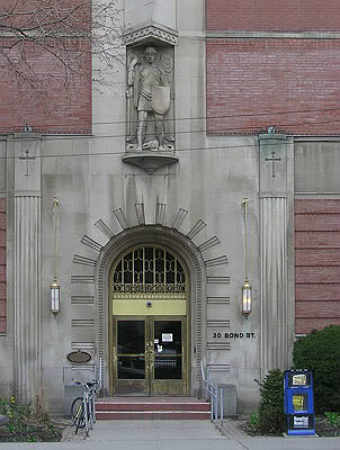
IN two posts at Reclaiming Beauty (here and here), Kidist Paulos Asrat reflects upon changes at St. Michael’s Hospital in Toronto. The hospital recently removed the image of St. Michael the Archangel from its logo. The image was inspired in part by an Italian statue of the saint which was found encrusted with dirt in a second hand shop on Queen street in the 19th century and has long stood restored in the hospital’s lobby.
Below is a modernist addition to the hospital funded by Hong Kong billionaire Li Ka-Shing, who has close ties with the Chinese government. The hospital’s insipid slogan is now “St. Michael’s, Inspired Care, Inspiring Science,” sure to offend no one in multicultural Canada.

PAULA writes:
A link to this video was sent to me from a Catholic friend who is aware of how my family has been broken apart by its members taking sides on the homosexual issue. I thought it was compelling to view and showed compassion to those struggling with same-sex attraction. It is amazing to think that there are homosexuals saying that they are living a happy, fulfilling celibate life through the saving grace of Jesus. Amen!
JOHN from Vermont sent this note along with a donation:
Thank you for The Thinking Housewife. I stumbled upon it a couple months ago and reading it has become a daily habit and joy ever since. Your reflections and thoughts help me to understand better our place in the world and healthy relations within the family and in society. I am agnostic and even a borderline atheist (I don’t say this with pride or even easily) although wondering about God and a transcending order in life preoccupies much of my conscious thought. (more…)
HERE is a glaring example of the irreverence of the Vatican II mass from St. Patrick's Church in Seattle. Notice the age of the congregation, the predominance of women and the sparse attendance. You have to pity some of these poor souls. Their minds have been worn down by schmaltz over the years. Perhaps they don't even notice it any more, like someone with bubble gum stuck to the bottom of his shoes, who finally says, "Heck, I'll just leave it there." See more examples of Novus Ordo sacrileges at Novus Ordo Watch.

AN excerpt from G.K. Chesterton’s Heretics, relevant to recent entries here about neighborhood and the ongoing theme of family life:
If we were to-morrow morning snowed up in the street in which we live, we should step suddenly into a much larger and much wilder world than we have ever known. And it is the whole effort of the typically modern person to escape from the street in which he lives. First he invents modern hygiene and goes to Margate. Then he invents modern culture and goes to Florence. Then he invents modern imperialism and goes to Timbuctoo. He goes to the fantastic borders of the earth. He pretends to shoot tigers. He almost rides on a camel. And in all this he is still essentially fleeing from the street in which he was born; and of this flight he is always ready with his own explanation. (more…)
ALAN writes:
In 1954, more than thirty tall, modern apartment buildings intended for “public housing” were opened near downtown St. Louis. They are “a shining addition to the city’s skyline” and people of different races and faiths will live there in peace and harmony. So said the St. Louis Post-Dispatch (June 19, 1954). Sixteen years later, those buildings had been made into the site of out-of-control crime and vandalism. Six years after that, they were dynamited into dust. “Twenty-story tombstones” is how Lillian Boehme described such apartment buildings in her perceptive review of the premises, costs, and consequences of “urban renewal” schemes (American Opinion magazine, May 1971).
Martin Anderson offered an earlier indictment of the “urban renewal” craze in his 1964 book The Federal Bulldozer, in which he concluded that the “urban renewal” bandwagon should be halted.
After five murders took place in 1994 in a group of low-rise government-subsidized apartments in south St. Louis, that neighborhood’s alderman said, “I frankly see results of a federal housing policy that has gone out of its way to ruin neighborhoods.” (St. Louis Post-Dispatch, Jan. 15, 1995) Doubtless that could be said about who knows how many other city neighborhoods throughout the nation.
KARL D. writes:
I want to share something extraordinary with you that happened to me the other night.
First, a little on my religious background. My father is an atheist Jew who was raised by observant Jewish parents, while my mother who was raised Catholic became an Episcopalian. Yet in recent years she has been moving back towards her Catholic faith due to her disillusionment with the now very liberal Protestant church. I however was not raised with religion in my life at all. We celebrated Christian holidays like Christmas and Easter in strictly secular ways. It was all Santa Claus and the Easter Bunny with some Christian information entering my young brain through my mother and the media.

THE General Assembly of the Presybterian Church (U.S.A.) endorsed same-sex “marriage” this week, voting to allow ministers to perform “any such marriage they believe the Holy Spirit calls them to perform.” The June 19th letter by Ruling Elder Heath Rada announcing the decision is a study in passive-aggressive rhetoric and arrogant, modernist blasphemy. According to Rada, a former Red Cross executive with a “a twinkle in the eye,” Christ died to make Presbyterians “reconcilers.”
“Please know that the same triune God in whom we place our hope, faith and trust in is still in control, and that the Assembly’s action today is the result of deep discernment to hear God’s voice and discern God’s will.”
The Presbyterians have a creepy cult of niceness. The spiritual life is dead within them. Niceness is an agreeable substitute. Super Nice people don’t say no to anyone who wants a wedding. In truth, this is not niceness, but self-love and cruelty. Liberals are cruel people with sugary-sweet smiles. In their niceness, they are masters of spiritual genocide.
Here is the letter in full: (more…)
WITH the further extension of federal marriage benefits to same-sex couples today, Obama extends his breathtaking revolution. Though only 19 states permit same-sex “marriage,” it is essentially available everywhere now. The ramifications and costs — in Social Security, immigration, federal health benefits — are incalculable at this time. So is the enormous conflict that will ensue.
Sexual freedom is another name for tyranny.

THE institution of the Holy Eucharist was the greatest act of love in human history. The Eucharist is a never-ending well-spring of love. Jesus made it plain that he was not speaking metaphorically when he referred to the bread as his flesh and the wine as his blood:
The Jews therefore strove among themselves, saying, How can this man give us his flesh to eat? Then Jesus said unto them, Verily, verily, I say unto you, Except ye eat the flesh of the Son of man, and drink his blood, ye have no life in you. {John 6:52-53}
It is through the Blessed Sacrament, the source and summit of the other sacraments, that Christ reigns in the souls of men so that they can in turn make this world reflect some of the glory of its Creator. We are called to form one Mystical Body with this sacred mystery at its center.
Today, the Feast of Corpus Christi, a day which was once filled with processions, is devoted to this ongoing miracle. Here are some words on the subject from St. Alphonsus de Liguori, from his work The Holy Eucharist:
Our holy faith teaches us, and we are bound to believe, that in the consecrated Host Jesus Christ is really present under the species of bread. But we must also understand that He is thus present on our altars as on a throne of love and mercy, to dispense graces and there to show us the love which He bears us, by being pleased to dwell night and day hidden in the midst of us.
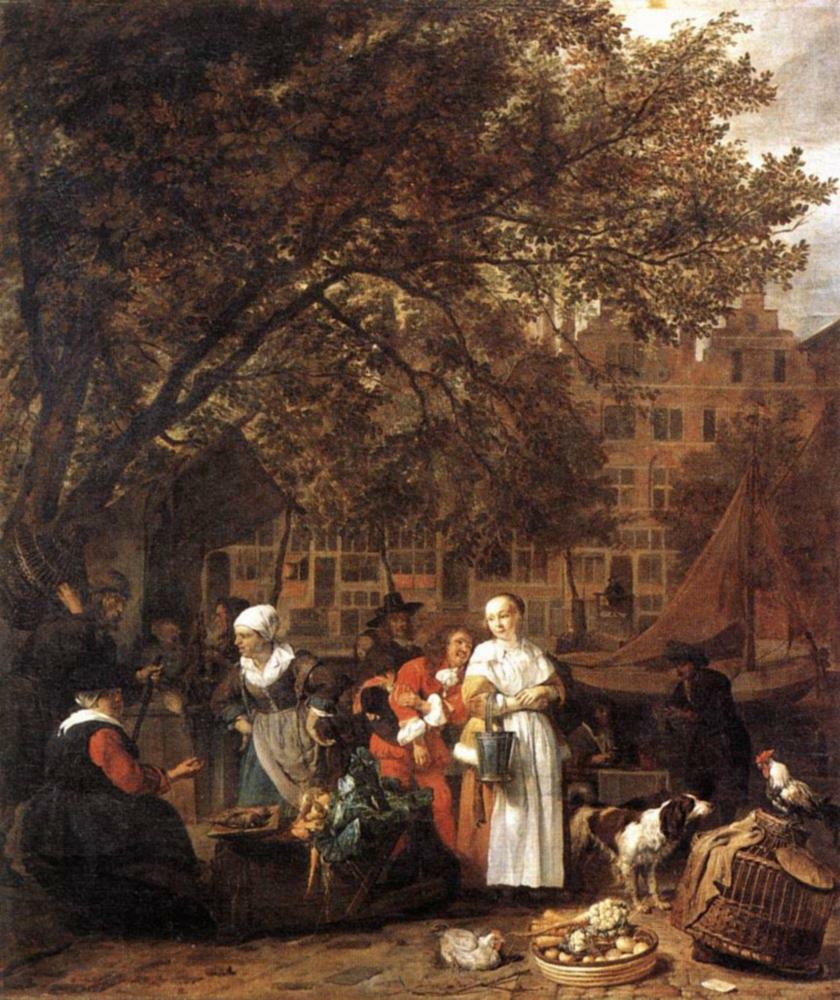
HERE is a wonderful painting, Vegetable Market in Amsterdam (c. 1661-1662) by the Dutch painter Gabrielle Metsu. It reminds me of a passage in Virginia Woolf’s feminist lecture series, A Room of One’s Own. While describing her meal in the dining hall of a women’s college, a meal which is greatly inferior to the glorious repast at a nearby men’s college, Woolf writes:
Dinner was being served in the great dining-hall. Far from being spring it was in fact an evening in October. Everybody was assembled in the big dining-room. Dinner was ready. Here was the soup. It was a plain gravy soup. There was nothing to stir the fancy in that. One could have seen through the transparent liquid any pattern that there might have been on the plate itself. But there was no pattern. The plate was plain. Next came beef with its attendant greens and potatoes — a homely trinity, suggesting the rumps of cattle in a muddy market, and sprouts curled and yellowed at the edge, and bargaining and cheapening and women with string bags on Monday morning.
Notice that to Woolf, marketing is “cheapening.” This painting suggests that marketing, even at its lowest, can be elevating. The women to the left in the canvas do seem to be cheapened by the experience of bargaining, assuming that is what they are engaged in at the moment. But the woman to the right possesses a calm and tranquility that transcends her surroundings. She seems untouched by the argument and the disorder. And that is because of her inner qualities, the artist suggests. Furthermore, the rooster and the cabbage leaves and the overarching tree make this excursion to buy food an encounter with nature in the middle of the city. It is a merging of country and city so that one imagines the woman returning to her city dwelling with the earth and the fields and the open skies clinging to her cabbage and onions. In comparison, the rummaging among words that must have filled the days of an intellectual like Woolf seems cheapening.