
Cattle Today, Whiskey Yesterday
IN “The Anti-Federalist Papers,” a series of essays against ratification of the U.S. Constitution that appeared in newspapers in 1787-88, the pseudonymous author Brutus argued that the proposed federal government was by definition despotic: It “will penetrate into the most obscure cottage, and finally, it will light upon the head of every person in the United States. To all these different classes of people, and in all these circumstances, in which it will attend them, the language in which it will address them, will be GIVE! GIVE!”
The current conflict between Nevada rancher Cliven Bundy, who refuses to pay for grazing rights on federal land and has been widely hailed as a freedom fighter and patriot, seems to confirm Brutus’s point.
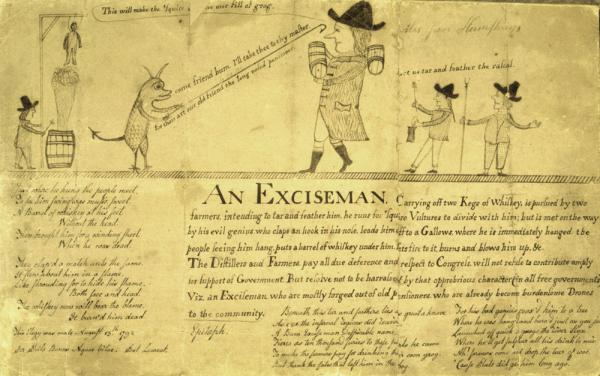
Defenders of Bundy decry the government overreach they say underlies the grazing fees. But this alleged overreach is commonly seen as something that violates the American order. But does it? Consider the Whiskey Rebellion. George Washington raised an army of more than 12,000 soldiers to quash a rebellion that is similar in its complaints to the one by Bundy against the Bureau of Land Management. Washington’s army confronted and overcame whiskey distillers and their supporters in Western Pennsylvania. The small-time distillers refused to pay federal excise taxes, which they said were making it impossible for them to do business and compete with large distilleries, who could pay a much less onerous flat fee.
Washington declared resistance by the rebels, who at one point raised a force of 7,000, as constituting “treasonable acts.” Ironically, these acts of treason were similar to those committed by the American Revolutionaries against the British. In his paper, “The Whiskey Rebellion of 1794: A Democratic Working-Class Insurrection,” (as quoted in Christopher Ferrara’s book Liberty, the God that Failed), Wythe Holt wrote that the tax rebels “were amazed that the Washington administration wanted to hang them for the same sort of actions which had been praiseworthy and heroic a short time before, while Hamilton and Washington never seemed to notice this deadly irony.”
Bundy also was born too late. He would have made a great revolutionary against the British — and would have had a better chance of success. British authority at least was not obscured beneath the mantle of Liberty.


